
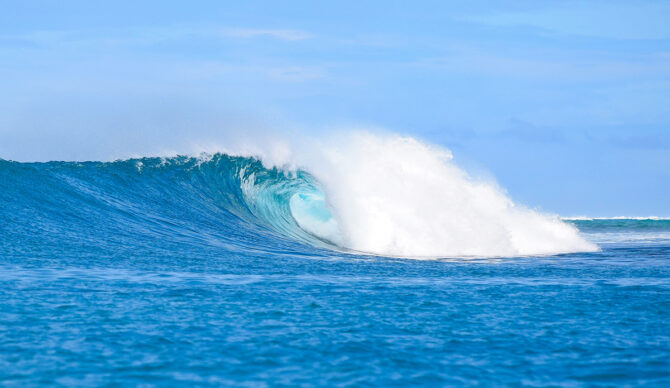
“Should have walked up the beach.” Photo: Jordan Ramos//Unsplash

What’s going on down the beach? It’s something surfers do, whether or not you’re aware of it. Our gaze always wanders off to the next best thing (we think). It’s a sliver of tribal knowledge, a ritual, a habit — whatever you want to call it.
From the shore, it’s a simple error in scoping out a break.
I first learned about this cultural habit with my father when I was seven years old. We started at the south end parking lot of a NorCal beachbreak, checking it out. The south end looked okay, if not slow. The day itself was average as average can get: 2-3-foot slack wind rollers. No real shape. No real power. Just gliders. Then a set rolled in about 30 yards north of us. It looked better. Something about the angle of the right as it approached us. We wandered north until we could look straight out at it, and waited for that set to return. When it did, the front angle didn’t look so alluring. But the next set, the one breaking another 30 yards north of us, did. We trekked north in this fashion, chasing the rights, until we hit the end of the beach and the cliff that contained it.
Then the disorder cast its spell in reverse. The very north end looked okay, but that left 30 yards south had promise. We backpedaled the lefts until we returned to go. Back where we started, looking at the same wave on the south end, my father and I laughed and scratched our heads. Months later, somewhere in the guts of an old Surfer’s Journal (or something of da kine), we finally read about it; put a name to the experience. And they called it the “Down-the-Beach Effect.” A false perception. The surfer’s equivalent of the grass is greener.
Out in the water, it’s not always an experience to laugh off. It can leave you with noodle arms and the disappointment of feeling skunked. Or in my case, both.
I sat out at Ocean Beach one fall day in San Francisco, surfing a peak all to myself. A perfectly fine peak. It wasn’t the day of days, but the waves were head high and shapely. To have a solo peak should’ve been enough. Then a lull, as swell tend to do. Out of the blue, I saw a right to the north, about 30 yards. Is it always 30 yards? From my angle it was a squared off, dream-machine tube. No one on it. I held strong for a moment, betting that a similar wave would hit me next. Only another set rolled through that spot where I was not, that spot down the beach. The itch, the syndrome kicked in, and the only scratch was to paddle over. So I scratched and paddled. Then the surf gods had their kicks with me. The patch of ocean I occupied fell stagnant, and the spot from where I’d come received that magic set. I spent the next half hour paddling to and fro — only catching the lulls, always staring at what could’ve been. If I’d held ground. Finally, tired and frustrated, I took the dreaded belly ride in.
To this day I occasionally fall into it, and wonder why. The down-the-beach effect reveals a lot about the mind of a surfer, how we evolve. The search is engrained in our DNA. The prospect of what’s around the corner, what gold lies just beyond, if we push a little farther? The same mechanism that engages when we go down the beach is a core feature in the art of the score. On the other hand, surfing is all about being here, now. To be present, to be patient.
The younger, youthful, more spirited surfer has all of the energy to chase waves around. The need for more, the lack of experience. We chase everything in youth, waves included. Life is up and down the beach. As we age, we let life come to us. Experience tells us that if we sit in the right spot for long enough, that waves will come. And that’s why it’s always the “Uncle” (no matter how old they are), sitting out back for a few hours, who catches the wave of the day, with the least amount of effort.

