Who hasn’t grit their teeth and suffered through a day (or worse, seasons) in an ill-fitting pair of ski boots? It’s such a common experience that most of us chalk up the pain of wearing ski boots as a circumstance out of our control. They’ll “break in” eventually, right?
Unless they don’t.
Ski boots are the connecting point between you and your skis, making them more valuable to our overall performance than they get credit for. They’re high performance gear, just like the rest of your equipment. It’s more than just comfort. It’s response time and feel moving from edge to edge. It’s better turns and less fatigue. The list goes on. Experienced skiers understand this. But if you’re newer to it all and find yourself in a progression rut, the right boots may be where that next performance nudge comes from.
“Having that boot or the insole under your foot is crucial when you go to articulate your ankle and the boot to get the ski onto edge, versus having your foot wobble inside the boot and then turn the boot to turn the ski,” explains Oliver Holmes, GM of Surefoot in Breckenridge, Colorado.
I’d met Oliver at his shop when I was offered a chance to try their custom process for myself. In college I had the benefit of a friend who fit more than his fair share of boots, so I knew a little about the boot fitting process and the adjustments that make an insufferable pair sufferable. I’d never had fully customized boots, liners, and insoles, though. I also always sold myself short, reasoning that I don’t ski enough in a given season or at a high enough level anymore to justify the need.
“I would say they’re a huge benefit for your everyday beginner skier, all the way up through high-end performance skiers,” Holmes reasons.
So what’s the process? What’s the point? And what’s the payoff of ditching off-the-rack boots for a fully customized pair (or just liners combined with your current shells)?
The Fitting Process
The first thing Oliver did when I walked into his shop was learn about my preferences and experience as a skier. After a short convo, we began measuring and scanning my feet.
This part of the process is where the brand uncovers the most specific details of your piggies in order to walk out with the most refined, customized boot. We did a three-dimensional computer model of my feet as well as a digital imprint of my soles and found that my left foot is four millimeters wider than my right at their widest points, while my right foot is two millimeters longer than my left. A little asymmetry isn’t uncommon. In fact, you’re in the minority of human beings if you have identical feet, so just learning those minute differences helped my boot fitter learn which shells would, and wouldn’t, be best for me.
Surefoot has a record of internal measurements for every brand and its models, so after getting those initial scans, Ollie stepped into the back of the shop for a few minutes and came back out with a pair of new Lange Shadow 120 MVs (mid-volume) and orthotic footbeds that had been customized to the measurements and scans of my feet.
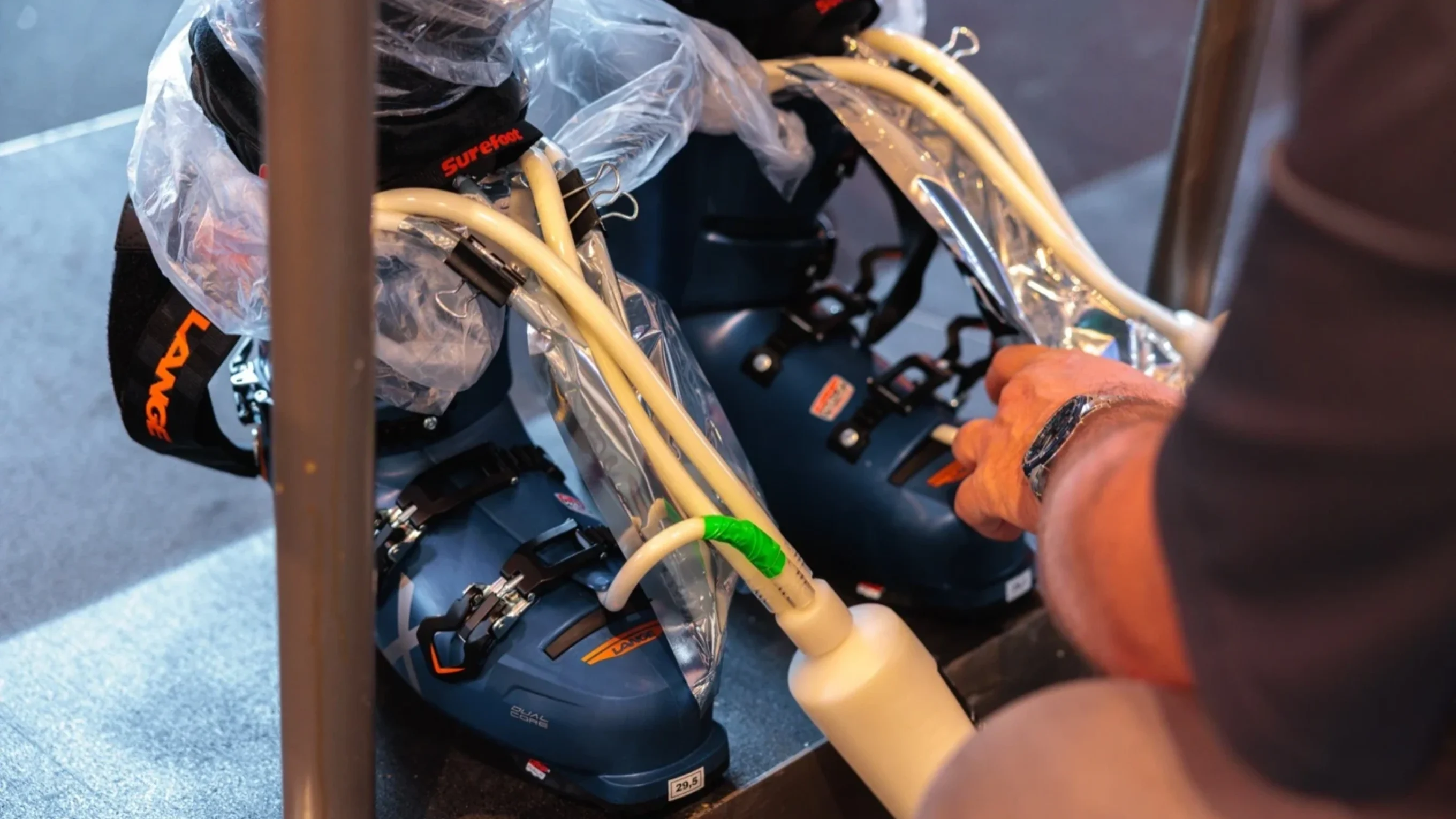
Once the footbeds were checked, the next part of the process involved shaping and filling the boot liners. While standing in the boots, foam is injected into the liners, which feels like somebody’s trying to squeeze your ankles, calves, and feet until they all lose circulation. It’s an odd feeling, but not a painful one, and it only lasts a few minutes as the injected gel molds the liner to every nook and cranny of your feet.
“They Gotta Break In’
I was told before this whole process that any adjustments that might be needed after my initial fitting could be taken to any Surefoot. I was getting my boots in Colorado but live in California, so I was happy to know that custom liners and boots extended into the break-in process of a season.
In hindsight, I was even happier that I never needed to take advantage of that part of the service. Ollie and I had noticed one pain point in our initial fitting — a wide right forefoot that was causing the outside metatarsal to push up against the shell. Holmes points out that some customers feel discomfort after their fitting and adjustments need to be made, or even a full refitting to make sure it’s done right. Rather than go the route of breaking the boots in and learning if the pain would or wouldn’t continue, Ollie took the boot back one more time for a final adjustment. It was the only adjustment I needed the entire season. From day one, my boots were comfortable and I skied pain free.
But “breaking in” doesn’t strictly mean waiting for pain to go away. Every boot breaks in primarily through the foam or gel of its liner shaping to your foot. That can take anywhere from a couple days on the slopes to several, where your foot essentially creates a negative mold of your foot. There’s a sweet spot where the boot is broken in, the movements of your feet and energy transfer happen without fighting against your boot or compensating for areas and spaces with a bad fit.
Liners vs the Whole Package, and What’s the Cost?
To be clear, Surefoot does make custom insoles or liners that can be fitted to your existing shell. That option alone may be a massive performance upgrade for some skiers who have shells that are in good shape but could use some fine tuning.
“It’s a material product and it’s going to sort of plateau through its life, and then towards the end of its life, it is going to get looser,” Holmes says.
I never opted to go Surefoot’s fully-custom route before because I wasn’t compelled to spend the money. Custom liners injected and molded in-store run about $500. Custom orthotics/footbeds are $285. If you’re adding those to a shell you already own and are familiar with, it’s a considerable upgrade cost. Those two products account for the bulk of any cost difference from buying boots at a retailer. My Lange Shadows retail for $750, shell only, bringing the whole package to more than $1,500. That’s admittedly a steep price point.
What I can vouch for now is that the fully customized option or even just upgrading existing boots with custom liners and footbeds makes for a much better overall product than grabbing boots off the shelf and hoping for the best. The performance aspect is noticeable, with better overall response and feel, and it does make me wonder now how much my progression might have been impacted by ill-fitting boots in the past. The comfort factor, however, was through the roof compared to stock boots throughout the length of my first season with them.
“The goal of a ski boot is to transfer the energy and movement from the person to the ski, and so you’re just looking for your ski boot to bridge that gap,” Holmes repeats, admitting that sure, “a rental boot can do it, but it’s just not going to do it in the manner that is totally tailored towards you.”