
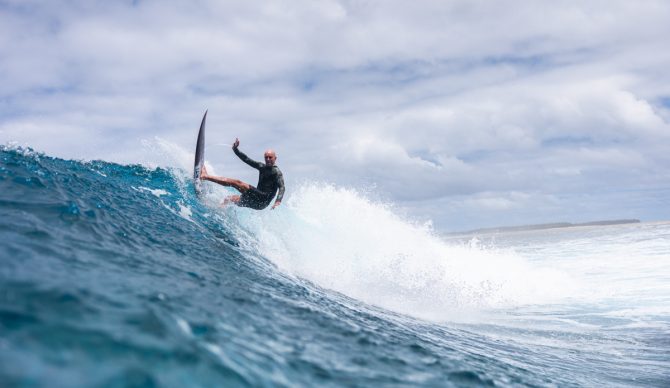
The man behind the brand, Keith Teboul, testing boards in paradise. Photo: Beau B Marshalls

If there’s anyone qualified to speak to the cross-pollination going on between surf and foil, it’s the team at KT Surfing. Led by renowned shaper Keith Teboul, KT has created some of the most progressive boards (and foils) over the past few years. At the recent AWSI wind and boardsports expo in Hood River, Oregon, I sat down with Keith for a quick chat about surfing, foiling, and how the two are starting to come together more and play off one another rather than their practitioners battling for priority in the lineup.
Born in Madagascar, Keith spent 10 years of his childhood there before moving to the Caribbean, and then to San Diego for high school, where he learned to surf. At age 17, he moved to Hawaii to chase the dream of being a professional windsurfer, a journey that led to him becoming one of the biggest names in board design for surf and windsports.
It feels like surfing and foiling are coming together a lot more. First off, seeing more pro surfers hop on the foiling train. Eric Geiselman, John John and Nathan Florence, even Gabriel Medina and Nathan Fletcher. So what gives?
I think there’s a place for it, I just don’t think it’s in the core lineups. For me, foiling is about getting away from people, riding the unrideable, getting to surf in subpar conditions, and feeling that energy.
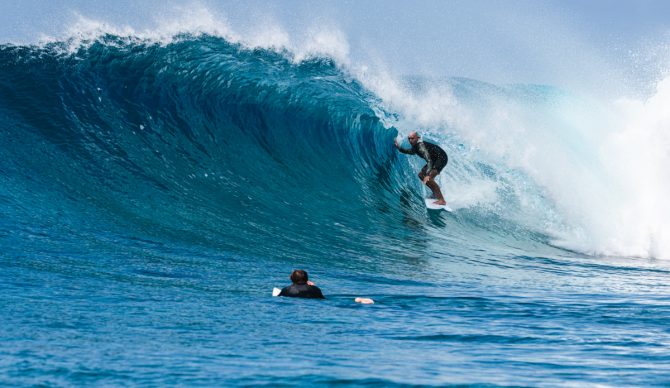
Surf, windsurf, foil, the man can do it all. Photo: Beau B Marshalls
I’m curious how, as a part of the design process, surfing and foiling are influencing each other. Is there anything about board design for one or the other that is being passed back and forth?
The first thing for me is that we pull a lot from surfing and the lines of windsurfing boards – everything we do is all about making clean lines. When you look at a surfboard and you’re like, “Oh, that looks sick, I want to ride it,” usually it’s going to work. And I bring that into foiling as well. But I think a lot of the foiling world is still coming around to that, because with the assistance of the foil, you can kind of get away with anything in board design.
But as foiling is growing and foils are getting better, you start to realize more of what’s going on – how a board flies through the air, how it gets off of the water, you start to see how much the clean lines, aesthetics, and the little nuances from surf or windsurf boards all play a part. I think with traditional surfboards, people are a little bit more close-minded – not in a bad way, but just in general. And now I’m starting to see a bit more crossover with these foil boards and windsurf boards – the speeds that you hit can teach you a lot about surfboards. For example, a lot of the foil board noses really lean into aerodynamic shapes, which then translates back to big wave guns, where minute aerodynamics apply a bit more at such a high level of performance.
And fins. Foiling is going to start really affecting surfboard fins in a huge way, and it’s something that I don’t really think has been tapped yet. There’s so much that we can learn there from foils, foil sections, and shapes. I think just keep an eye on Kai (Lenny), because he’s going to be someone who really pushes that forward in a big way.
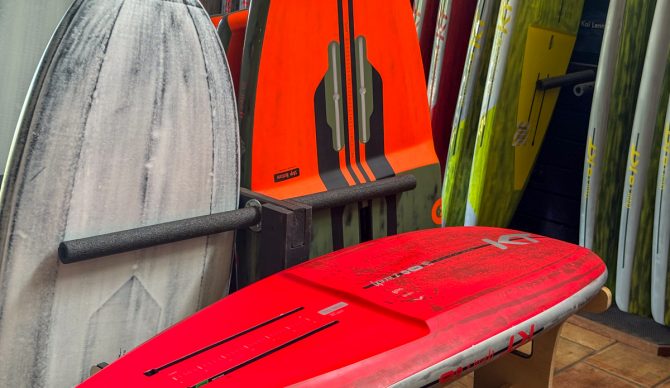
The progression of cleaner lines: Behind, in orange and green, the 2023 KT Ginxu step-bottom foil board. In red, the 2024 KT Ginxu 2 Pro, with much more subtle and “clean” lines. Photo: Will Sileo//The Inertia
Kai Lenny is really bringing all these different watersports together. Even snowsports. One thing he told me a couple of years ago is how he sees snowboarding and big wave surfing as closely connected. The way he sees it, you’re basically just riding a massive frozen wave when you’re snowboarding.
Well, these mid-lengths that we’re riding down the river right now (for foiling) really feel like snowboarding, too. Especially now because we’re all using straps, which brings more connection to the board, and all of a sudden you find yourself doing turns and painting the same sort of lines as you would on a snowboard. I’ve actually been imagining myself snowboarding when I go out to foil bumps (in Hood River, Oregon), just the way I’m holding my body and stuff like that, it’s pretty game-changing.
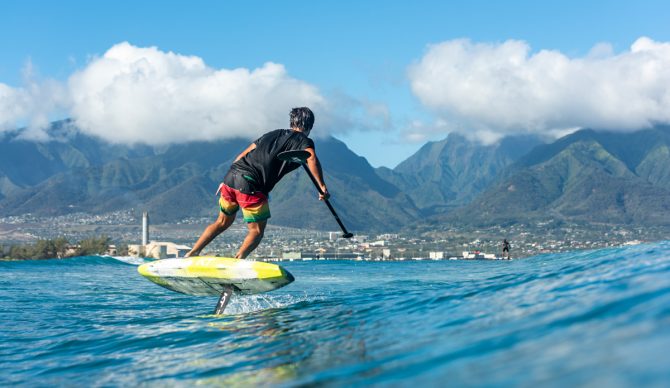
KT’s Logan Bediamol finds his flow off of Maui. Photo: Fish Bowl Diaries
Anyone else in the pro-athlete world that you see as bringing it all together in a special way?
Yeah, actually, it’s been really cool to see Zeke Lau getting into all the downwind stuff. We’ve chatted with him a bit about that. I mean, he’s about the most core, “air” guy you could imagine in surfing, and here he is on a foil, getting vulnerable and being a kook again. That’s like the biggest hurdle I feel like in this whole thing. A lot of really good surfers are gonna have to take a few steps back and go through the learning process again. But from my experience in learning to foil myself, coming from surfing, it has been so worth every second of struggle.
I actually look forward to summer here when it’s flat. There’s not much swell in Maui in the summer, but with the foil we are riding every day. I feel like we’ve gone, in the past couple of years, from seeing summer coming and lining up surf trips to Mexico to get off the island, to all of a sudden, this year feeling like we don’t want summer to end! It’s just so good, and with the windswell we get on Maui, you can surf all summer long. And we’re learning so much at the same time.
I also feel like there’s so much to be gained from the sort of learner-beginner’s mindset that comes with foiling.
There is so much to be gained there with keeping an open mind and trying new things – it’s so good for us as humans. And I’ve never had stronger legs! I’m not gonna do 500 squats a day, but you have to if you’re going to do a 10-mile downwinder!
Also, for someone who’s learning to surf, to get to the level where you can feel that sensation of the turn takes a lot longer than it does foiling, so you can tap in and it feels like you’re doing a big ripping turn, and maybe you’re actually not, or it doesn’t look that way, but it feels that way, and everyone loves that!
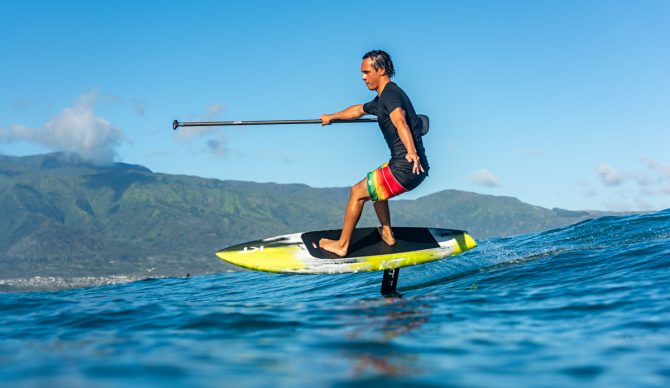
Getting out and finding flow in subpar surf conditions is the true magic of foiling. Photo: Fish Bowl Diaries
Coming back to Kai, I’m curious how it goes when you’re working so closely with some of the best professional athletes and watermen in the world, and then using their feedback to inform designs, including for beginners and intermediate riders. How do you make it all work?
Well, how it often goes is, Kai will come to us with an idea, and we’ll set him up for success and let him run with it. We’ll maybe try it ourselves, but a lot of our current designs come from our own knowledge and experience. After years of making boards for the market, you start to understand what people want and where you can be a little extreme or not. And that’s super important, because it’s not easy to put this stuff into production. It takes a lot of time, energy, and money, so you want to hit the mark.
So, as the designers, we’ll come up with a board or foil design, and then get Kai or Kane (de Wilde) on what we’ve developed, and then they tell us what it felt like to ride. Which, a lot of times, might be something so subtle that we can’t feel it ourselves. But these are the little things. We do the dirty work for a little while and get things to a place where we think they’re pretty damn good, and then we have Kai or Kane come in and tell us what they’re feeling, and that can really influence the finishing touches.
For example, we’ve been here riding for the past week in Hood River with the team, changing boards back and forth, and we figured out some things. So the team and Kane sat down for six hours doing some redesigns, and that’s going to be the base for our next model. So now those designs are sitting at home, waiting for us to shape and ride when we get there. We’ll continue the process, and then hopefully in two or three weeks, we’ll have a whole new line put together. So it’s a super-cool process, but I allow Kane and Kai and the team to have a lot of freedom and just explore a little bit, and see what comes. And there are a lot of good things that come out of that, and yeah, you make mistakes, but that’s just a part of the process too.
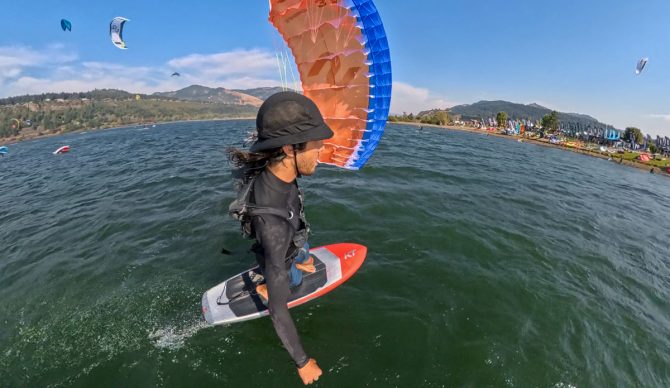
The author, testing the latest KT foil boards (and a prototype Slingshot parawing) in Hood River. Photo: Will Sileo//The Inertia
Ok, one final question – parawings. How does that play into it all?
For the last three months, that’s all we’ve done, day in and day out. It really speaks to the surfer in all of us. Here in Maui, we’ve got a cool little run where you hop in, throw your parawing up to get on foil, put it away, and you’re just surfing for 30, 40 minutes. Parawinging is totally the missing link between surfing and foiling with the wind, because you’re using the wind, you can tap into the wind swells, but then you put the parawing away, and you’re basically just surfing, down the coast, for an hour, or however long you want. So it’s really kinda the best thing ever for guys who just want to surf and ride waves in whatever form we can get our hands on.
And as you get better and better and start turning harder and harder, for me, I start thinking about how I can make the board better, or how I can make the foils better. For me, the parawing is a huge part of the future for us because of how much it relates to surfing. In the end, we all love to surf. Turn hard, throw the tail, whatever we can do. So to have that during the summer months when it’s small and being able to have fun without chasing conditions that are really hard to surf is huge.
I also think we have a lot to offer in that realm, because we all just went through the (parawing) learning curve in the past year, and that taught us so much about stability and getting up on foil and all these parameters, so we’ve gotten to work on some stuff for the next year that should be pretty awesome.
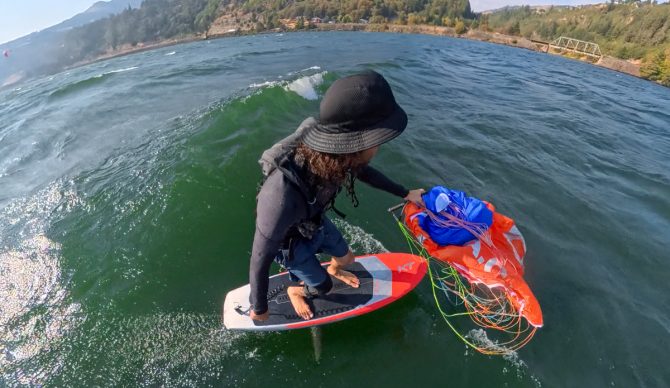
Parawinging: the missing link between foiling and surfing. Photo: Will Sileo//The Inertia
How long do you think until we see a KT parawing?
We don’t go into something unless we’re really passionate about it. And if you’re passionate about it, the product is going to have a good base. So there are a lot of different opinions about where we should take things with parawings in the shop at the moment, but it’s gonna be good. We’re stoked.

