
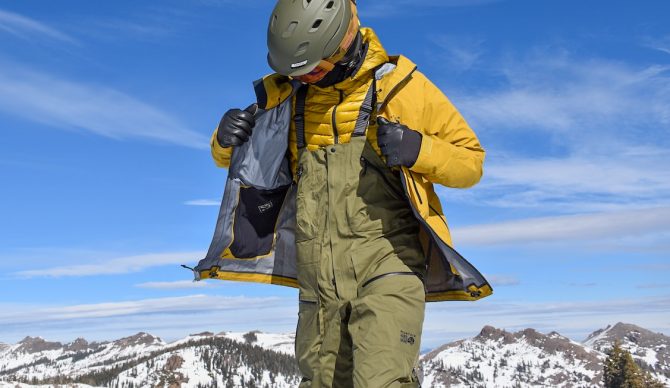
Mountain Hardwear’s High Exposure Bib is our top-pick bib for backcountry use. Here’s why. Photo: Nick Bruckbauer//The Inertia

Bibs in the backcountry? Believe it or not, with modern materials, it’s no longer such a crazy idea. A couple of years ago, the Mountain Hardwear High Exposure Bib ($550) landed on the market, making use of an ultra-thin and surprisingly durable version of GORE-TEX C-Knit to produce a bib that weighs less than most ski pants. That material is also very breathable, while remaining completely waterproof, and with lots of ventilation from long outer-thigh vents that double as a full drop seat, there’s really nothing about these that will hold you back from reaching the peaks of your dreams, while keeping the snow out of your clothes on the descent.
Re-released last year with a new, more environmentally-friendly material (GORE-TEX ePE) that, in testing, has proven to be just as good as the original version. After a season of testing, we felt it was time to provide some more details as to why these are our favorite backcountry bibs for the past couple of years running.
Bottom Line: Mountain Hardwear’s High Exposure Bib defines lightweight breathability among bibs with a strong focus on backcountry applicability. They’re proof that bibs and the backcountry are not mutually exclusive, providing all the benefits of bibs (snow protection, storage, etc.) without the downsides (weight, running too warm, etc.). The lightweight material is surprisingly durable, but that said, if you ski 20+ days on the resort per season, you’ll probably be better served with bibs that have a burlier, resort-oriented construction. Or just be ready to patch ’em when the time comes.
Check Price on Evo Check Price on Mountain Hardwear
Related: Best Ski Bibs | Best Ski Jackets | More Snow Gear Reviews
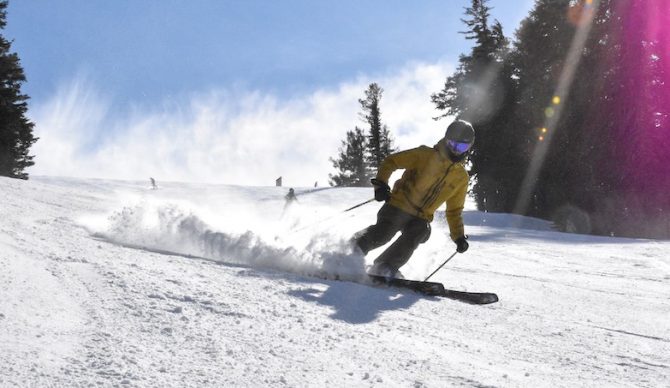
Intended for the backcountry, these bibs can certainly handle some time on-resort as well. Photo: Nick Bruckbauer//The Inertia
Bibs in the Backcountry
Backcountry skiing prioritizes lightweight and breathable equipment. Since you’ve got to hike up before you can ski back down, it’s a good idea to reduce weight and prevent overheating as much as possible. Historically, bibs have been a liability for both of those considerations, adding extra material (weight) around your midsection (warmth).
However, the appeal of extra pockets and keeping snow out of your clothes is universal — whether you’re in the backcountry or on the resort. And nowadays, there are a number of bibs that have been engineered specifically for backcountry use with lighter materials, extra ventilation, and other fun features.
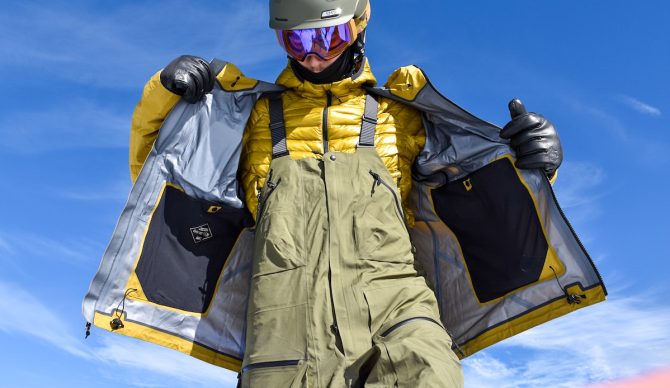
Four spacious pockets make for a well-organized and clean pocket layout. Photo: Nick Bruckbauer//The Inertia
Testing The High Exposure Bibs
I’ve spent a couple of seasons in the prior-generation High Exposure Bibs, and also had a friend put them through their own season-long torture test. Since receiving the latest version of the High Exposure Bibs last season, I’ve gotten them out in the backcountry a handful of times and spent a solid number of days on the resort in them as well to see how they stand up to the rigors of resort riding. So far, so good. The main changes from the prior generation bibs are the new ePE fabric and some tweaks to the pocket and bib-upper layout.
Notable Features
Pockets
The High Exposure Bibs come with a straightforward pocket layout that provides plenty of room for essentials without adding unnecessary bulk. Four zippered pockets adorn the front of the bibs, one on each thigh and one on each side of the front zipper that divides the upper bib section. The upper pockets have webbing loops to attach things like a beacon leash, and the thigh pockets have internal organization sleeves to keep your phone or other items from bouncing around.
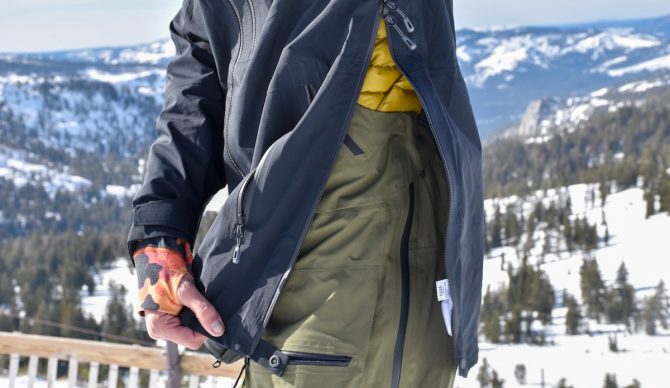
Long side vents from hip to knee provide great ventilation and also allow for a full drop-seat. Photo: Nick Bruckbauer//The Inertia
Ventilation
Lightweight material or no, backcountry bibs need solid ventilation. Luckily, the High Exposure Bibs have this property in spades. Long ventilation zippers on either side zip from knee to hip, letting you really air things out, while also providing a full drop-seat. There are no inner thigh vents, which is a favorite feature of mine, but to be honest, I didn’t miss them on the High Exposure Bibs because of how breathable and well-ventilated they are already. As a bonus feature, the full front zip can also be opened up to let things air out even more, which is something you definitely can’t do with a pair of ski pants. You might get some jokes about your fly being down, however.
Low-Profile Suspender Straps
A common pet peeve of mine (and many others) is bibs that have bulky suspender straps with chunky buckles that don’t sit well underneath the straps of a backpack. This is especially a problem for backcountry travel, as you likely won’t be wearing many layers on the uphill, and less layers equals less padding. Thankfully, the High Exposure Bib has fairly low-profile straps and buckles. Not the lowest-profile I’ve ever seen, but enough to not cause any issues for my bony shoulders on the uphill.
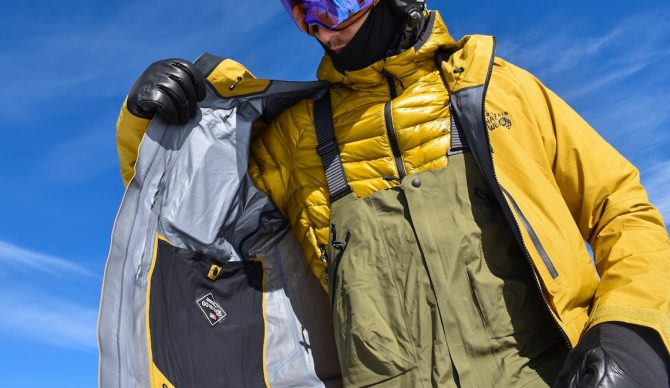
The bib suspender straps are wide and supportive, but with minimal hardware, are quite comfortable under a backpack. Photo: Nick Bruckbauer//The Inertia
Fully Waterproof
For as lightweight and breathable as these bibs are, they’re surprisingly quite waterproof. Or maybe that shouldn’t be surprising considering the material is of GORE-TEX design. The DWR is also a nice, strong one, keeping water repelled (instead of soaking into the top layer to be blocked by the waterproof membrane) for a while.
Sizing
These bibs come in a great range of sizes. As well as the usual S, M, L, there’s an XL and XXL size, and all of these sizes are also offered in Short, Regular, and Long inseam lengths to help dial in the best fit. The bibs have a fairly roomy fit, which is perfect for layering up underneath on colder days, and gives a bit of that baggy freeride aesthetic without adding bulk or looking like you ordered two sizes up.
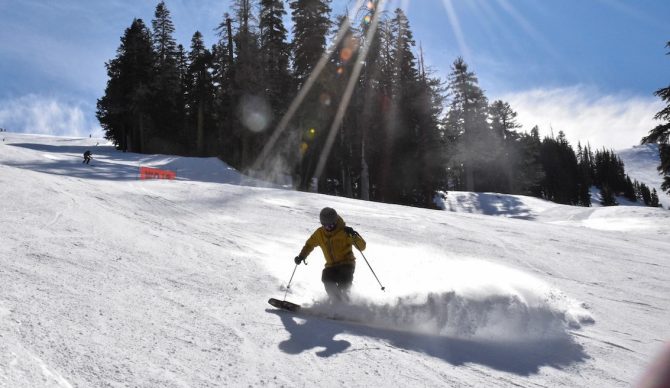
While these bibs can certainly handle some time on the resort, they wouldn’t be our first choice for someone who spends most of their time in-bounds. Photo: Nick Bruckbauer//The Inertia
Drawbacks
Warmth
It comes with the territory when you’re designing bibs for lightweight breathability, but these bibs are certainly not the warmest on the market. Especially when the wind is strong, I found that the material gets cold if worn too closely to the skin, requiring some thicker insulation underneath – with just a baselayer, I got a little chilly. This is more of an issue for resort skiing, however.
Durability
To be clear, this is mostly just speculation, and we’ve had no issues crop up in our season of testing these bibs that would have us concerned about durability. Quite the opposite, in fact, as we were quite surprised as to how well the prior generation of these bibs has lasted in our ongoing multi-season torture test that involves both backcountry and resort riding.
That said, it’s worth taking a look at the numbers. For this, we look at Denier, which is a rating of fiber thickness that can be a general indicator of durability. The High Exposure bibs are made with a 30 Denier face fabric, which is quite low for ski equipment. In comparison, the OR Skytour Ascentshell bibs use a 40D x 65D face fabric, and our all-around champ that’s high on durability, the Flylow Baker Bib, uses 150D face fabric.
Durability and Denier are by no means a direct correlation (in other words, it’s not like the Flylow Bakers at 150D are 5x more durable than the High Exposure bibs at 30D), but it’s usually a decent clue as to which bibs you’d rather fall on rocks in. If you spend most of your time on the resort, I’d probably steer you towards a more robust pair of bibs.
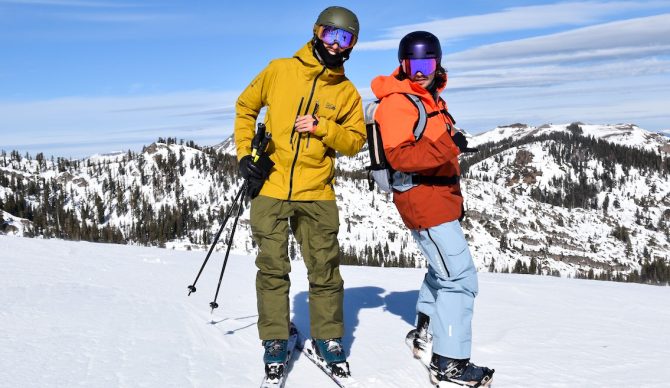
Photo: Nick Bruckbauer//The Inertia
The Competition
Outdoor Research’s Hemispheres Bibs are another pair of backcountry-oriented bibs. Last year’s version sported a unique feature, being two inner-thigh panels made of a more breathable (and less waterproof) fabric to help dissipate heat. However, it appears OR has done away with that feature, and the bibs now use GORE-TEX C-Knit, the same material as the High Exposure Bib, however, in a thicker construction with 80 Denier face fabric compared to the High Exposure’s 30 Denier. The bibs have a lower-cut upper and long side vents, so warmth shouldn’t be an issue despite the removal of the breathable inner-thigh panels, but we’ll reserve judgment on that score until we get out in the latest version of these bibs.
Mammut’s Haldigrat Bibs have a similar-weight material to the High Exposure Bibs. Made from Mammut’s proprietary DryTech Pro material as opposed to GORE-TEX C-Knit, they’re a little heftier with a 40 Denier face-fabric, but breathe and move extremely well. However, we much preferred the fit and pocket layout of the High Exposure bib, as well as the ventilation options. However, if you’re looking for more of a trim-fit, the Haldigrat bibs might be the ones for you.
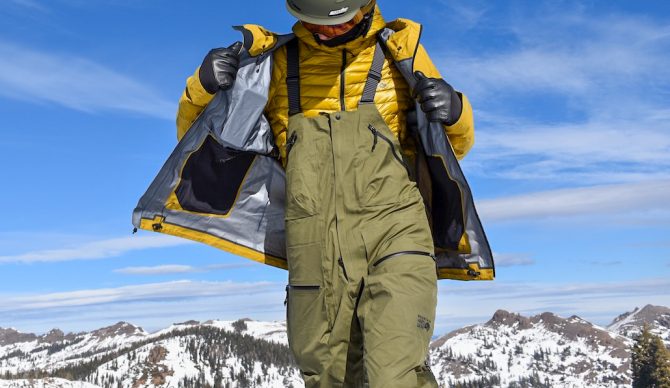
If testing the High Exposure bibs taught us anything, it’s that bibs and the backcountry are not mutually exclusive. Photo: Nick Bruckbauer//The Inertia
Final Thoughts
If you’re intrigued by the idea of wearing bibs in the backcountry but worried about weight, bulk, and warmth, the Mountain Hardwear High Exposure is the bib for you. Lightweight, easy-moving, and about as breathable and ventilated as they come, these are the bibs to make you forget that you’re wearing bibs… at least until you’re waist-deep in fresh powder, without a speck of it making its way inside to your less-waterproof layers. While we wouldn’t recommend them for day-in, day-out resort use, they’re sturdy enough for a decent amount of resort time, but to truly appreciate the benefits of these lightweight bibs, the backcountry is where they shine.
Check Price on Evo Check Price on Mountain Hardwear
Related: Best Ski Bibs | Best Ski Jackets | More Snow Gear Reviews

