
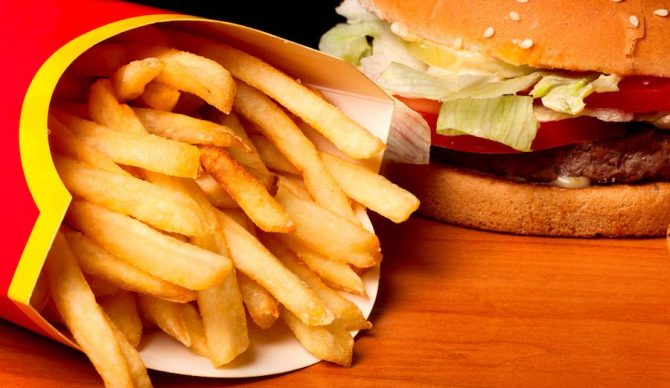
Look appetizing? Maybe. What if I told you this meal were 137 days old? Photo: Shutterstock

It’s easy to hate on fast food. By now, the public is well aware that fast food is generally deplete of nutritional value, and disingenuous about the ingredients and processes by which they make their food. If we can call it that. Not to mention revenue among major chains is in serious decline.
But it’s always a great time for a nice little reminder about the great lengths to which fast food corporations have gone, for one reason or another, to obscure what’s really in their products. And while the rise of the farm-to-table ethos, one wherein people want to know each and every ingredient that goes into their food and as a result their bodies, has grown in prevalence, reportedly about half of Americans continue to eat at fast food establishments weekly.
Personally, I’m no saint. I slum it at Micky D’s when the mood strikes me, just like anyone else. I know in the back of my mind that it’s probably not healthy, but try to put it out – probably not the best attitude before a meal. So if you’re like me, it might be time to be grossed out to kick that fast food habit for good, and start treating that body like a temple by remembering the following:
1. ‘Egg’ might not really mean eggs.
In a survey of 6 fast food restaurants, one Forbes contributor noted some strange ingredients in the eggs of breakfast items. Some were worse than others, but the main culprit, Subway (followed closely by McDonald’s), reportedly adds something called ‘premium egg blend’ to the breakfast staple. That blend is made up of: isolated pea product, salt, citric acid, dextrose, guar gum, xanthan gum, extractive of spice, propylene glycol and not more than 2% calcium silicate and glycerin to prevent caking – none of which comes in any way shape or form from eggs. According to the author, propylene glycol is also used anti-freeze, air conditioner compressors, and deodorant sticks. Tasty.
2. ‘Ground beef’ might only be 40% actual beef.
Back in 2011, Taco Bell came under fire for putting not beef but “taco filler” in its ground beef tacos and other offerings. Mind you, this was completely separate from allegations the chain was using horse meat in its ground beef for European locations (an equally revolting fact that I’ll let stand on its own). The company later came back in 2014, saying its ground beef was 88% beef. Whether that’s true, it always was, or has since changed is irrelevant, because it launched an entire debate about what qualifies as beef. Apparently the USDA’s definition of ground beef stipulates it must be at least 70% lean beef. In this case, Taco Bell would not be able to legally claim its product as beef if it were around 40% as the lawsuit claimed. But Taco Bell would be perfectly within its rights to call the meat taco filling (which the USDA requires be no less than 40% beef). If all these nuances in percentage of actual meat a product must have to be considered as such don’t frighten you, they should.
3. The USDA allows for some maggots and fly eggs in your pizza sauce.
Is nothing sacred? For tomato products, the USDA has very specific rules about how many maggots and fly eggs are allowed. Apparently any more than 30 fly eggs per 100 grams over 12 subsamples, and the sauce will be recalled. Got 29? You’re in the clear! As for maggots, 2 or more per 100 grams and that’s a recall. But only 1 per 100 grams is all good!
4. ‘Pink slime’ was and could still be a thing.
That’s right. At one time, companies willfully used meat colloquially referred to as ‘pink slime’ in food. Lean finely textured beef (LFTB), as it’s also known, is essentially all of the undesirable parts of the cow ground up to create an additive for beef products. When use of ‘pink slime’ came to light in 2012, fast food chains cut back heavily on using it (some discontinued using it completely). But, by 2014, ‘pink slime’ was already on the up and up. Which chains, if any, have started to use it again may remain a mystery for some time – it reduces cost, so corporations have an incentive to reincorporate it so long as it doesn’t result in the same level public outcry.
5. Preservatives, preservatives, preservatives.
It’s a fact that if you don’t eat food fresh, it must be preserved somehow. Hell, salt’s important role in human history as a preservative is huge. But being sure that something keeps for a few days, a few weeks tops is one thing. A few years, now that’s crazy talk. One art project famously photographed a Happy Meal over the course of months. After 137 days, it looked no worse for ware. That’s largely due to the preservatives. Experts also say it has to do with their fat content that’s extremely high and creates a low moisture environment, making it difficult for mold and bacteria to grow.
Still hungry?

