

It has been said that we can disappear from our lives on backpacking trips, or even day hikes. But one Ohio outlaw disappeared on the Appalachian Trail between Maine and Georgia for six years, avoiding authorities after he was convicted of felony wire fraud.
James T Hammes was convicted in Cincinatti in 2009 after he embezzled $8.7 million from the Pepsi-Cola bottling company he was working for by manipulating money transfers. Instead of turning himself in, he vanished, leaving behind his wife and young daughter for a life on the trail.
What’s perplexing is that the Appalachian Trail while it features wild, remote sections, isn’t nearly as lonesome as its western counterpart, the Pacific Crest Trail. But Hammes managed to elude capture, hiding out on the trail’s many twists and turns while sometimes finding safe havens where he could stay in Indiana and Maine.
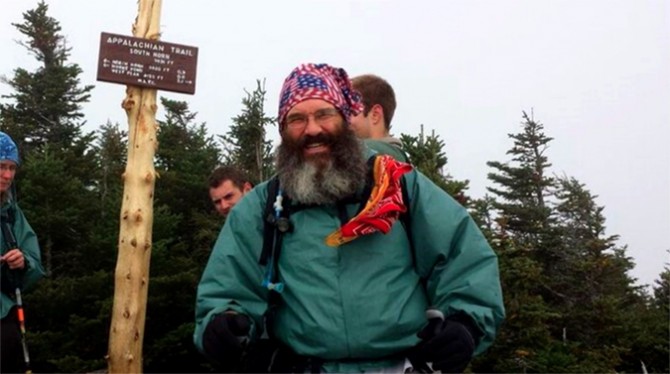
He also frequented a bed and breakfast in Virginia, where he was captured after a fellow hiker saw him on the crime television show, American Greed. “I’d say he was one of my favorite guests,” said Susie Montgomery, who owns the four-bedroom Montgomery Homestead Inn where Hammes was apprehended during an event last year known as Trail Days celebrating the famous trail. “He was a smart man, interesting to talk to; a pleasant personality. All of the other people who stayed here liked him.”
The FBI surrounded the bed and breakfast when it got word Hammes was staying there, arresting him without incident. Montgomery gave Hammes a hug as he was cuffed and taken away.
It seems Hammes easily made friends on the trail. Both the Appalachian and Pacific Crest Trails are frequented by people who are seeking a way out of their regular lives or are perhaps going through a mid-life crisis of some sort, often taking trail names to form new identities. Hammes, who took the name “Bizmarck” blended in with that crowd. But he wasn’t withdrawn. In fact, many describe him as outgoing and fun. Which makes it even harder to believe that he avoided capture for so long. At one point, he even contacted an Appalachian Trail guidebook author for advice.

“He was a little more gregarious and social than the typical hiker,” said David Miller, a Floridian who pens a guidebook in PDF form that he regularly updates called The A.T. Guide. He wrote about his own journey in the book, AWOL on the Appalachian Trail. “I think the most surprising thing about it to me is he had high visibility on the Appalachian Trail. There are thousands of people on the trail every year.”
Miller said that Hammes even appeared in social media as hikers took selfies with him, and that he sent him updates to put in his guide, like if a hotel was offering special rates to hikers, for example.
Hammes’ case is another testament to the vastness that is the North American continent. And that even with social media and ever-increasing media outlets, disappearing into that vastness is as easy as walking out the back door.
James T. Hammes pled guilty in late 2015 and his sentencing hearing is set for June 22. Wire fraud carries a maximum 20-year sentence.

