
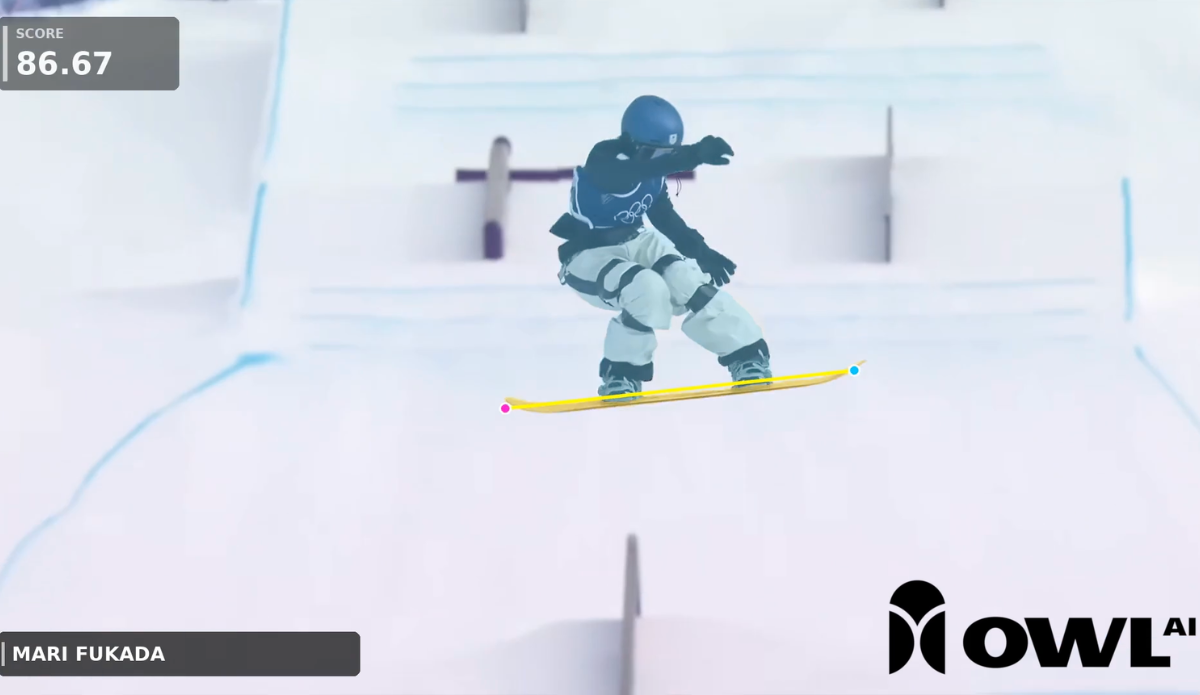
Screengrab: Owl AI

Olympic snowboarding last month was bogged down by judging controversies. The women’s halfpipe and women’s slopestyle competitions in particular were contested by armchair experts and network broadcast team members alike, and according to Owl AI, the podium in one of those events deserved a shake up. For reference, Owl AI bills itself as possessing “sports officiating and analysis tools used by major leagues to deliver unbiased, elite-level game insights.”
To give a quick recap and context for the Owl AI analysis, Livigno, Italy received a couple inches of fresh snow leading up to the women’s slopestyle final. That new snow slowed the course down enough that athletes were forced to adjust their runs, and in the simplest terms, bigger maneuvers were swapped out for smaller ones because snowboarders couldn’t create the necessary speed. The trickle down effect of that, of course, meant an adjustment by judges, who were now analyzing tricks with fewer rotations than a typical Olympic-level run. Social media and the live network broadcaster, Todd Richards, lost their minds when two 720s (two rotations) were scored higher than a triple cork 1260 (three and a half rotations) and a double cork 1080 (three rotations).
Japan’s Mari Fukada delivered the two 720s and took Gold with a 87.83. New Zealand’s Zoi Sadowski-Synott, whose run was objectively more progressive and riskier, won Silver with 87.48.
“A perfect older trick basically beat a great progressive trick,” explains Josh Gwyther.
To re-judge the controversial finish, Owl AI built a data set of the past five years of judging for 720s and 1080s and reanalyzed the scores that were given to the Olympians. New scores given out by the system flipped the podium, with Fukada’s score adjusted to 86.67 and Sadowski-Synott’s score adjusted to 89.13.
“This is where we really think we could augment the judges,” Josh Gwyther, Owl AI’s CEO told The Business Journal. “Because if you, as a judge, are putting in a score and immediately saw this deviation, you might be like, ‘Okay, let me see, Is there something there?’ And maybe notate that anomaly.”

