
Editor’s Note: This article was co-authored by both Niklas Lollo and Ansel Olive Klein jointly. Due to the one author rule, Ansel Olive Klein is credited here but retains equal authorship. Additionally, this is part of the Adventuring Through an Evolving World series, through which members of the Energy and Resources Group at UC Berkeley, in collaboration with Adventurers and Scientists for Conservation, will lend a quantitative eye to environmental change and its relationship to the outdoor sports community.
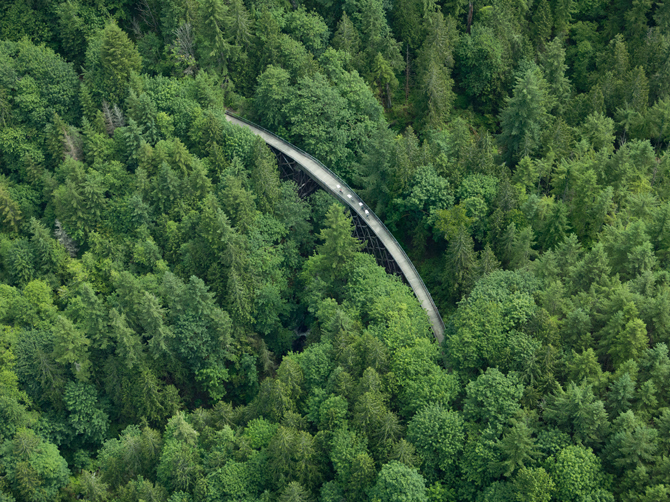
Day 2, Snoqualmie Valley Trail, Washington. Photo: Michael Light
“In a car you’re always in a compartment, and because you’re used to it you don’t realize that through that car window everything you see is just more TV. You’re a passive observer and it is all moving by you boringly in a frame… On a cycle the frame is gone. You’re completely in contact with it all. You’re in the scene, not just watching it anymore, and the sense of presence is overwhelming.” – Robert M. Pirsig, Zen and the Art of Motorcycle Maintenance: An Inquiry Into Values
Snaking through the deep valleys of Idaho on bicycle offers a unique vantage. On your bike, you can listen to the gentle hum of your tires scrolling over the pavement, while breathing in the rich diversity of mountain species — great blue heron, spotted sandpipers, trillium wildflowers. As you carve through the most spectacular and remote landscapes between the quaint little mining towns, the rich history is transmitted from the mountains.
This is the allure of bicycle touring: getting away from the bustle of the cars and people, peering into unknown landscapes, and discovering. You’re not the passive observer the car is, as you insert yourself into the landscape and pedal away powered by your own fuel.
In 2014, while touring as part of 4 ½ Feet, an art-on-bicycle adventure, Ansel Olive Klein and four women set out along a bicycle trail in Idaho laid down by the Rails-to-Trails Conservancy. Since 1986, Rails-to-Trails has worked to transform hundreds of miles of defunct railroad lines into bicycle paths.
The 4 ½ Feet crew rode through the valley with reflective white capes at their backs as aerial photographer Michael Light flew overhead and photographed. The eventual goal of 4 ½ Feet is to compile enough images to draw out a singular bicycle route across the U.S. connecting all these Rails-to-Trails routes — currently, no such official U.S.-wide bicycle route exists.
While on the ride, 4 ½ Feet soon learned that the area surrounding Coeur d’Alene was steeped in the all-too-common and tragic story of indigenous displacement and environmental destruction. Peeling back the asphalt of the Idaho bicycle trail, there was a deeper history different from what the mountains offered.
The land had once sustained the Schitsu’umsh people (now referenced as the Coeur d’Alene Tribe) with its abundance of trout, salmon, and whitefish. However, during the pioneer days, starting in the late 19th century, the vast area became consumed by the highly destructive activities of the mining industry. Propped up by the ever-expanding network of railroad construction, the booming economic area was a hotbed for environmental degradation.
Fast forward to the early 1990s. The Coeur d’Alene Tribe, tired of the foamy white rivers and soils saturated with highly toxic lead, arsenic, and mercury (among others), sued the Union Pacific Railroad and local mining companies. Backed by the EPA, the Coeur d’Alene Tribe eventually won the settlement — a landmark case — and since then, the surrounding area has become the second largest (and best-kept-secret) superfund site in the state of Idaho. Eventually, the railroad tracks and ties were carefully washed and removed, and the remaining toxic sludge conveniently sealed under an asphalt bicycle trail. The trail that remains today follows the historic path of the railroad.
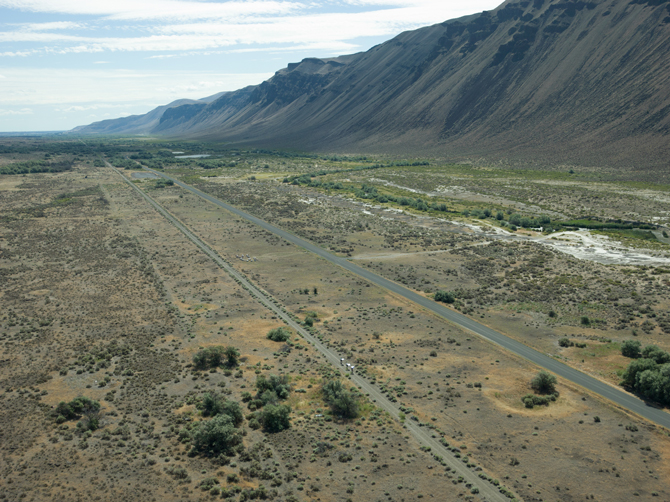
Day 6, John Wayne Pioneer Trail, Columbia River Basin, Washington. Photo: Michael Light
Beyond accessing the previously unreachable landscapes, the repaving signals a turning point in environmental values and our fundamental understanding of nature. Despite their gentle erasure over the past five decades, railroads have radically transformed the way we frame our world. Railroads singlehandedly synchronized time, creating the concept of time zones; traveling between cities condensed to hours and moving across continents compressed to days. So much so, Rebecca Solnit posits railroads as the original “annihilators of time and space.”
As observers in railcars whisked by, environmental degradation, like the toxic sludge, was able to be swept under the rural rug of America. But the rug was lifted when in 1962 Rachel Carson published Silent Spring. Her work, and those that followed, ushered in a renewed conception of our relationship to “the environment.” The wilderness was the environment, and therefore the environment was a “thing.” It was with this conception in mind that the Clean Air and Water Acts of the 1970s were passed.
While this frame persists today to an extent, there has been a shift in our relationship to the environment. Modern environmentalism has sought to break down these barriers to forge an intimate understanding of and integration with our natural surroundings. Cities are nature and nature is us.
Our agricultural system is a perfect example of this cultural shift. No longer conceived as a product from a linear supply chain, food has become a nexus for water, soil, justice, climate, culture, health, and community. Michael Pollan has been particularly convincing in creating this shift, with his marked penchant for a kind of riveting storytelling that lays bare the complexity and interdependencies of the food system (see Botany of Desire and Omnivore’s Dilemma). On any given day of the week in the San Francisco Bay Area, we can visit a farmer’s market with organic produce served by a local farm while street vendors hawk handicrafts and buskers pick chords. It is a visceral representation of many of these interconnections.
Transportation is similarly being re-conceived. It is no longer simply a method of getting from point A to point B. Your transportation choice is your identity, and health and environmental impacts are increasingly weighed in decisions. Indeed, the transportation “land footprint” is receiving more press. But the new frame is really about moving beyond environmental impact assessments, towards accepting humans as part of the landscape.
We can begin to see how transportation is a part of our larger system and that we as humans are deeply embedded in it. The old way of compartmentalizing humans and nature in separate zones, and the old way of thinking that transport is for travel and food is for nutrition, is slowly retreating. The paving over of railroads for new bike trails embodies the metaphor fully. Whereas we were once able to lay down tracks, create superfund sites where we damn pleased and zip across landscapes, now we prefer to be quietly and slowly embedded in it all. On bicycle, we are passersby powered by our calves, in a frameless landscape, observing, connecting to nature, fully exposed.
Yet the experience does not do away with the historically fraught superfund inches beneath our tires. Not to mention the displaced indigenous peoples. In this sense, the bicycle trails have rehabilitated and repurposed a divisive remnant of recent railroad history on the one hand, while on the other, it may appear to repeat an all-too-common historical erasure. This erasure is troubling, because while it is relatively easy to rip out railroad spikes and lay down asphalt, it is much more difficult to deal with the negative social and ecological consequences that the railroads bore out.
So while the hundreds of miles of bicycle trails laid down by the Rails-to-Trails Conservancy pave the way for more bicycling and less driving, we should also appreciate the metaphorical power of the trail. Each holds the stories of environmental splendor — wildflower fields, redwood groves, glassy lakes — and issues — monoculture, drought, deforestation — of which we are part and parcel. And when all this is reflected upon, it paves the way for a bike tourer to truly connect with the great outdoors in new dimensions. That is what bicycle touring is all about.
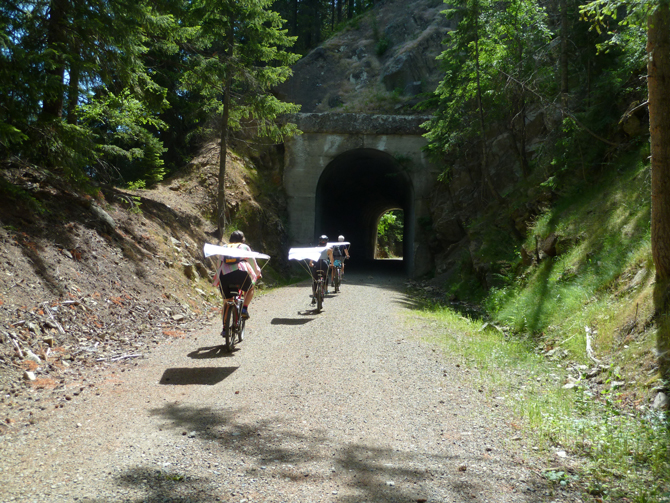
Day 3, Iron Horse State Park, Cascades, Washington. Photo: Michael Light
All photography is courtesy of Michael Light. For more from the photographer, head on over to his website.
For more information on the people and organizations behind Adventures Through an Evolving World, be sure to check out the Energy & Resources Group at UC Berkley as well as Adventurers and Scientists for Conservation.
Catch up with the rest of the series:
Adventuring Through an Evolving World: A Series on Environmental Change
El Niño and a Mysterious Disappearance in the Pacific Ocean
Combatting the Growing Environmental and Human Health Hazards of Microplastics

