
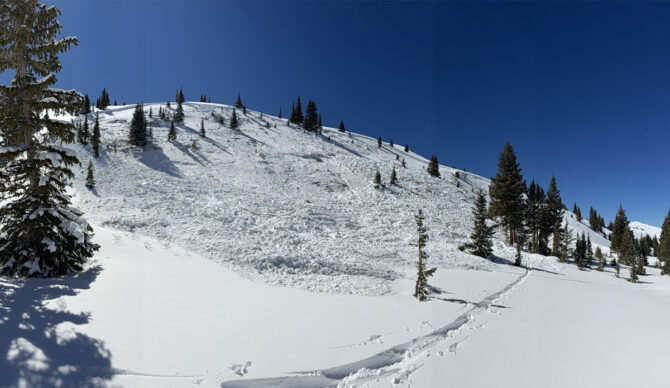
Photo: Colorado Avalanche Investigation Center

On March 7, David Pickett-Heaps became the first avalanche death of the Colorado ski season. Now, a report from the Colorado Avalanche Information Center has detailed exactly how the tragedy unfolded.
Pickett-Heaps, a 58-year-old from Silverthorne, Colorado, arrived at the Vail Pass Winter Recreation Area at approximately 7:00 AM. He was skiing solo and using a snowmobile to access terrain. A few hours later, he was spotted by another group of skiers on a skin track near an area locally known as Resolution Bowl. Afterwards, he was seen heading to the Boss Basin area, south of Ptarmigan Pass, at around 1:15 PM.
It was on his second descent that things went awry. Because he was alone at the time of the slide, it is impossible to know exactly where on the slope the avalanche released. According to the report, even though the slope was not complex or extremely steep, the fact it ended in a flat bench formed a terain trap that allowed avalanche debris to form a deep pile at the bottom of the slope. Despite the relatively short vertical fall, Pickett-Heaps ended up buried near the toe of the debris, with only one tip of his ski visible
A family member reported him missing around 11:30 p.m., and Summit County Rescue Group members found his snowmobile four and a half hours later. Around 6:00 a.m., a drone pilot located the slide, and two hours after that, a Flight for Life helicopter dropped in two searchers and an avalanche rescue dog, who were able to find him.
In the report, the investigators provided some commentary on how other skiers could seek to avoid a similar circumstance. “We cannot know if having a partner would have changed the outcome for Skier 1,” wrote the investigators. “However, given the depth of Skier 1’s burial, lack of signs of trauma, and the condition of his equipment (skis on with toe pieces in downhill mode), there is a reasonable chance that a fast and efficient companion rescue could have produced a different outcome.
“Skier 1 would have needed to wear a transmitting avalanche rescue transceiver so potential partners could find him quickly. Skier 1 was not, but carried two transceivers in the off position in his backpack. An avalanche transceiver will not help you survive an avalanche while traveling solo, but it will make it easier for rescuers to find you. That shortens the search-and-rescue operation. It is also possible that another group traveling in the same area could use their avalanche transceivers to look for a buried skier or just search fresh avalanche debris. In this case, good weather, a well-coordinated multi-county rescue effort, and well-trained rescue personnel aligned to bring a quick resolution to this accident.”

