
Photo: @mcsnowhammer//Instagram

Just like the rest of the surfing world, I’m going to try not to react to way-too-early world record claims until the claims start landing a little closer to reality. In the meantime, I’ll just double down on my take: big wave surfing’s totally predictable trend of immediately marketing the latest bomb of the day as a “world record” or “first 100-foot wave” is…annoying. It’s fascinating, also, but mostly annoying.
If you’ve followed big wave surfing the past decade or so, and specifically within the past five years, you’ve noticed that this happens annually now. A surfer tows into something unbelievable, somebody throws out the words “new world record,” and then the wave in question enjoys several months of unverified viral status. The photographer and surfer inevitably get plenty of press, not for the true fascinating nature of their accomplishment — the superhuman act of riding a wave 99.99999 percent of humanity could never do — but simply because that wave reached an arbitrary mark we’ve become obsessed with. HBO even built a series, a really enthralling and beautifully produced one, on one of those arbitrary marks.
Step two of the process comes when the size of that wave is verified several months, if not more than a year, later. I’ve lost count now of how many “100-foot wave” and “world record” claims turned out to be neither 100 feet or new world records, but I can verify that well, none have reached 100 feet and the last time we verifiably saw a world record was October of 2020. So, basically what I’m saying is, they’re all reliably wrong.
Step three is where it all vanishes. So much time has gone by since the wave in question was actually surfed that the integrity of the original claimants doesn’t take a hit. We forget, we move on, nobody gets hurt, and we wait for the next XXL swell to produce a wave that’ll throw us into this obnoxious spin cycle again.
It’s funny because claims are an understood faux pas in surfing. They’re understandable, on one hand. We all know the genuine ones when we see them. But we cringe at the forced ones. And in my opinion, running to social media to measure a wave on your own and blasting it as a new world record so that it goes viral is the contrived, cringe-worthy type of claim. At least until some of these claims stop falling so short of 100 feet or Sebastian Steudtner’s 86-foot record.
To the credit of most surfers, I can’t say I see them doing the chest thumping and campaigning. Alo Slebir’s 2024 Maverick’s wave of the year was claimed to have been 108 feet tall, for example. Slebir never made the claim himself, and he went out of his way to say he didn’t care how big the wave was or if he had set a world record. He just knew it was the best and biggest wave of his life. When the WSL finally shared the official measurement of that wave, it turned out all those claims had exaggerated a full 30-plus feet. That’s a telephone pole, a little more than the length of a London bus, two giraffes. To be exact, the 108-foot wave was actually 76 feet.
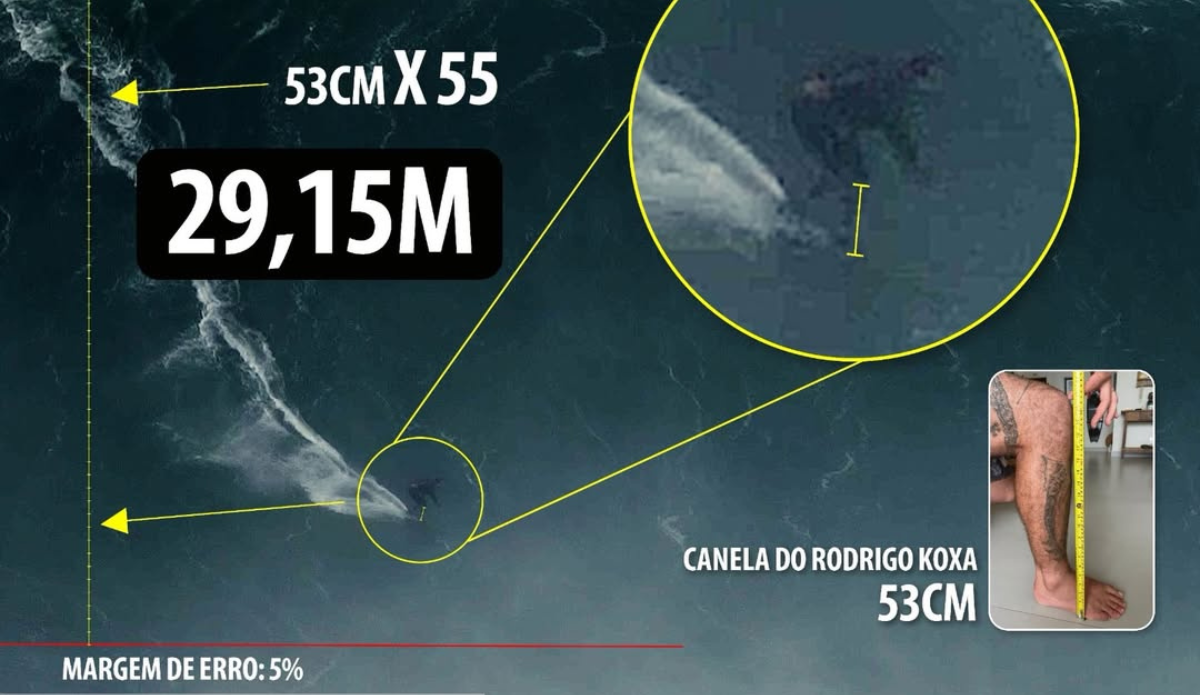
That saga ended just three months ago. And now, we are just two days into a new winter and the cycle has begun again. This time the wave in question isn’t said to be 100 feet. Whoever went through the trouble of measuring Rordigo Koxa’s latest behemoth at Nazaré came out with a height of 95 feet.
“He may have broken the record for the largest wave ever surfed in the world, reaching a height of 29.15 meters,” a post with Koxa’s December 19th ride says.
One day we will get a new world record and one day that world record might top 100 feet. Can we ever go back to just enjoying the fact that 50- and 60-foot bombs matter too? Because big wave surfing is a helluva endeavor, and the people who put their lives on the line chasing them down must be compelled to do so by something bigger than just an arbitrary number…even if it’s technically smaller than that arbitrary number.
View this post on Instagram

