
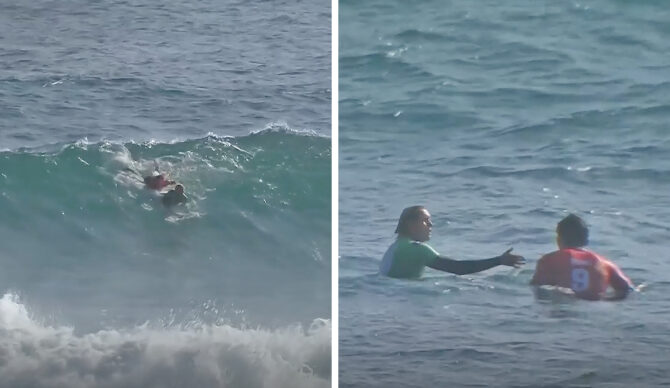
Jacob Willcox and Yago Dora exchanged heated words during their round two heat at the Margaret River Pro after judges didn’t call an interference on Willcox. Photo: Screenshot//WSL

The 2026 WSL Championship Tour is barely two events old, and controversial priority calls have already influenced heats. Both the Margaret River incident between Yago Dora and Jacob Willcox and the Bells Beach incident between Samuel Pupo and Jack Robinson highlight an important question: Is drawing an interference on purpose a legitimate heat tactic?
At the Margaret River Pro, reigning world champion Yago Dora pulled back from a wave as local wildcard Jacob Willcox appeared directly beneath him in the takeoff zone. Dora had priority and believed that Willcox had committed a paddle interference. Two judges agreed. Three disagreed. The majority ruled, and no call was made. Dora spent the next 10 minutes directing frustrated body language at the judges’ tower. Surfers have grown accustomed to learning interference outcomes mid-heat, an expectation that likely compounded Dora’s frustration when no announcement came. The dispute continued up the stairs, spilled into the car park, and required security intervention as the situation nearly became physical between Willcox and Dora.
To put it plainly, it was a bad moment for the sport. Fortunately, a potential solution already exists. Professional skimboarding has addressed this issue.
Two gray area examples and one clear-cut case
To be clear: I am not asserting with certainty that Dora intentionally manufactured an interference. It fits in a gray area. However, Willcox appeared to believe that Dora was attempting to bait him into a call. Intent in the water is difficult to prove, and that ambiguity is precisely the problem. What is clear is that Dora acknowledged in his post-heat interview that he perhaps should have “forced it a bit more” because the judges didn’t call it.
Two weeks earlier at Bells Beach, defending event champion Jack Robinson was eliminated after a controversial priority interference call while surfing against Samuel Pupo. Robinson was already midway through his first turn on a wave when Pupo paddled into the wave with priority. Pupo stood up and faded deeper slightly, threw his arms up in protest before bottom turning, and then surfed the wave. As Pupo popped up, Robinson exited the wave and grabbed his board, but the judges deemed him too close. Kelly Slater, watching from the outside, said he didn’t think it was interference. Robinson notably said, “Some guys milk it a bit. They can use it to their advantage.”
Both the Dora/Willcox and Robinson/Pupo incidents sit in genuinely gray territory. Neither rises to the level of the most obvious example in recent WSL history: the 2017 Pipe Masters heat in which Gabriel Medina, holding priority, dropped in on Kelly Slater’s Backdoor wave and steered his board away from the wave’s natural direction, not to make the barrel, but toward Slater. That is the clearest case on record of what I would call priority abuse: a priority holder choosing a non-ideal line, not to maximize their own ride, but to force an interference on their opponent.
The pattern across these incidents, ambiguous or clear, points to the same structural flaw: the WSL’s interference rule, as currently designed, creates incentives that reward gamesmanship over surfing. When a priority holder can gain a strategic heat advantage by drawing a call rather than riding a wave, some will inevitably pursue that path. The sport deserves a rule that disincentivizes this.
Skimboarding’s blueprint: the “CIF” framework
As a former competitive professional skimboarder and current president of the sport’s professional circuit — the United Skim Tour — I’ve seen priority abuse up close. In skimboarding, competitors run on sand, which makes forcing an interference easier. You don’t need to be positioned perfectly down the line. You just need to chase someone in their blind spot and aim. Skimboarding’s mechanics make priority abuse easier to execute than surfing. Within the first few seasons of instituting a priority system in 2022, we started seeing priority abuse. We diagnosed the problem and came up with a solution.
In competitive skimboarding, we have developed a framework to define priority abuse called CIF: Check, Indicate, Force. For a priority abuse call to be made, three criteria must be met: the non-priority rider must have checked whether the priority rider indicated intent to ride the wave; the priority rider must have clearly indicated their intent to ride the wave (either by holding their board in ready position, taking a committed step toward the wave, or verbally calling out to other riders that they’re going); and the priority rider must have chosen a line where they forced an interference. All three criteria must be satisfied.
The caveat to this rule is that if an interference call is about to happen, the priority rider has a responsibility to yell out to the other rider, telling them they’re going on the wave, allowing the non-priority rider to get out of the way. Anyone who surfs waves of consequence regularly is familiar with similar behavior. If you’re about to pull into a bomb at a barreling break, you often hoot if you’re in the best spot. Calling people off is already very prevalent, especially in heavier surf.
With any interference call in skimboarding, a unanimous panel decision is then required to apply a penalty. If any one of the judges has doubt, they can vote “no” in protest, and the result is a no-call, no penalty. In skimboarding, we believe that a no-call is preferable to a bad call. Our structure is different from surfing, where a simple majority call is enough to apply a penalty. When the penalty is significant, the standard of certainty must be the highest. A simple majority is not sufficient to strip a skimboarder of a heat result.
Skimboarding heats run 10-12 minutes compared to surfing’s 30-40, leaving no time for mid-heat deliberation. All potential calls in skimboarding are flagged at the moment, but discussed and voted on at the end of the heat, when there are no time constraints. At the end of the heat, judges have time to discuss details of the incident, review footage, and then vote whether to apply a penalty. Because of this, skimboarders don’t expect a call to be finalized in the middle of the heat, and they’re incentivized to skim the heat to the end, because they won’t know the final call for minutes after the heat buzzer goes off.
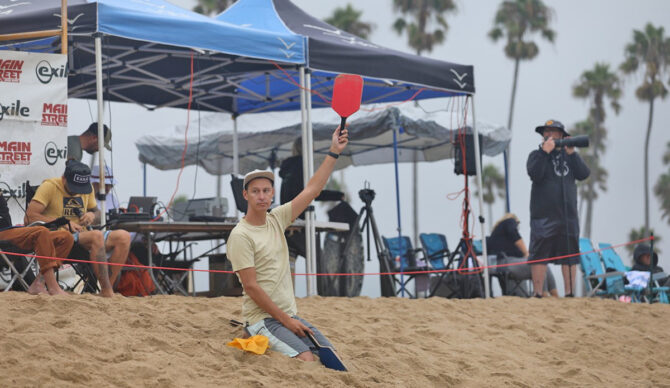
David Haefele working as a priority judge at a skimboard world tour event in Newport Beach. Photo: @lagunasocal
One important note of clarification is that blocking and priority abuse are distinct. In the 2013 Gold Coast event, the incident in which Kelly Slater dropped in on Joel Parkinson, is often cited as an example of excessive gamesmanship; however, because Slater chose to ride the wave in its natural direction, he was merely using his priority to block Parkinson from earning the score. Blocking is allowed, and should be, as it’s the priority rider’s right to ride the wave in whichever way they choose. However, when it’s obvious that a rider is riding in a way where it seems they’re trying to sell an interference instead of surfing the wave, that behavior drifts into priority abuse.
In skimboarding, the penalty for priority abuse is intentionally minimal, removing only a rider’s lowest score (of three), rather than their best wave like other interference penalties. That distinction is deliberate. The goal isn’t to punish aggression. The penalty is light enough it shouldn’t make anyone fearful of utilizing priority. However, it closes the loophole where creating an interference becomes more advantageous than surfing the wave.
Skimboarding is a young sport, and we don’t claim to have a perfect system, nor do we claim perfect enforcement. As we create new rules, athletes find new ways to test their edges, and we find ways to refine them. This is the normal lifecycle of any competitive ruleset. Rule evolution is the mark of a sport that takes competitive integrity seriously. That’s precisely where the WSL finds itself at this moment.
The WSL already has language in its rulebook acknowledging that deliberate unsportsmanlike interference is a distinct category of offense. However, the lack of clear structure on that rule has meant it’s gone unenforced. While surfing would need to restructure some language to make a similar rule work in the water, the CIF framework is clear.
The goal is better surfing
The goal of adding a rule for priority abuse is not to eliminate competitive strategy from surfing. Smart positioning, priority management, tactical heat awareness, and even blocking are legitimate and exciting dimensions of the sport. The goal is to ensure that the optimal strategy for winning a heat is always to catch the best wave, not to engineer a situation that sends your opponent back to the beach on a penalty.
Dora won the heat against Willcox despite the controversy. The better surfer prevailed on that occasion. But the sport lost something in the process: minutes of a professional heat consumed by protest, gesticulation, and, later, locker-room confrontations. That is not what fans generally want (although drama does sell). It definitely isn’t what athletes spend their careers training for. And it’s not what the WSL built its brand to deliver.
The conversation is already happening in the water and on the beach. It’s time for it to happen in the rulebook.

