
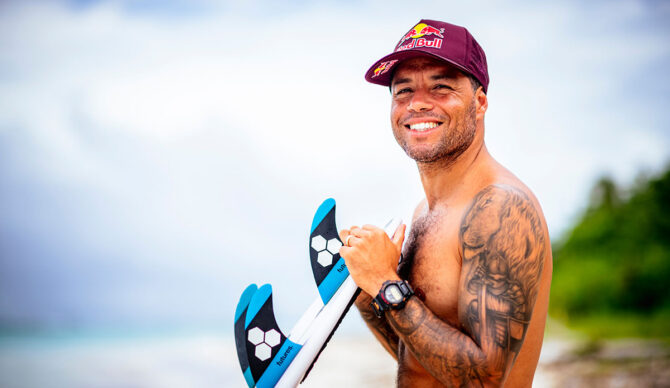
Adriano de Souza is a still a familiar face on tour, but in a different way these days. Photo: Marcelo Maragni//Red Bull

Ten years ago, Adriano de Souza stood on the podium at Pipeline as the new world champion. It was the end of a historic season — one of the most competitive in Tour history, with six surfers arriving in Hawaii still in the title race. Adriano sealed the deal by winning his semifinal and, with the world title already secured, went on to become a Pipe Master against Gabriel Medina, a world champion himself the previous year. A decade later, Adriano is again a familiar face on the Tour — but he’s on the other side of the rope.
Since retiring in 2021, Adriano has been building a career he never pictured for himself: coaching. After a solid experience within Italy’s Olympic program and a brief stint helping young phenom Erin Brooks, he is now fully focused on his work with Miguel Pupo, the very person who flipped the switch in his head.
Right after he retired, Adriano wasn’t thinking about coaching anyone — until he got a call from Pupo.
“Man, Miguel was the guy who really flipped that switch for me,” de Souza said. “When I retired, all I wanted was to rest. It was November 2021, I had just stepped off the subway in São Paulo, and he called me. I looked at the phone and thought, ‘What does Miguel want from me?’ He said, ‘Hey, I know you’re trying to rest, but I need your help.’ I thought, ‘Uh-oh… what now?’ He told me, ‘I really want you to be part of my team. I want you to help me.’ And I said, ‘Dude, I’ve never done this before.’ But he sparked something in me. He made me think, ‘Maybe I can go down this road.’”
That call planted the seed. Adriano asked for a year to study and prepare, and he meant it.
“During that time, I was more like a guide for him,”Adriano said. “But I started doing mentorship courses, too. Red Bull let me spend a week inside their football club to learn how coaches work with players. I had a great talk with their manager to understand how to deal with a group, how every person reacts differently, and how to motivate each one. I also spent time with tennis player Bruno Soares, which was amazing, because it’s a totally different sport with a completely different training mentality. And I was at the Praia da Grama wave pool working with surfers who didn’t have much experience, helping them progress. That was important for me, too.”
Adriano also revisited everything he learned during seven years working with Leandro “Grilo” Dora, the coach who guided him to the world title and who he still sees as his biggest influence.
“I learned so much from Leandro Dora — the way he talked to me, the things that calmed me down, the things that didn’t. Everything I know comes from those years with him. That’s where the real learning happens: living it, day after day.”
Add to that his time in Italy’s Olympic program, coaching juniors all the way up to Leonardo Fioravanti on the CT, and even a short collaboration with Erin Brooks in Saquarema when she was fighting for her qualification.
All of it paved the way for him to finally step fully into the role. In 2025, Adriano began working with Tatiana Weston-Webb — who later stepped away from the Tour after becoming pregnant — with Alejo Muniz, and Miguel Pupo, the latter of which, at 34, has had a late-career surge and is once again a tough out on tour, even against many of the CT favorites.
“Miguel was the guy who put me out there,” de Souza remembered. “He was the one who said, ‘I want you.’ He always believed in me. He’s the one surfer I don’t want to let go of. I don’t know if I’ll make every event — that depends on costs and everyone’s financial situation. But that’s why I say I’m committed to Miguel. One way or another, he’ll want me with him during the year.”
On working with more than one CT surfer at a time, Adriano is blunt. “It’s tough,” he said. “Really tough. You help someone win, then they meet in a heat, and only one survives. There’s no dual-win scenario.”
Still, Adriano doesn’t rule out having multiple surfers in the future. It all just depends on structure, budget, and the dynamic between everyone involved.
“Having one athlete is great because you can give all your attention to them,” he explained. “With two, you start dividing it. With three, it’s divided even more. In an individual sport, there’s a lot of ego involved. The coach has to put everything on the table and say, ‘This is what I’m here to work on with you. This is what I’ve been able to do.’ When things are clear, the surfer relaxes. Nothing’s vague.”
Adriano is only in his third year as a coach, but he already has international experience, a growing reputation, and invitations from high-level athletes. Not bad for someone who, not long ago, thought retirement would simply mean rest.
And while competing is no longer part of his plan — despite recently winning, at 38 years old, a stop on Brazil’s highly competitive domestic tour — helping others compete at the highest level still lights the same fire. Who knows, maybe we’ll see Adriano de Souza lift another world title someday — only from the other side.

