
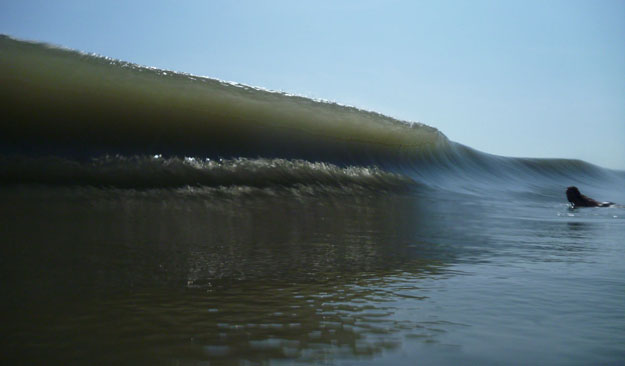
“If you’d told me a week ago that I would score these conditions in Colombia, I would’ve laughed at you.”

I’m writing this from a hammock. It’s strung between two palms brimming with coconuts on a deserted beach in South America. I’m facing away from the water while I type, thus strategically placing my head out of the drop-zone of said coconuts, lest one should fall and crack open my skull. More people die from falling coconuts each year than shark attacks. Behind me the waves look fun and punchy but the onshores are up and I’m surfed out. I’ve been here five days now and I’ve had 10 long sessions. The waves have hovered around the 2-3ft mark and I’ve been barrelled every day. If you’d told me a week ago that I would score these conditions in Colombia, I would’ve laughed at you.
I came to this place serendipitously, almost passed it up entirely. I was spending the night in Santa Marta, on the country’s Caribbean coast, headed for Parque Nacional Tayrona — Colombia’s most popular national park – the next day. The Lonely Planet guide promised ‘million-dollar views’ and virgin rainforest. With a couple of weeks to kill before my flight to Europe to reunite with my girlfriend, I thought a week lounging around the national park’s pristine beaches would suffice to eat up a big chunk of this time. I’d heard from a few people that there was surf in the park, but I wasn’t holding my breath. Hell, you can surf in Cuba or China if you really want, but I won’t be planning a surf trip there anytime soon.
Still, I decided I’d bring my board and fins, just in case. There is always a cute Canadian girl working at the hostel bar. By chance I mentioned to her that I was hoping to ride some waves in the park. She told me a new surf camp had sprung up just outside the national park’s boundaries where the beach and lineups were always empty. It was owned by some of her countrymen. Good waves in Colombia, at a surf camp owned by Canadians? Nothing about that sounded promising, but half an hour later, with nothing to lose, I was walking through the bustle and dead-fish stench of the Santa Marta markets to the bus stop – my red-bottomed bodyboard drawing curious stares from local vendors while my fins, dangling from my backpack, consistently knocked the legs of annoyed pedestrians.
Stepping off the cramped, sweaty bus an hour later, I was greeted by the sight of a dreadlocked guy standing on the other side of the road. After approaching him and asking in Spanish whether he spoke English, I knew I’d found a fellow Australian – the thick accent in any language we speak gives us away. He introduced himself with a nickname which, being from Australia, of course ended with an ‘o’. We spoke briefly and he told me the way to the camp, which was apparently a little hard to spot. He also described the waves nearby, adding that there was a spot not far from the camp which was ‘good for beginners’. That raised my hackles slightly. I’ve only met a select few white men with dreadlocks who don’t look like some sort of archetypical surf caricature.
I didn’t dwell on the issue because minutes later I was greeted by a white sand, palm fringed beach with punchy peaks as far as the eye could see, albeit only 2ft. I had a fun two-hour session that afternoon, even managing to make a dubious barrel. I went to bed content that Colombia’s waves had already exceeded my expectations, and the fact I’d ticked another country off the long list of those you’re able to get tubed in. One of the most unique feelings in surfing is that of being in the ocean alone, in a foreign country looking towards shore at new sand, scenery and landmarks.
The past four days have produced some of the most fun waves of my six-month trip through South America. After the small windy slop of the first day, the waves grew a foot. Each day they’ve been glassy for a few hours in the morning and in the hour preceding sunset. While they haven’t been of the size or consequence of other more fancied spots I’ve surfed in say, Chile or Peru, I would still rate Colombia as one of my most memorable surf trips. The water temperature is perfect (it’s warm but not uncomfortable, southern-Mexico warm) and there are no crowds (the most I’ve surfed with is three other people – the camp owner, his girlfriend and the dreadlocked Aussie). Plus, the fact most people never consider Colombia a surf destination (friends I was traveling with high-tailed it up to Nicaragua, after a week of boozing and debauchery in Medellin, thus skipping the Colombian coast altogether) means you garner automatic bragging rights if you score good waves.
I’ve been lucky. To get five consecutive days of good waves in the wrong season, in the already fickle Caribbean-side is no mean feat. But I think the parable of my experience is a well used one: you can’t judge a book by its cover. If I’d written off my chances of scoring waves and headed for the national park sans-board, I would never have experienced hollow tubes and buttered-rum sunsets. Likewise, if I’d held on to my preconceived notions about surfers with dreadlocks, my encounter with the Aussie by the side of the road never would have developed into the mateship it did by the time he left to catch his flight home yesterday. We’ve already talked of plans to catch up when I’m in Sydney next year for a beer and a session at the infamous Shark Island. I’m looking forward to that youthful excitement of being in the water at a foreign spot once more.

