
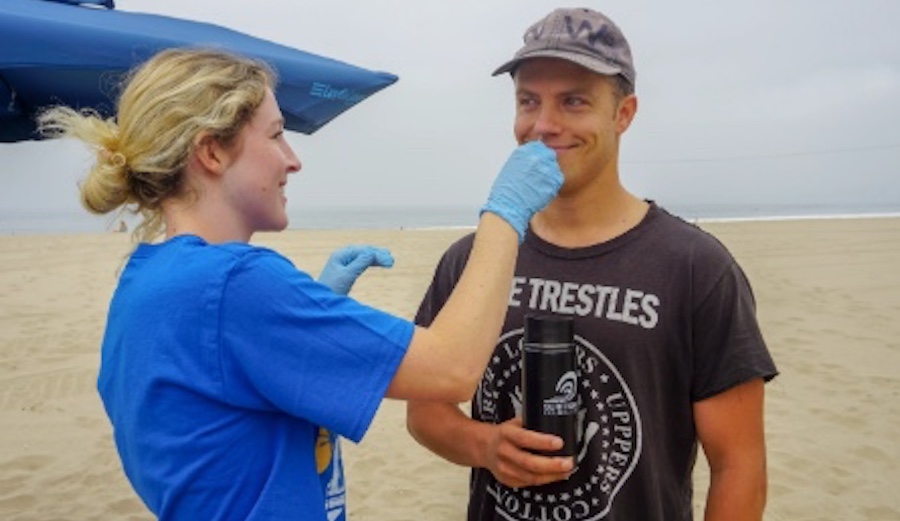
UCLA Ph.D. student Megyn Rugh swabs a surfer’s nose to test for the presence of superbugs. Photo: The Surfer Resistance Project

If UCLA Ph.D. student Megyn Rugh asks to swab your nose with a Q-tip as you walk toward the showers after a surf, don’t be alarmed. It’s just science.
Rugh is a member of a team of researchers led by Dr. Jennifer Jay, professor of civil and environmental engineering at UCLA, who are trying to understand the impact of so-called superbugs present in ocean water on human health. Their guinea pigs? Surfers.
“Surfers are an ideal population for evaluating the relationship between environmental exposure and [antibiotic resistant bacteria] and [antibiotic-resistant gene] colonization,” explains the website, called the Surfer Resistance Project. “Surfing involves a high frequency of submerging your head underwater for extended periods of times. Surfers are in the ocean year-round, particularly in the winter when storms occur, resulting in poor water quality due to urban stormwater contaminants.”
So what are these superbugs and why are Dr. Jay and her team so concerned with understanding them?
According to the Centers for Disease Control, antibiotic-resistant bacteria (or superbugs) are “one of the biggest public health challenges of our time.” Every year in the United States, the CDC explains, at least 2 million people get an antibiotic-resistant infection and of those 23,000 people die.
In 2013, the CDC issued a report identifying the 18 most concerning antibiotic-resistant bacteria. Among them, Methicillin-resistant Staphylococcus aureus or MRSA, and Vancomycin-resistant Enterococcus or VRE, two ARBs Dr. Jay and her team are currently testing for. MRSA is particularly nasty and can cause a variety of problems ranging from skin infections and sepsis to pneumonia to bloodstream infections, according to the CDC. VRE, on the other hand, can sometimes cause infections of the urinary tract or bloodstream.
Combined MRSA and VRE account for 12,500 deaths per year.
For over a decade, Dr. Jennifer Jay’s UCLA lab has conducted studies on various aspects of ocean water quality, but the recent emergence of superbugs as a major topic of interest among public health researchers and policymakers has led the team to shift their focus on superbugs in the ocean and their impact on human health. For the Surfer Resistance Project, she and her team partnered with the Surfrider Foundation, Sea Grant, and Heal the Bay.
“Recently our laboratory has been screening for two different antibiotic resistant (AR) pathogens in some local surfing beaches, including Venice Beach,” explains the Surfer Resistance Project website. “Specifically, we have detected MRSA and VRE, both of which are categorized as Serious Threats by the Centers for Disease Control. We have seen widely differing levels from beach to beach, and we are interested in how these and other pathogens may be affecting surfer health.”
Surfers, in this case, are the canaries in the coal mine.
The study launched last winter and has so far produced troubling results depending on what beach you call home.
According to the OC Register, data was collected at fifteen various Southern California beaches from Santa Monica to Imperial Beach, with the exception of Orange County due to funding limitations. Of the beaches tested, Venice Beach had one of the highest levels of MRSA.
Dr. Jay and her team are currently raising funds in order to broaden the scope of their research. And at time of publication, they had successfully raised over $2000 of their $5000 goal.
“We are in desperate need of lab supplies,” the study website explains. “We currently have funding to have 80 participants, and analyze for MRSA as well as three antibiotic resistance genes. With an additional $5K, we would also be able to analyze for vancomycin-resistant Enterococcus (VRE), which we also measured at our beach survey, and we would be able to increase the number of participants.”
The goal of the team’s research is a noble one. “The results of this important study will help us protect the health of surfers and other ocean swimmers,” the page explains. “In addition, this work addresses the issue of rising antibiotic resistance, which has been increasingly recognized as one of the foremost health challenges of the next generation.”

