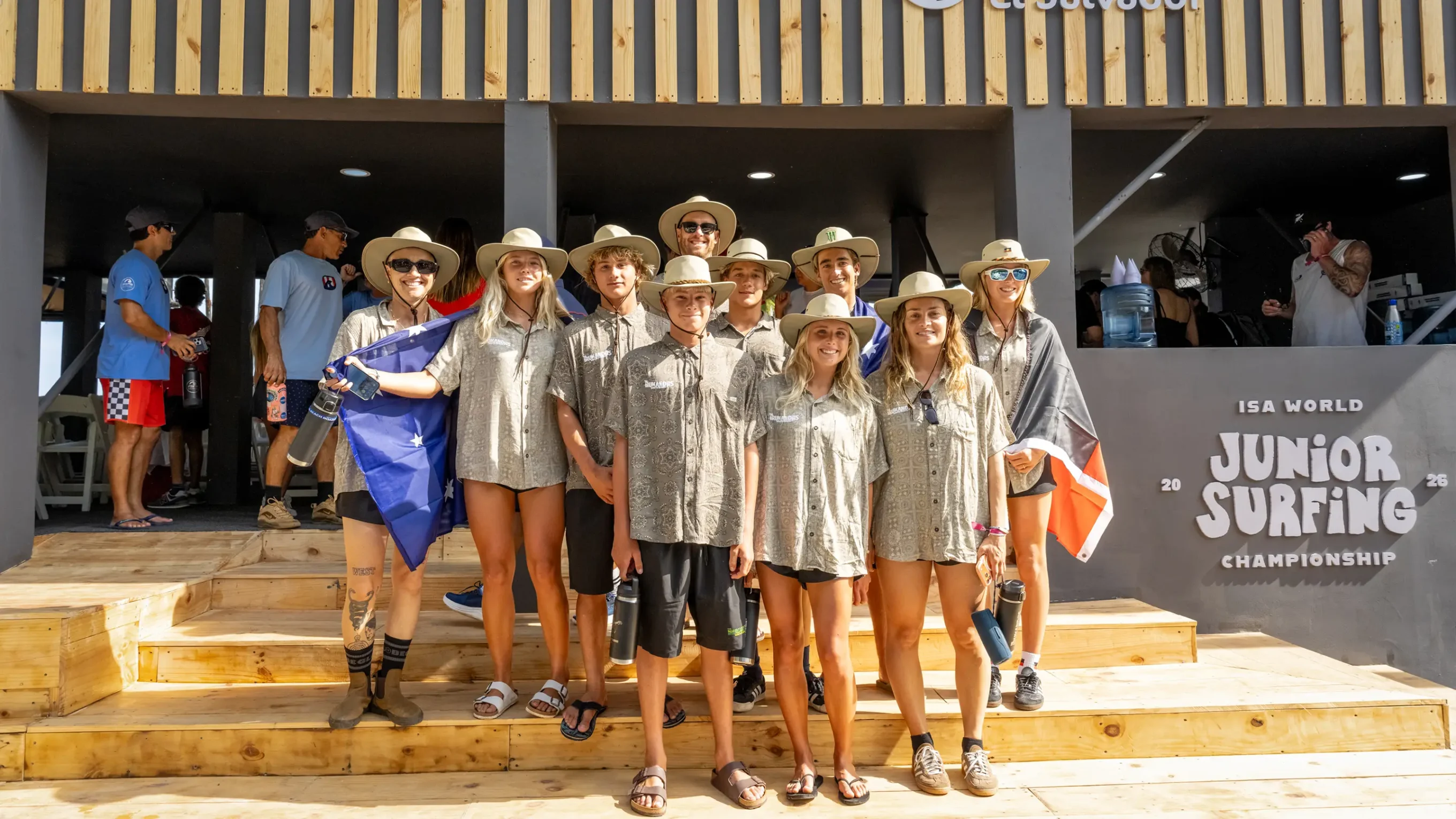
Whatever the Australian junior surfers are putting in their protein smoothies is working. Team Australia has won the last three editions of ISA Junior Championships, and, last month, the Aussies took home three of the four individual gold medals and six of the 16 medals overall.
The incoming surge of Australian talent mirrors the 2000s when young Aussie stars like Steph Gilmore, Tyler Wright, Owen Wright, Julian Wilson, and Sally Fitzgibbons emerged. However, the difference between the older generation and the incoming crew is the Olympics — more funding is available for surfers.
With 2025 revenue of USD $8.4 million ($12 million Australian dollars), the Australians are by far the best-financed national surfing federation on the planet, and the investment is paying dividends.
According to Peter-Rees Duncan, Surfing Australia’s pathway coach and head coach of the junior team, the federation’s abundant resources give young surfers a trove of opportunities to develop the physical and mental sides of the sport.
Around 45 surfers who perform well in the national rankings, at the Australian titles, or who receive a wildcard from Surfing Australia receive benefits. The perks include coaches, a nutritionist, strength conditioning, a sports psychologist, workshops, and access to a high-performance center on the Gold Coast. Funding is also used for training camps, surf trips, and wave-pool sessions.
“Inherently the Aussies are great surfers and very competitive,” Duncan told The Inertia. “You’ll have a crew that will be able to do it (regardless), but I do believe we’re having an impact on the success through that funding.”
While not every national surfing federation’s financials are readily available, the next-best funded federation is likely Brazil’s, which had revenue of USD $3.2 million in 2025 — less than half that of the Australians. In USA Surfing’s most recent financial documents from 2024, it reported revenue of USD $888,000 and a deficit of $41,000.
For years, some of Australia’s best surfers avoided ISA events. But in the Olympic era, the incentives and funding sources have spurred good results. Duncan says surfers need to learn how to compete in the four-person heats utilized in ISA’s week-long team-style events.
“The ISAs and the WSL grew apart, and the ISA journey wasn’t as relevant for (our) surfers,” Duncan said. “That’s why we probably didn’t invest so much time and energy into that space.”
Now “it’s the Olympic style format,” he added. “Everyone needs to learn how to compete in these events…and we’re obviously having success.”
For many, success in the ISA junior champs has often been followed by success on the Championship Tour or in the Olympic Games. Gabriel Medina, Filipe Toledo, Caity Simmers, Caroline Marks, and Tyler Wright all won ISA junior gold medals before becoming world champs. And of the 71 surfers who have surfed in the Olympics, 87 percent of them represented their nations at the ISA juniors.
“It definitely looks like we’re going to have a dominant push in the next couple of years on the Challenger Series, and then hopefully on the world tour,” Dunan said. “Once they get to the world tour, it’s a hard competition.”
Duncan pegs Locana Cullen, Ocean Lancaster, Dane Henry, Charli Hately, Lucy Darragh, and Ziggy Aloha Mackenzie as a few of the top youth who will usher in the new era of Aussie surfing.
Surfing Australia has started hosting national events at CT venues like Western Australia, Snapper Rocks, and Bells Beach to help the surfers prepare for actual venues on the tour. And before they compete in world championships, they do pre-event training camps where they not only work on technique, but also the psychological challenges.
“The psychological frame up that we’ll do in our camps seems to be really working lately,” Duncan said.
China has shown what increased funding can do to a surfer. They dumped money into a non-existent surf program and popped out an Olympian in less than eight years. And Australia has shown that a rich surfing culture, blossoming talent, and abundant resources are a recipe for success. The next test is whether the new batch of Olympic-era funded surfers can translate that success to the CT as they mature.