
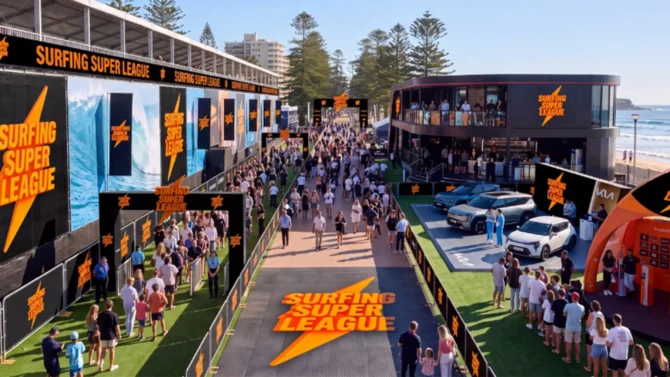
A rendering of an SSL event. Photo: Surfing Super League

Waves are fickle. Even the best breaks are highly dependent on the mercurial will of swells, winds and tides. All of which makes surfing a sport that defies organization. And yet we still try.
There have been many attempts to turn surfing into something resembling the kind of professional league seen in virtually every other sport. The big dog, of course, is the WSL. But there’s also the ISA, World Surf League predecessor the ASP, and an entire constellation of regional organizations across the globe.
According to Chris Mater, though, we still haven’t cracked the code. But he has an idea as to how to do it. “It’s not ‘The ISA is doing it wrong and the WSL or Surfing Australia are doing it well,’” he says, “I think it’s an inherent problem with surfing.”
It is a problem that Chris Mater is intimately familiar with. He encountered it as the CEO of Surfing Australia for seven years, and before that nine years with Red Bull. And his solution is the Surfing Super League, or SSL for short. The upcoming league has a number of key differences from what we’ve seen in the past – most notably a high-energy, team-based format tailor made to draw in television audiences. However, the organization also has loftier goals than just attracting eyeballs. As he sees it, the SSL could be a brand new pathway to the pro circuit, and a league that Australians can finally call their own.
But where does one even start when trodding such unstable ground? We sat down with Mater to find out.
What made you want to start the SSL?
I’ve worked in and around surfing for a long time and I was underwhelmed with what professional surfing is today. I just thought there could be a better version or a different version than what we have. And I was looking at the teams format that we surf here in Australia a lot, which they do at the amateur club level, and going “Wow, that’s a much better surfing format.”
What are the common pitfalls that surf leagues fall into?
I think generally there’s several problems with surfing as an entertainment product. The first and biggest one is the television – and it’s not one thing, it’s a whole bunch of things. They can’t schedule it, which doesn’t work for a broadcaster. When they do schedule it, it often runs at times where people don’t watch sport. That’s no one’s fault. That’s just how they’ve structured it to catch for the best waves.
Within the actual product itself, it’s one of the least “action” sports in the world. The action is catching the wave, and that’s about 80 seconds of a 35-minute heat. That’s a major problem, because there’s about 45 percent of the time where you’re watching someone do nothing. If you’re trying to attract casual fans or bring new people into the sport, they’re not going to watch people just sitting there.
I also think individual sports are much harder to create fandom around than team sports. In the NFL or NBA, when a player retires or leaves, the fans don’t care to some extent. They follow the team and the players come in and out. That’s a much better platform to build a sport on, because players retire and then you can lose the fans who follow them.
So you have a two-part problem, which is the fan investment and then the downtime. It sounds like the team event is your solve for both.
Exactly. Because we have four teams of four players plus a power surfer, you start and finish on the beach, and you’ve got unlimited waves, there’s no downtime. When you watch our game, there’s always something going on. Then the second thing is, you’re not going for an individual, we’re creating teams that people are going to get behind.
You said that the team format is very common in Australia. How did you draw inspiration from that?
What happens with surfing, I think, is that when you play individually, people will lose almost all the time to their friend who’s a better surfer. But when you make it a team event with four or five people, all of a sudden it makes it much more competitive, because even if the club up the road has the best surfer, they won’t have the second, the third, the fourth, and the fifth. You have much better parity of competition. That’s why it’s really popular in Australia.
Why do you think it’s important for Australians to have their own league?
It’s like America having all these amazing basketball players and no NBA. It would be mental. It’s the same for surfing. It’s actually surprising that there’s not an existing domestic league, because there’s so many great surfers. So it was really easy for me to look at the market, look at the amount of surfers, look at the product we have. When we build this, I think people look back and go, “Why didn’t we have this 20 years ago?”
Do you have any aspirations of trying to go international in the future?
We don’t have aspirations to take the Surfing Super League international. We want it to be the Surfing Super League for Australia (and likely New Zealand). But we do see a Brazilian domestic league or an American domestic league. We think the most likely expansion is a domestic version in other places.
Which other sports taught you the most about how you wanted your own format to be?
Definitely Indian Premier League and Big Bash cricket. They took something that didn’t exist and then they created a new league. They also took a long format and made it short, then created teams that didn’t previously exist with an identity, a brand, and a fandom. And they didn’t just do it in those markets, they did in India, Sri Lanka, England, America, South Africa, Australia.
We also watched NRL and AFL in Australia. And for business models, we looked at the NFL. So we studied how they make money, which sort of gave us that insight that television is the driver.
Then we looked at how to cover sport. Netball, for example, which is an Australian sport, they have a microphone in the locker room and they listen to the tactics the coach gives the players in quarter time and half time. I thought “That’s a nice innovation.” People will be quite surprised. They’ve seen some of the things that we’re doing because we’ve announced it, but there will be lots of other surprises when you watch our first games and how it’s covered.
Once you’ve drawn inspiration from other sports, where do you start with making a league?
You basically paper plan it. You think about all the things that need to be done in a business plan, the players, the format, the locations, where the money comes from. You look at benchmarks to see if they’re realistic, and you pressure test it. You talk to surfers, coaches, the surf industry – a lot of consultation. That was the first stage.
Then the next stage is to get a television deal. Because the whole thing is based on TV, like every sport. If we don’t have a TV deal, we don’t have a league. So that was our next step, which we did. Then as soon as you got the TV, that’s the gate to go get our sponsors and partners. That’s the stage we’re in right now.
What do you hope to change about the sport with this, if anything?
My son is an aspiring professional surfer and he has two pathways as an adult professional. He can be in the Olympics, which is a very small group of Australians and that only happens every four years. The other option is he can go on the world tour and win a world title – which is fantastic, we’d love that. But what we’re going to do is we’re going to build a third pathway, which is bigger, more relevant, happens annually, and more Australians can be part of it – which is the Surfing Super League.
It’s the equivalent of building the MLS. There used to be no MLS, and now there’s an MLS that exists, and now there are players, there are teams, there are contracts, there’s money, there are businesses, there’s community, the sport grows. In five years time, the Surfing Super League will be the most dominant thing in Australian surfing, we’re really sure of that. And that’ll provide value to hundreds of surfers. We think it’ll boost the whole Australian surf industry because it’s more relevant.

