
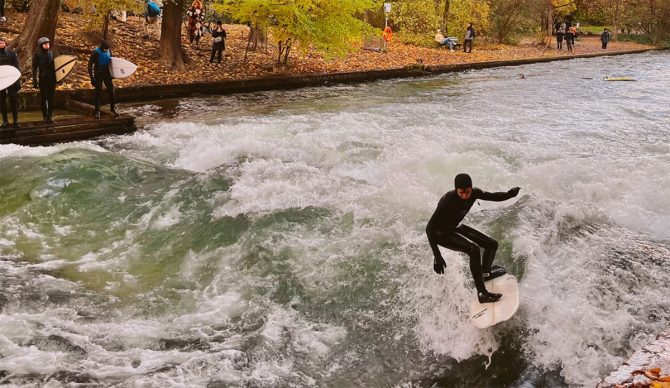
A surfer rides the now-defunct Eisbach River wave in Munich. Photo: Unsplash

The Eisbach has been the hub of German surfing for decades. Located on a 1.2-mile long man-made river that flows through the Englischer Garten, a public park in Munich, Germany, the man-made wave first appeared in 1972, after the city submerged several concrete blocks under a bridge to block the river’s strong current. Surfers quickly found the wave, at first in secret, and then openly when the city of Munich sanctioned surfing there in 2010.
In October, the wave suddenly disappeared.
As part of a city dredging project, engineers lowered water levels to remove potentially dangerous sediment build-up, which destroyed the wave. “It’s a whitewater wash now because, as you can see, the water that’s coming out from the two channels, it’s not finding any resistance after because it’s going down,” local surfer Alexander Neumann told NPR. “And then you have the backwater that’s coming. So that’s why it’s breaking in itself.”
Though the city has promised engineers are working on a more permanent solution to the problem, impatient surfers have repeatedly attempted to install their own DIY solutions to the problem. The first was a makeshift ramp on the river bottom, which was promptly removed by authorities. Then, on December 25, someone sunk a beam into the water to partially recreate the wave and hung a banner over the water that read “Merry Christmas,” as The Guardian reports.
The Christmas miracle was short-lived, however. As the local surfers’ association Interessengemeinschaft Surfen in München (IGSM) wrote on its website, city authorities promptly removed the beam three days later.
The fate of the wave remains uncertain. “The wave will likely re-emerge eventually on its own,” wrote the IGSM. “However, how long this will take, and whether a surfable wave will even form again 365 days a year without intervention, is completely uncertain.”

