
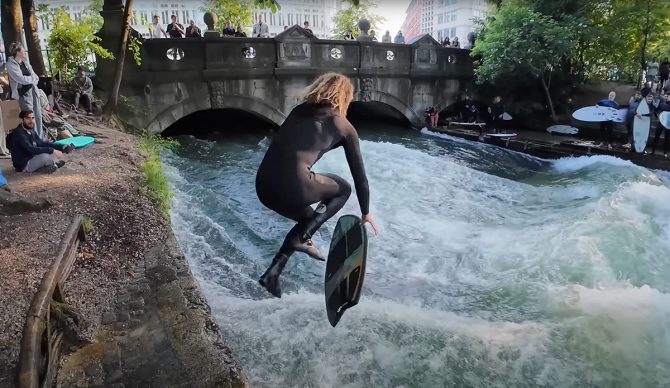
Blair Conklin drops into Germany’s most famous river surfing wave. Photo: Blair Conklin // YouTube

Though man-made waves are often decried as the sanitized alternative to the ocean, they are not without their own risks. A recent incident at the Eisbach river wave in Munich, Germany has led to the fire department closing the world-famous attraction until further notice.
The Eisbach wave, or Eisbachwelle, is a 1.2-mile long man-made river that flows through Munich’s Englischer Garten public park. The feature has been around since 1972, when the city submerged several concrete blocks under a bridge to block the river’s strong current. German surfers have ridden the resulting standing wave ever since, but river surfing in Munich has only been legal since 2010, when the city reversed a longstanding ban on the practice.
On Wednesday evening, a woman was surfing the wave, when she fell and her leash caught on the riverbed. The strong current prevented bystanders from freeing her for nearly half an hour. Finally, fire officials were able to rescue the woman, after which she was revived and taken to the hospital in critical condition, according to a fire department press release.
Since then, the river wave has since been cordoned off and marked with caution signs, as EuroWeekly News reports. There is no word yet from City officials as to when it may reopen, but they emphasized that they would be reviewing safety measures before doing so.
In 2022, a 17-year-old surfer drowned in the standing wave in Bend, Oregon. Ben Murphy died after his foot became entrapped in the shaping devices used to form the wave in the Deschutes River.

