
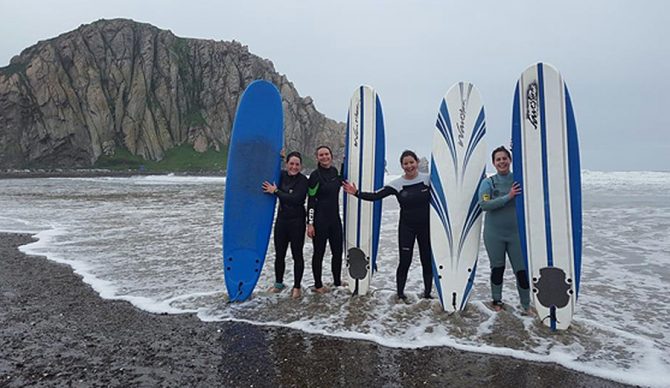
The birthday crew after one of our surf sessions.

My wife, Suzanne, and I have a tradition of going big for birthdays. We’ve skydived, we’ve done a polar plunge. We even built an igloo once when it was negative forty degrees, all to have a birthday sleepover. My birthday was no exception this year; we decided to celebrate by planning a surfing and camping birthday getaway.
Morro Bay, California was the destination for our adventure. We’d been to Morro Bay in the past and loved its welcoming atmosphere and gorgeous beaches. So we gathered a group of about ten loved ones and made the journey, braving the brisk February beach weather to camp.
We were in Morro Bay to do exactly what the Sierra Club mission encourages everyone to do: explore and enjoy the beauty our natural environment has to offer. But unfortunately, hate got in the way.
Our surfing lesson was incredible. Afterward, our adrenaline was rushing from the crashing of waves and the attempts to get back up to our feet time and again. It wasn’t long before our stomachs were rumbling, so we decided to pass on making dinner back at camp and head into town for dinner instead. We stopped at a restaurant where we had eaten the night before with live music and dancing. Spirits were high and we started to dance. It wasn’t until the third song that things took a turn for the worst. The lead singer on stage started making crude comments into the microphone, targeting those of us that identify as LGBTQ. It took us less than a minute to start walking back to our table but the comments kept coming. I couldn’t make out all the bandleader’s remarks, but “redefining marriage,” “forcing your agenda,” and “”they are always shoving it in our faces” were all strewn into the hateful barbs. It was all a bit of a blur as I tried to shut out the negativity and hate. We asked for our check and the bandleader continued to follow one of the couples from our party into the dining area, keeping up his barrage and by this point screaming and shouting.
I sought out the manager, who was quick to defend the band, claiming that “being offensive” was just part of the act. They also offered that we were free to leave if we were uncomfortable. A festive mood had been broken by misogyny, homophobia, and hate. We gathered our things, subdued and disappointed, as restaurant patrons walked up to the band leader to praise his efforts and to compliment the band’s set before the night was ruined by “them.”
I can’t make it past my front door without one of my identities. They are what make me who I am – even when I am on a weekend getaway to explore and enjoy the ocean. ”Them” is what my wife and I are often reduced to. We are people who are continually forced to look over our shoulders in fear of our own safety. We are women who bite our tongues when passers-by shout lewd comments for no reason other than we were walking by on the street.
It is hard not to wonder whether this would have happened before last year’s election – before people felt empowered to act on their hate thanks to our new political climate.
The trip was still a great adventure, but the experience made me reflect on the deep connection between our environment and social issues. As Director of Equity, Inclusion and Justice at Sierra Club, I often hear the question: why does Sierra Club support Black Lives Matter? Or immigration? Why do we speak out on LGBTQ issues? Or call out oppression where we see it?
This story is my answer to that question. How am I supposed to enjoy and explore the planet when people with similar identities aren’t welcome in many communities? Must I only explore and enjoy the parts of the planet with progressive social values that practice acceptance or tolerance? We were in California for our surfing trip, so my options would be pretty limited if I only explored places where I’m guaranteed not to experience harassment.
The Sierra Club’s mission statement calls on all people to “explore, enjoy and protect the wild places of the earth” and to “protect and restore the quality of the natural and human environment.” But people with marginalized identities can’t enjoy the planet if our human environment is toxic and unwelcoming.
I can’t leave my identity behind when I go surfing, camping, biking or hiking. My identity comes with me everywhere I go. I bring it with me every day when I come to work at the Sierra Club. It helps me see what might be invisible to others – the hatred and intolerance that keeps people of color, LGBTQ people, and others with marginalized identities away from spaces where we don’t feel safe.
A writer named Rahawa Haile spoke powerfully about her experience being one of the few Black women ever to hike the entirety of the Appalachian Trail. She told Atlas Obscura that she had once had to stay at a hostel along the trail that flew a Confederate flag, saying “There’s hiking the trail, but there’s also having to go into trail towns. You need food, you need to do that laundry. It’s not the trail that’s the problem with the trail. It’s what it’s like to be bothered in places that don’t expect to see you.”
I’ve been there. My wife and I have conversations all the time about our outdoor adventure plans that include planning for our safety and analyzing the cultural and political context of our destinations. These are conversations our straight, white cis-gender friends aren’t forced to have or even consider. But I won’t let hate stop me from exploring and enjoying the planet. I’ll keep surfing (maybe in warmer weather next time). And I’ll keep working to make the Sierra Club and this nation a more welcoming and inclusive space for people of all identities.

