
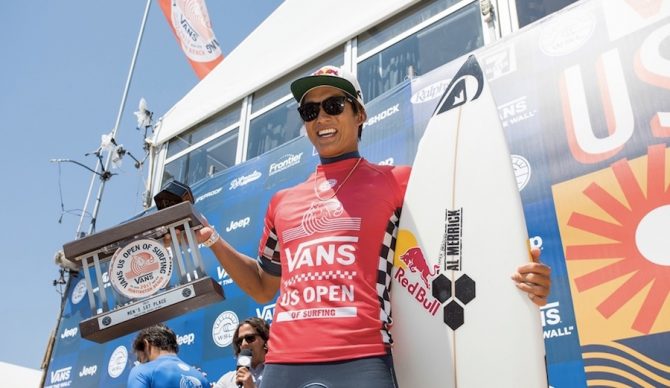
Kanoa Igarashi won the US Open in his backyard this weekend. But not before a controversial heat against Filipe Toledo in the semis. Photo: WSL/Morris

Local boy Kanoa Igarashi celebrated his first Vans US Open victory on Sunday in front of a cheering crowd of thousands. “We did it we did it!!!! HB I love you guys! What an amazing day, thank you everybody who took part of this, you guys all know who you are. The best day of my life,” said the 19-year-old in an Instagram post.
But Kanoa’s win wasn’t without controversy. In what was essentially a redux of Round 3 in Brazil, the judges called an interference on Filipe Toledo in his semifinal heat against Kanoa. It cost him the heat.
Filipe was visibly upset. And for good reason. In spite of his disqualification from Fiji, he sits no. 7 on the Jeep Leaderboard. Had it not been for his interference against Kanoa in Rio, one could argue, he’d be in serious world title contention. Maybe number one. And for the second time in a row he couldn’t get out of his own way. Or this kid from Huntington Beach wouldn’t get out of his way – depending on how he sees it.
But talent alone does not a world champion make. Two man heats are as much strategy as they are displays of ability, which brings us back to the most recent interference call.
According to WSL Head Judge Richie Porta, the call against Filipe was straightforward. When there’s a defined peak offering a left or right, the surfer closest to the peak has priority. In this case, it was clearly Kanoa. A straight on angle of the wave proves as much.
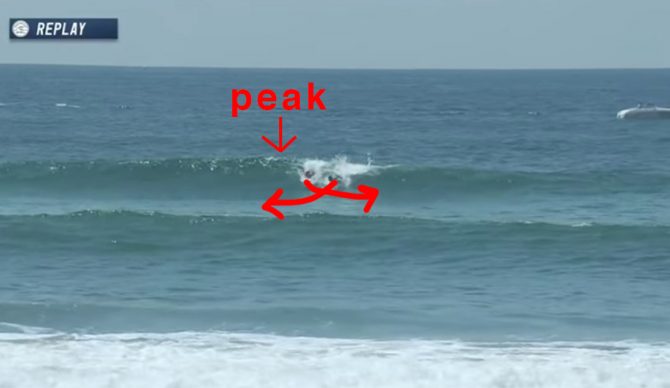
Crude photoshopping not withstanding, this front angle clearly shows a defined peak to Kanoa’s right.
But the text of the WSL rule book is a little less clear. Article 147 states the following interference rules for non-priority: “The Surfer deemed to have the inside position for a wave has unconditional right of way for the entire duration of that Ride. Interference will be called if during that Ride a majority of Judges determine that a Surfer has hindered the scoring potential of the Surfer deemed to have right of way for the wave.”
And more specifically when it comes to defining priority at a beach break with one peak the rule book states, “If there is a single well-defined peak with both a left and a right available, at the initial point of take-off and neither the right or left can be deemed superior, then the right of way will go to the first Surfer who makes a definite turn in their chosen direction (by making an obvious right or left turn).” Here, one could argue, Filipe made the first definite turn.
The judges ultimately decided, with one vote of dissent, that Filipe committed the interference against Kanoa and not vice versa. Critics will likely call Kanoa’s US Open win into question, or at the very least say the rule needs to be changed. But if Kanoa knowingly goaded Filipe into an interference situation, he deserves the win just as much as Filipe, if not more. Why? Because he understands the rules enough to leverage them against a fellow competitor. It’s just good strategy.
Part of what makes competitive surfing exciting is exactly what pisses people off the most in moments like these – that the most talented surfer doesn’t always win. On talent alone, Filipe might be the best surfer in the world. But being aware of the rules and using them to one’s advantage in spite of a potential talent deficit and a fading swell, that’s called working with what you have. And leveraging that against your opponent? That’s the beauty of sport.

