
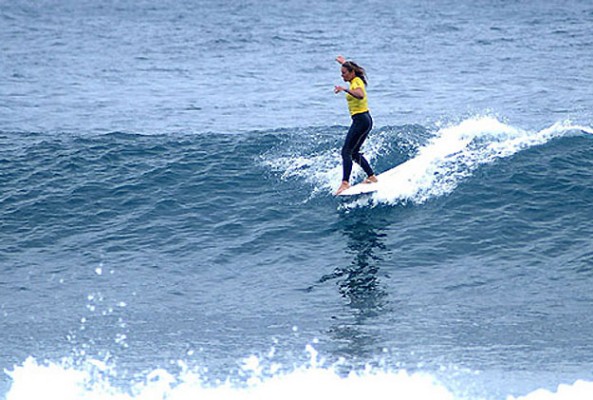
Cori walks the walk. Photo: Cerda

My research through layers of surfers led me to the most outspoken one of all: Cori Schumacher. I was blown away by how kind she was and willing to talk in depth about surfing. She is many things: a straight shooter, open, honest, eloquent, well-spoken and educated. It’s obvious she could do a lot of good for this world with her logical but groundbreaking advice.
I had to seek out this woman for an interview. She is one-of-a-kind, very smart and sophisticated. I learned a lot from the interview–some of it was about the business of surfing. I also learned what surfing is really like for someone who lets themselves be in the moment. We need women like Cori to speak out more and open up about surfing. Someone who is not afraid to be true to themselves. In the end, her message was simple: get out on the water.
You’re quoted recently as saying, “I have taken some hiatuses from surfing, but even in these times, I could feel the ocean moving deep within me, directing my thoughts, my emotions, my perceptions. Riding waves, understanding in my sinew and bone how energy moves, being able to tap into the momentous emotional/mental/physical unity that surfing demands is my worldview, my ideology.” What is it like to be out there in the ocean since you feel it calls to you? Is it beyond explanation?
Being in the ocean for me is a return to the source–of life, of inspiration, of creative forces. Surfing itself is not a lifestyle, a religion, or an identity for me. It is not some static noun or some space I situate myself within. It is a moment of indwelling and expansion of being, a dissolution of self, when “being” becomes a verb and the moment expands to allow inspiration’s extended breath into and out of a vacuum most often occupied by a claustrophobic, self-monitoring awareness. One example I can give of a similar sensation is that of an artist in the act of creating. Surfing is not art itself (perhaps for an observer it is) but the connection that allows the creation of art to flow through one’s body. Or the act of meditating, which is not itself a religion but is the act of clearing the space within to allow connection to an infinite, flowing source.
Like creating art or meditating, surfing has a tremendously long, and often frustrating, learning curve. It takes a lifetime of dedication and commitment to surfing with no cemented, objective end-goal that makes this such a unique effort. There are no shortcuts. There is no end. There is only the birth of the learning itself for the individual and the conclusion of this individual’s experience come life’s own cessation.
The ocean is constantly changing and every wave is a distinct and shifting sub-set of the ocean’s fragmenting (tides, currents, sea-floor configurations, winds) that demands intuitive attention to flux. This is learning to ride chaos. This parallels living, not as ultimately explainable, formulaic, or even inherently teleologically meaningful, but turbulent, unpredictable, even uncaring: in a constant state of flux despite us. What we bring to surfing shapes our experience of it and so it becomes a mirror of sorts for a time before the inrushing experience which is the surrender of one’s will to that of the ocean’s motions. Even then, we have more to receive. In a word, surfing is transcendent.
Is it beyond explanation? Yes, and therefore all the more important to attempt to explain our experiences in as many ways and as uniquely as possible. There are as many descriptions and explanations of surfing as there are waves in a lifetime multiplied by the number of surfers living and passed multiplied by the amount of surfers in their various stages of experience. All of them valid.
What are your plans in surfing since you stopped in 2011?
Since I stopped surfing competitively in 2011, I have refocused my surfing on enjoying the experience of riding waves and simply being in the ocean sans expectations of performance. I have returned to riding a variety of equipment as I did when I was younger and have begun to focus more on body surfing and single-fin log riding.
As a competitor, there was a certain self-awareness that I couldn’t release when I surfed with others in the water, even when I was simply free-surfing. Expectations get in the way of enjoying surfing, even when they are the expectations layered on by oneself. It has taken me some time to peel these layers back and re-learn an innocence that I haven’t felt in awhile when surfing. I plan to continue to develop this relationship with surfing the activity and to remain open to learning all that I am able through this passion.
You have really opened up about the surfing industry and I learned a lot about the way women are viewed. It is shocking how much women get paid and how little they are respected. What would you like to see in the near future in surfing? Do you think things will change?
I have two different feelings about the future of surfing for women with regard to this question. The two lines of thought emerge from surfing as a business and surfing the activity.
For surfing as a business, what I would really like to see are more women in the board rooms and as CEOs of surf companies, surf media, and the ASP who have a clear understanding and desire to change how women and men are used to sell product and surfing as a lifestyle.

