
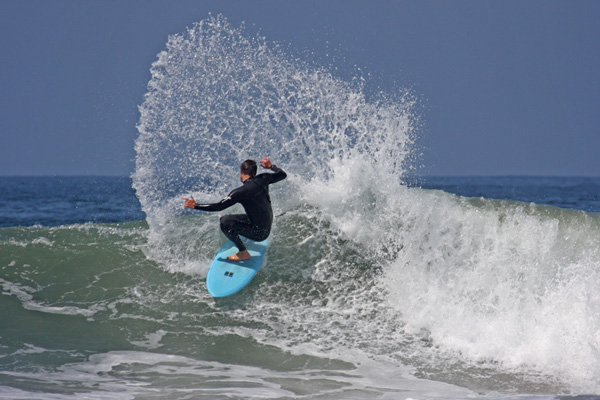
Mark Jeremias tears into one. Photo courtesy of Mark Jeremias

SMASH is one of the coolest things to happen to New York in a long time. And New York is a big place with a lot of things going on. SMASH, as much an acronym as it is a production company, stands for Surf / Movies / Art / Shaping / History. It also stands for the preservation of the roots of surfing and surf culture. It does that through publicly showing a body of work–be it film, art, shaping and/or history–to the greater surf community in order to educate its members on surfing’s roots while staying current and appealing to contemporary surf culture. It serves to represent the evolution of the founder’s projects–one of which being the New York Surf Film Festival.
Mark Jeremias is a part of the all-star cast of curators at this year’s SMASH Fest. Born in Germany and raised in California, he is well known for producing and directing One California Day among other impressive film projects. With plenty under his belt, he is a solid choice as a SMASH Fest curator. With so much experience and a keen set of eyes on the SMASH panel this year, if you’re in the area, you don’t want to miss the event. Tyler Breuer and company have put together a seasoned group that will give viewers quite an experience.
-Reid Levin, The Inertia Assistant Editor
In your opinion, what makes SMASH unique? Why is it different from other surf film festivals?
I think what makes this festival unique is that from inception the focus was always on celebrating the filmmaker and providing a unique platform to showcase their work.
Can you give us an idea of what it’s like to work on this film festival? What made you want to jump into that?
I still really believe in the importance of independent surf filmmaking, which unfortunately is getting lost in the age of free branded content. So when Tyler laid out his plans for the festival and asked if I wanted to get involved as a curator, I jumped at the chance. As curators, we were given the assignment of screening all of the submissions, which really was a treat, as there were a number of films that I probably would have never discovered otherwise.
What makes surf cinema unique?
I think what makes surf cinema unique is the independent spirit of the whole thing. There are so many different approaches to making a surf film–from films that focus on action or adventure, to those that are more experimental or focused on telling a story. There is no right or wrong, just different ways to capture and interpret what surfing is.
What is one thing that will blow the minds of this year’s SMASH attendees?
I think at the end of it, all people will appreciate the quality of work that makes up this year’s festival. There are some beautifully shot films and some really impactful stories–stories that speak to surfers and non-surfers alike.
Where do you think surf filmmaking is heading in the future? Paint a picture for us.
There is a really big shift in surf filmmaking (and independent filmmaking in general) that has been happening for the past couple of years–the first part being a move away from DVD to digital distribution. Secondly, a move by the major brands to produce and distribute free content. Couple that with the large amount of free user-submitted content being put up on websites and blogs, and you have a pretty difficult environment to monetize and actually make a living making surf films.
The move to digital distribution will ultimately prove to be a positive by opening avenues of self-distribution to a global audience without the high cost of maintaining inventory of DVD’s the same way that it did for the music industry. The harder part will be convincing consumers to spend money on content when so much of it can be accessed for free. That’s where it will really come back to the quality of the work and the filmmaker’s ability to produce impactful work that resonates with an audience.
I am hopeful that surfers will continue to support the independent films that get made. In my opinion, they tend to be the best ones!
With recent developments in technology, like the GoPro for example, do you think it will help or hinder surf films? How?
I think any advancement in technology can be looked at as a positive. At the end of the day, technology is nothing more then another tool available to the filmmaker. The technology itself does not make for a great film. It still requires the filmmaker to use the tools appropriately to help convey a feeling or their intended message.

