
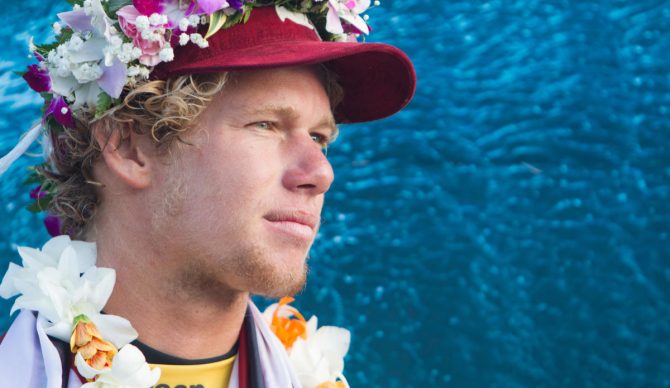
John John Florence of Hawaii celebrates becoming a 2X World Champion at the 2017 Billabong Pipe Masters. Florence dreamed of winning a World Title in Hawaii and that dream became a reality when he backed up his 2016 World Title. Photo: WSL / TONY HEFF

When John Florence won his first world title in 2016, he and the rest of the surf world took a collective sigh of relief. At 24-years old, he’d avoided falling down the path of unfulfilled expectations a-la Taj Burrow – the same road we fear Jordy Smith may go down. Florence had been crowned and nobody would ever be able to take that away from him.
Rumors about him wanting to spend the next year sailing to each CT tour stop paired with his humble, sometimes indifferent attitude made me believe he’d more or less take 2017 off while haphazardly going after a repeat. The year certainly started off with the right ingredients: The Jurassic Park trio of Kelly, Mick, and Joel was lined up for one more title run before retirement. Filipe Toledo seemed eager to prove himself worthy. Medina needed to show his 2014 title wasn’t a fluke. The tour had a coached, improved, and now proven Matt Wilkinson who’d worn the yellow jersey for a significant portion of 2016. And of course who could forget Jordy Smith, who can’t risk another year of aging without winning a title?
In spite of all that, JJF ended up taking his second title. And it didn’t even seem like he was trying. How scary (or impressive) is that? A man takes back-to-back world titles without even appearing to try. What would happen if and when John John really puts his foot on the gas pedal? To this point, he’s made it look easy. But was it?
In order to answer that, I decided to put hunches, emotional interpretations and admiration aside so the numbers could tell the story. Taking a look at figures from 2010-2017, I wanted to see what was unique about JJF’s title campaigns when compared to the championships of other surfers in the same era. Sure, we could look back further, but with the new points system taking effect in 2010, it’d be like comparing apples to oranges in this context. Another apples to oranges hiccup I found is that some tours consisted of 10 stops while other years featured an 11-contest campaign. Nonetheless, the numbers can still tell us a story of each Championship Tour winner.
The first thing to understand is that the WSL’s points system is a zero-sum game. There are a set amount of points on the table and the only question is to ask who they will be distributed to. When Competitor A takes more points, Competitor B is left with fewer. When there are more than two contenders (and there are more than 30 on the WCT), any points you fail to take off the table (and are distributed to surfer X), may still positively affect your ranking (by the sheer fact that they were not distributed to surfer Y).
This leaves us with a short list of scenarios to describe how surfers win titles:
The Meteor:
This champion is constantly taking the most points off the board, making it impossible for anyone else to keep up. This title may seem like a walk in the park.
The Grinder:
Most points are distributed among an elite group of competitors and the Grinder has to be the best of the bunch, fighting for every point as if their life depends on it. It is very likely we’ll see the Grinder facing a win-or-die scenario at the end of the line.
The Observer:
Points are distributed in a granular way amongst a larger group and eventually, a single contender will stand out amongst the herd. It can be interpreted that this champion is given the title by others as opposed to being forced to win it themselves.
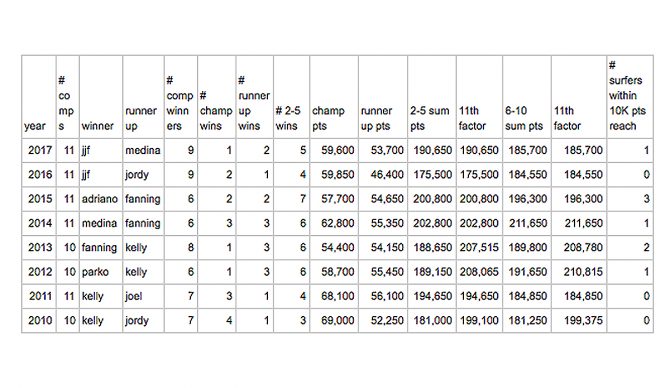
Kelly’s 2010 title stands out amongst these scenarios, as he made it look like a walk in the park. Slater won four out of 10 contests in 2010 while six other athletes won the remaining contests. Translation: no one but Kelly won more than a single contest. The rest of the top five combined for three wins, leaving Kelly with a tremendous number of points and the second-place finisher 17,000 points behind when it was all said and done.
Kelly’s 2011 title race was a similar walk in the park.
It starts getting interesting with Parko’s win in 2012. He took it with just a single win but compiled a long list of strong results, including four total finals appearances and three other contests in which he made it to the semis. His throwaway results were a fifth and a ninth, while his closest challengers took six wins. A mere 3,000 points gave him the title and the distribution of points in his rival group was insane. It was very hard to win points as a low seed in this season. It was a textbook Grinder title. Parko had to fight for each point against an elite top tier of surfers within reach of the title.
Mick’s 2013 was very similar. Oh did he ever work for it. He had a herd of hungry competitors chasing him but was finally able to nab the title by a mere 250 points.
In 2014, Gabriel Medina vied for one of those Meteor campaigns with three wins but his rivals didn’t let him run away with it. He may have had some help from the field ranked between 6th and 10th, who ended up taking points away from his closest rivals in the top five. He won that title by a 7,000-point margin but you could still classify Medina’s 2014 title as a Grinder.
By the numbers, Adriano’s 2015 title was the toughest grind. As many as three contenders finished fewer than 10,000 points from the top spot, having won seven contests among them. Looking at the distribution of points, this would appear to be the toughest year to win a title, so kudos to Adriano. He is the mother of all grinders.
And that brings us to John John. According to the numbers, his 2016 title was much easier to win than 2017’s. According to the numbers, Florence faced a weaker field of runner-ups in comparison to other champions. Points were distributed further down the rankings with three wins going to athletes who finished lower than 10th on the leaderboard. This is the same year Keanu Asing won in France yet still failed to requalify for 2017, falling to the WQS. You may remember John John wasn’t even in the water when he secured the title in Europe; Conner Coffin eliminated Jordy Smith from the title race, leaving Florence with no win-or-die moment in 2016. In the literal sense, John John was able to sit back as an observer, doing what he needed to win his first world title.
Though 2017 was a bit tougher, he still wasn’t left in position for a heroic do-or-die moment. Too many points were distributed to low seeds this season. For the most part, this left John John as an observer while the title was won with a lack of significant threats to his lead. And again, Florence wasn’t left to win the title in a heat himself, instead, watching as Gabriel Medina was eliminated in the quarterfinals of the Billabong Pipe Masters. Another Observer title.
Now, winning an Observer title doesn’t make someone less of a champ. It’s simply not the glorified and glamorous way we envision championships. I adore John John. His surfing is divine. But the numbers suggest his titles are coming a little too easy. Kelly rode meteors to his latest titles while John John has more or less observed them. And personally, I want to see JJF fighting his way to a title. I want to see him grind. I want to see him survive a win-or-die moment.
Then again, these aren’t things we can ask John John Florence to provide us. It’s up to his rivals to step up and, well…be rivals. The WSL tells us it takes a tour to make a title. I say it takes a rival to make a title. And to this point, John John doesn’t have any.

