
Editor’s Note: This piece was made possible by our friends at The Frynge, providing funding and exposure for professional athletes in action, adventure, and Olympic sports.
Graham Ezzy
In 2004, Graham Ezzy missed qualifying for the Windsurfing World Cup in Maui by one spot. The average age of the field was about 28. Ezzy had just turned 14. He went to school the next day playing back the performance in his head, trying to find an answer to where he went wrong. The gut punch vanished when Ezzy’s father picked him up that day before lunch. He told his son that one of the Europeans had dropped out of the event, and a spot had opened up. He was pitted against the sailor ranked second in the world, and he won. Defeating the elites as a high school freshman, Ezzy was beginning to etch his name into the sport of windsurfing.
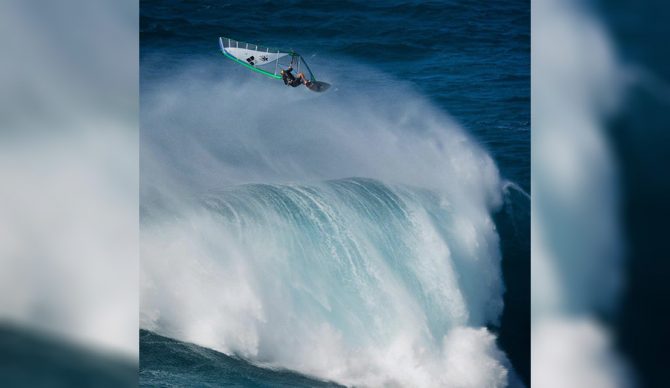
Growing up in Maui, Ezzy watched the World Cup long before he competed. As a kid, he marveled at the stalled forward loop, a high-flying trick where the surfer stays upright and whips 360 degrees just before smacking the water. “I was really impressed with the jumping,” he says. At age nine, Ezzy surfed and messed around on the boogie board before he tried his hand at windsurfing at a summer program. Not until two years later did he begin to take it seriously. Even though Ezzy dove competitively in high school, windsurfing ultimately took the reins. “Every day after school, I would train at Ho’okipa Beach until it was dark,” he says.
David Ezzy, Graham’s father, holds a prestigious spot in the sport. In 1983, David launched a custom sail business out of an old shed. Now, he runs a state of the art 20,000 square foot factory out of Sri Lanka dedicated to producing high-quality sails in an epic work environment. Despite his legacy, David never pushed his son to windsurf, gave him gear, or spoke to a sponsor on his behalf. “Only once I was into it, did he coach and encourage me,” says Ezzy. Building on natural talent, Ezzy embraced the higher speeds of a windsurfing board, as opposed to a traditional surf board. “I generate my own speed, and don’t need to be towed into a large wave,” he says. “Wind surfing comes alive in the big waves.” Once the board lifts off the water, Ezzy takes control with the sail. “Jumping and big waves are the two best parts,” he says.
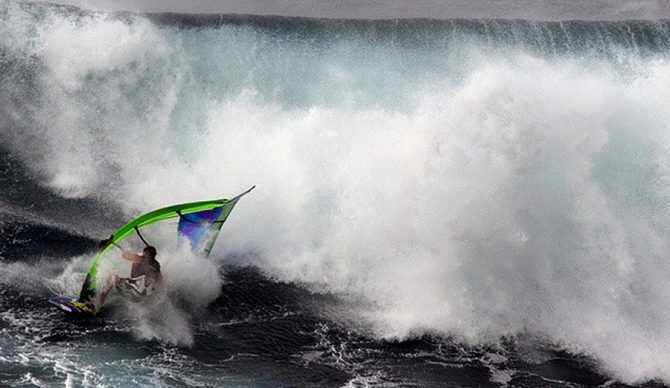
The Mecca of windsurfing, Maui allows for plenty of big waves and gaping heights. The sport spawned in California, moved to Oahu, then matured in Maui. With most of the major competitions in Europe, Ezzy surfs as the only Hawaiin on tour. “A lot of guys don’t see the point in competing because the conditions are so different than Hawaii,” he says. “The tour isn’t a good representation.” In Hawaii, the waves climb higher, crash more powerfully, and the wind blows from the opposite direction of Europe. A surfer’s orientation changes with the wind. “It’s always at your back,” says Ezzy. Because of rivaling wind patterns, a Hawaiin windsurfer must relearn every skill with the opposite foot forward to compete in Europe. “Imagine throwing a baseball with your right arm your whole life, then someone ties it behind your back and tells you to go pitch,” he says. “It’s like that.”
Graham Ezzy
Learning to surf from both sides, Ezzy competed in half the world tour at fifteen. He clawed for top five finishes but consistently placed outside the top ten. As the youngest surfer on tour, he felt out of place. Ezzy struggled to win against adults but had been barred from junior competitions because of his world tour status. Refusing to fold, he trained summers in the Canary Islands before enrolling at Princeton University. “A lot of people expected me to compete full time instead of going to school,” says Ezzy. He only applied to top universities and would focus on windsurfing if he received no acceptances. Once he was accepted to Princeton he transplanted his Hawaiin surfing style to the East Coast. Ezzy flew back to Hawaii five times per year to windsurf over breaks. During the school year, he followed the low-pressure systems to Outer Banks, Cape Hatteras, and Long Island. He easily burned through the maximum allowed absences each semester while juggling touring, an English major, and rowing. He practiced with the lightweight rowing team for two hours every day, before stopping after sophomore year to focus on windsurfing. Had NCAA rules not conflicted with his professional windsurfing status, Ezzy would have tried to walk on to the rowing team. “It was a balance of extremes,” he says. “I would take a long weekend to focus on windsurfing, then take the same amount of time for school work.” Rarely did the two collide. “Once, I had to write my final papers while at a competition in Japan,” he says. “If I had to go one day longer past graduation I would have gone crazy.”
Out of school for a few years now, Ezzy windsurfs full time. “I like how I’m living,” he says, “but I’d like to do better. I’d like to win world cups.” In windsurfing, luck swings a heavy hand. The ocean gives and takes wind and waves without any regard for hard work. Physical payoffs of uncontrollable forces, the waves reward some rides and dismantle others. “Sometimes when I’m not prepared I’ve done well, and when I’m very prepared the luck hasn’t gone my way,” admits Ezzy. “It’s not like I can’t express my ability, but it’s frustrating feeling like I can’t have a clear link between ability and ranking.” Struggling to find satisfaction after certain heats, he turns to freesurfing. Taking on waves outside of competition creates a balance in the sport born from recreation. “It [freesurfing] definitely lends itself to a meditative, in-the-zone state,” he says. “At the end of the day, all we do is go around in circles, then come in.”
Note: From June 26th through July 9th, 10% of your purchase of any product at The Frynge will go towards supporting Graham Ezzy. For action sport disciplines like windsurfing, funding doesn’t always come easy, and elite athletes often times have to incur large personal costs to compete at a high level. The Frynge is proud to provide a platform that allows readers and customers like yourself, to have a direct impact in supporting athletes like Graham. So be sure to check back each week for new stories, gear and apparel!

