
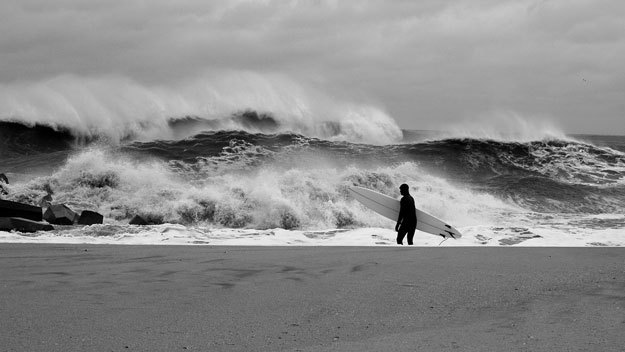
Professional golfer Bernhard Langer once said, “A wrong decision is usually less disastrous than indecision.” In other words, "Go!" Jenks. Winter of 2007. Photo: Adam Lindstrom

Metacognition is all about considering one’s thought process and developing actions through analysis and self-reflection. What do I need to do, to research, to learn in order to achieve goals or solve specific problems? In my everyday pursuit of teaching Earth Science, I attempt to facilitate metacognition. It is often a daunting task. But it got me thinking about how surfers consciously or subconsciously reflect and make decisions. Surfers are a unique group that is continuously reflecting on daily decisions that often revolve around one major factor: riding waves.
Take, for example, an average, working surfer’s dilemma: to surf the hour before dark at a crowded break probably only attaining a few excellent rides or to surf at a less crowded, less-than-stellar break, while likely achieving numerous less quality rides. The answer lies within the personal analysis of the surfer and the factors that matter most to him/her. The less experienced surfer may wish he was better than average, to be comfortable and confident to surf the more crowded break with higher-quality waves. The metacognitive thought process takes over in the surfer. Thoughts and emotions may race through the person’s mind: “Ah, if only I had more daylight.” “I need to become better and work my way into the rotation.” “I just want to surf alone, and catch a lot of waves.” Even peers may become a part of the equation: A buddy calls and says that somewhere else is going off. Now what?
Additionally, surfers are often alone with their thoughts in the water – where metacognition may take hold. Paddling to the lineup, we often think of our last ridden wave: “I should have cut back sooner or I should have pulled into that barrel.” And these metacognitive thoughts can be good for us – we progress, stick the cutback and the barrel ride. Then again, between sets, we may be thinking of that less crowded sandbar a few miles down the coast, and lose sight of what’s in front of us. While surfing, too much self-analysis can be detrimental; I’ve seen it paralyze more then a friend or two. Somehow, they get caught in their thoughts, not catching waves or not surfing to their usual ability.
Metacognition also extends to the professional level. Take the technical thoughts and reflections that must go into Kelly Slater’s board designs. His reflections must be so in-depth, so detailed, and so in-tune with his surfing that for most average surfers – it’s unfathomable. I think we’d all love to be a fly on the wall hearing his and Al Merrick’s board design conversations. How about Dave Rastovich’s technical prowess and barrel riding talent on Tom Wegener’s Alaia? The point is – this is not mindless surfing. This is talent, analysis, and reflection transferred into progression – personal and collective to the sport.
Metacognitive processes are essential to our planning, problem-solving, and evaluating decisions and ourselves. It’s the conscious, or even subconscious, reflection; to self analyze, to progress, to solve a problem. It’s the NSSA Junior surfing with purpose – practicing, filming, and critiquing his/her every wave. It’s the college-grad presented with two job opportunities and selecting the one with the most-flexible hours to achieve more water time. It’s the newly weds buying a house near the beach, and choosing a commute for work. It’s human. Metacognition is barely noticeable. We are presented with a problem and quickly make a decision taking into account all the variables, emotions, and possible outcomes – this is metacognition.
The number one goal for most surfers is to have fun and catch waves – and if possible, to ride those waves well. Now, I’m not a coach or professional athlete; nor am I making any claims about how to improve one’s surfing. Nevertheless, transferring some of the metacognative concepts to progress might be as simple as being honest, having purposeful thoughts, and undertaking actions to improve. Take Mick Fanning; he set out to become a World Champion and he took actions to incorporate new regimens into his game. He succeeded.
As surfers, there is always that one factor in every personal, professional, and even daily decision – the ocean and your relationship with it. Taking purposeful steps towards identifying a goal, researching what you can do to progress, taking action, and self-evaluating will likely help you improve your ocean experience. True, this is all easier said than done. Much of this ends up being a head game, but you must avoid paralysis by analysis. Bernhard Langer, the German professional golfer once said, “A wrong decision is usually less disastrous than indecision.” Paddle into that bowl, take off deep, and stay committed. If you fall . . . oh well. At least you went.

