
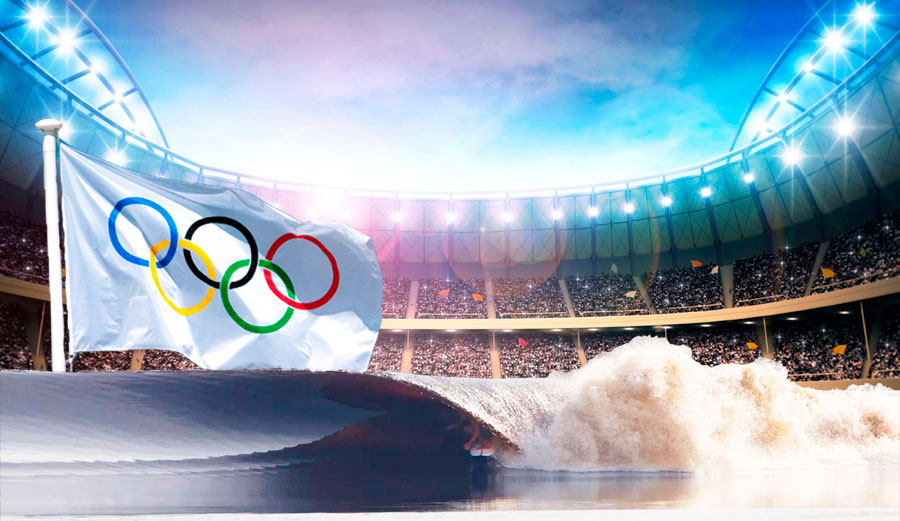
Olympic surfing imagined.

What separates man from beast? We humans are merely weak-skinned bipeds compared to other animals. We are not special. We are needy creatures. Thankfully, we have a great advantage in this life because we have this beautiful big ass thing in our head called a brain. And with this brain we build. To engineer is human. That’s how we survived in the jungles and took over this planet. And reading it one way, the story of history is a long, inexorable march towards the construction of man’s greatest engineering feat — Kelly Slater’s wave pool.
By now you’ve heard everything about Slater’s dream machine. No doubt you also have a strong opinion about it as well. Either you think it’s perfect, flawless and magical, or it’s inconceivable, unethical and a downright sin. But despite these preferential differences there’s one thing everyone seems to agree on: it’s boundlessly convenient. If perfect waves can be endlessly spewed day-by-day in Fresno, California then they can be made anywhere.
And guess who loves convenience? The International Olympic Committee. For decades now the IOC has awarded cities around the world with either the summer or winter Olympic Games because of their — financially, symbolically and aesthetically judged — convenience (the bribes help as well). Surfing has been in talks to join the Olympics as a medal sport for some time now. However, unlike swimming, archery, equestrian, speed walking and curling, surfing’s arena is never a set or predictable thing. The ocean is a constantly changing place. You know this, I know this, we all know this. Look at the differences in both the waves during the Rio and Fiji Pros. In any other sport, say track and field, it would be like holding an event at the Rose Bowl with a follow-up event on Mars. There are too many variables involved with the sea, and for the IOC that unpredictability could spell too much logistical trouble over the long haul, and that just won’t stand.
But, despite what looked like insurmountable odds, surfing — along with baseball, skateboarding, sports climbing and karate — was unanimously voted by the IOC’s executive board to be added to the 2020 Tokyo Olympic Games yesterday. On top of this, the IOC has promised that the competition, which will include 20 men and 20 women from around the world, will be held in the ocean — which has both given surfing traditionalists an ounce of gratification and thrown Slater into a fit of cold sweats.
And while some may call it conspiracy, it seems a little odd that all of this Kelly Slater Wave Company and the Olympics hubbub have started to come to fruition at the same time.
The convenience of wave pools have been around forever, but, none have ever come close to being as perfect as Slater’s. We’ve seen all the videos; the perfect barrels, airs and open faces. Anyone and everyone who has surfed it has claimed it to be the greatest thing since the thruster.
Unfortunately, Adam Fincham, the researcher Slater worked with to build it all, has kept the exact technology behind the most consistent, surfable wave machine a secret. Thankfully, he has given a small glimpse into the general concept: a hydrofoil. Imagine something like an underwater airplane wing creating swell, then turning that swell into a surfable wave using a specifically shaped bottom, causing a break, as happens in the ocean. Essentially a big piece of metal runs along a specifically shaped lake bottom to create a long-lasting wave with enough power to be ridden, and has a phenomenal barrel to boot. Oh, and apparently the entire device is solar powered as well. Engineering! It would be pretty naive to think that this combination hasn’t left the IOC wide-eyed for a couple months now (and just think of those new millennial viewers that will be picked up with this hip, cool sport).
Obviously, nothing is set in stone now. But, with the wave pools, committee voting, and Hurley Olympic team boardies, all signs are quickly starting to point to yes.

