
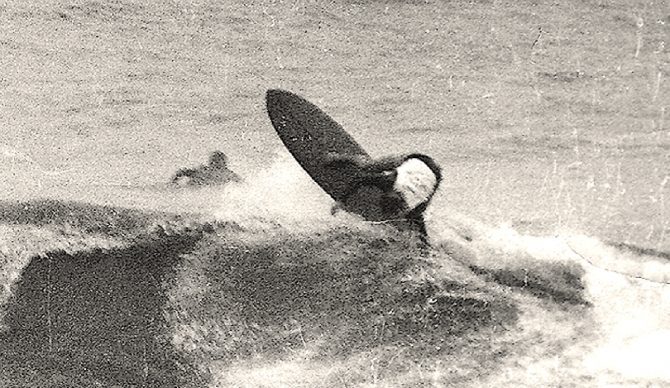
Rusty riding his first creation in a High School contest. Photo: Rusty Preisendorfer

Rusty Preisendorfer now has his name emblazoned across surfboards around the world, and under the feet of some of surfing’s greatest competitors and freesurfers (see Mark Occhilupo, CJ Hobgood, Josh Kerr, and Noa Deane). But long before all that, he was just a surf-stoked teenager, growing up in La Jolla, California.
The first board he ever owned was a 9’3″ Ekstrom asymmetrical he bought for thirty dollars in the fall of 1966. It was categorically the wrong board for him – Rusty rode goofy and the board was designed for a regular foot. But he didn’t know that at the time.
The first new board he ever got was a Bear Mirandon twin-pin he bought from LJ Surfboards the following year. It was 8’10,” with two v-panels starting just behind center, and cutaway glass-ons on the outer side of each panel. “Tough decision, as David Nuuhiwa Featherlights were ruling at that time,” remembers Rusty, “But all the best surfers in La Jolla were riding Bear’s boards.”
Now, the first time he made a board of his own was in the summer of 1970, in his junior year of high school. It was a time of profound change in the world of shaping – the transformative era that came to be known as the Shortboard Revolution. “In the fall of ‘67, [surfboards] were getting shorter,” Rusty remembers. “By 1968, half of the magazines had longboard ads, but the other half were shortboard ads. By April, longboards were basically history.”
Now, the shape of a performance board is basically proscribed, with a few subtle variations allowing for creative input. At that time, though, there seemingly were no rules for what a surfboard could look like, and Rusty felt the itch to make his mark.
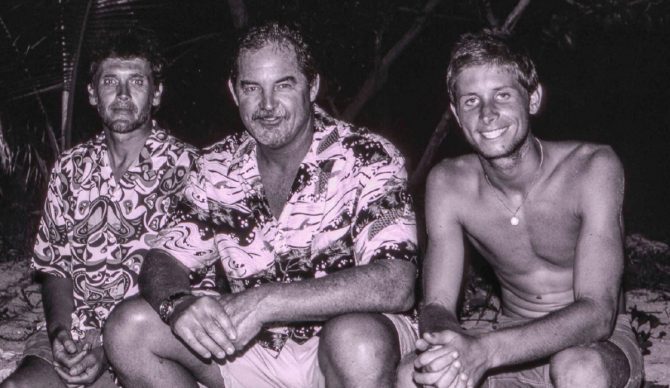
Rusty Preisendorfer (center) is better known as the man behind Rusty Surfboards. Photo: Tom Servais
He partnered up with a friend, Dan Evans. Dan’s father was Reverend Louis Evans, a pastor at La Jolla Presbyterian Church who would eventually go on to be named senior pastor of the National Presbyterian Church in Washington, D.C. (Rusty even remembers when Evans’ father held a service for Richard Nixon on the La Jolla High School football field). Dan didn’t follow in his father’s ecclesiastical path, though. At that point, he was a relatively experienced shaper, with around 20 boards under his belt.
Together, they made a six-foot, three-inch, arc tail twin fin – a big board to match Rusty’s 6’3”, 190-pound frame. Dan did most of the actual hands-on shaping, with Rusty providing the design. For the fins, they also decided to defy convention. Instead of the the tall template typically used on a twin, they opted for the lower profile, similar to the keel fins usually reserved for fish shapes.
The finished board turned out well. Really well, actually. Rusty rode it at the San Diego High School Surf Championship Contest and managed to place second. The fact that the pair managed to produce a surfboard that was not only functional, but actually good, was equal testament to Rusty’s nascent shaping ability and his raw talent in the water. Or maybe it was a supernatural force, imbued in the foam by “the son of a preacher man,” as Rusty affectionately calls Dan.
Soon after came another sea change. This time it was personal, rather than in the world of surfing. Rusty’s father, Dr. Rudolph Preisendorfer, Ph.D, was a mathematician in the midst of a formidable academic career. He had graduated from MIT, acquired his PHD from UCLA, and was working at the Scripps Institution of Oceanography as a research mathematician. In January of 1970 he took a guest chair at the Navy Post Graduate School in Monterey, which would move the entire family to Carmel.
“My father was a mathematician and he used to build these complex model kites. I think that’s part of where I get my shaping from, call it prowess or whatever,” recalls Rusty. “He was a brilliant mathematician, but I was an artist and I studied psychology at UCSB, so it’s kind of a combination of everything.”
It was there that Rusty would meet his hero, Jock Sutherland. “I took that twin fin up to Carmel beach,” he remembers. “I was out. It was a pretty good day, and I saw this jarhead (Fort Ord was above Carmel). He took off regular foot. He dropped out the bottom of the wave, and he did a bottom turn. And then he switched stance and pulled up into the barrel. And I went, ‘What?'”
As he describes the moment to me, Rusty briefly becomes emotional, vividly remembering coming face to face with a personal legend.
“He got clipped, and his board washed right up to me,” he continues. “I started pushing it towards him and I went ‘Fuck, it’s Jock Sutherland.'”
Later in life, Jock ended up dating the sister of one of Rusty’s friends, and they would end up getting to know each other pretty well over the years. In that moment, though, he was still a larger-than-life figure. “He was the king of Pipeline, and he was kind of an intellectual,” explains Rusty. “A lot of the surfers were kind of more down to earth and stoned out and stuff. Maybe he was a stoner, I don’t know, but he was an intellectual. He did these interviews that were insane.”
Rusty’s first board took him a long way and opened up a world of opportunities. Including a chance meeting with one of surfing’s legendary characters.
Editor’s Note: The Inertia’s Cooper Gegan works with well-known shapers to tell the stories of the first surfboards they created. Read about Craig Sugihara here, Stretch Riedel here , Darren Handley here, or Doc Lausch here.

