
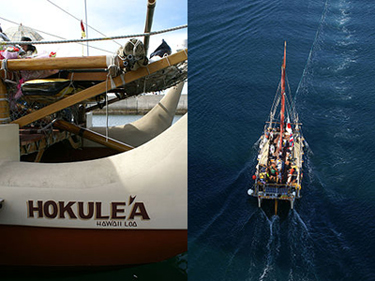
The legendary Hokule’a. Photo: Wikimedia Commons // Waka Moana

The 19th and 20th centuries were not kind to Hawaii. A legacy of poverty trailed development and commerce, leaving entire communities bereft of the traditions that had sustained them for many hundreds of years. But the Hawaiian sovereignty movement of the 1970s gave voice to the dispossessed with its emphasis on traditional arts and practices, perhaps none more powerful than ocean navigation aboard Hokulea, the 61-foot voyaging canoe that irrefutably proved ancient Polynesians sailed to and from Hawaii (and across the rest of the Pacific) with intention.
Nainoa Thompson, Executive Director of the Polynesian Voyaging Society, spoke recently at Turtle Bay on Oahu’s North Shore, evoking the significance of Hokulea not only as a living experiment, but as a platform for sharing ways of knowledge that have been retrieved from the brink of extinction. This knowledge — traditional, practical, and sustainable — is central to the mission of the PVS, which is at once extremely local in its focus on Hawaii, but also international in scope as Hokulea’s next voyage (starting in May 2014) is a journey around the world.
With his quiet strength, Thompson speaks in a measured cadence, and at the Surfer Bar at Turtle Bay the audience was silent in the darkened room, guided and sailing on his words. “We know the sail plan for the earth,” Thompson said, “[and] the data doesn’t work.” But the PVS is dedicated to a hopeful future, secure in the knowledge that the old ways that sustained robust Hawaiian populations might well be adapted to the world of today. Not necessarily that we’ll turn back from technology, but that we’ll cultivate a way of being that is less about material gain and more about cultural connectedness.
Much of the evening’s talk focused on the bare facts of Hokulea, and the remarkable contribution of a man from Satawal in the Caroline Islands, Mau Piailug, who, as one of very few masters of traditional Polynesian techniques of ocean navigation, shared his knowledge with Thompson starting in the 1970s. But the bare facts of Hokulea and the training regimen for Nainoa Thompson, the ship’s navigator, quickly blends into the realm of myth — not in the sense of fantasy, but in the way that these techniques brought Thompson and the rest of Hokulea’s crew in immediate contact with ancestors. Old knowledge, so close to being lost forever, was saved in its transmission from Piailug to Thompson. And with the cultural losses suffered in Hawaii, Thompson noted that “We know what extinction smells like, what it feels like.” But the story of Hokulea is one of “reclaiming our culture by reclaiming voyaging,” as Thompson put it.
Relating Mau Piailug’s training, Thompson noted that Satawal has no natural harbor, which saved it from development by foreign interests, inadvertently preserving traditional practices. Selected to be a navigator by his grandfather at the age of one, Thompson said Piailug underwent a rigorous indoctrination that included being pulled behind a canoe as a young boy with his hands tied — an experience that Piailug explained, made him “become the wave.” Thompson’s talk was like an ocean current, steady pulling in its direction, touching on ideas of what kind of a world our children will inherit and explaining that navigating without instruments relies on instincts and “remembering” on a physical level — “knowing, but not knowing what it is about.”
With support from the United Nations World Heritage organization, and the National Geographic Society, Hokulea looks to connect with cultures across the planet — the “youngest” culture of Hawaii with the “oldest” in the Zulus of Africa when the voyagers meet with Archbishop Desmond Tutu. The spirit of Eddie Aikau is hugely important to Nainoa Thompson, who was with him on Hokulea’s first voyage to Tahiti when the canoe capsized and Eddie famously paddled for the distant shore to rescue his shipmates. For Thompson, remembering Eddie means developing “the ability to find courage when you’re most in need it of it.” Hokulea is a craft that travels simultaneously back in time and forward to the future, challenging boundaries and asserting in a powerful and essential way that (as Thompson said) “culture is a reflection of environment.”

