
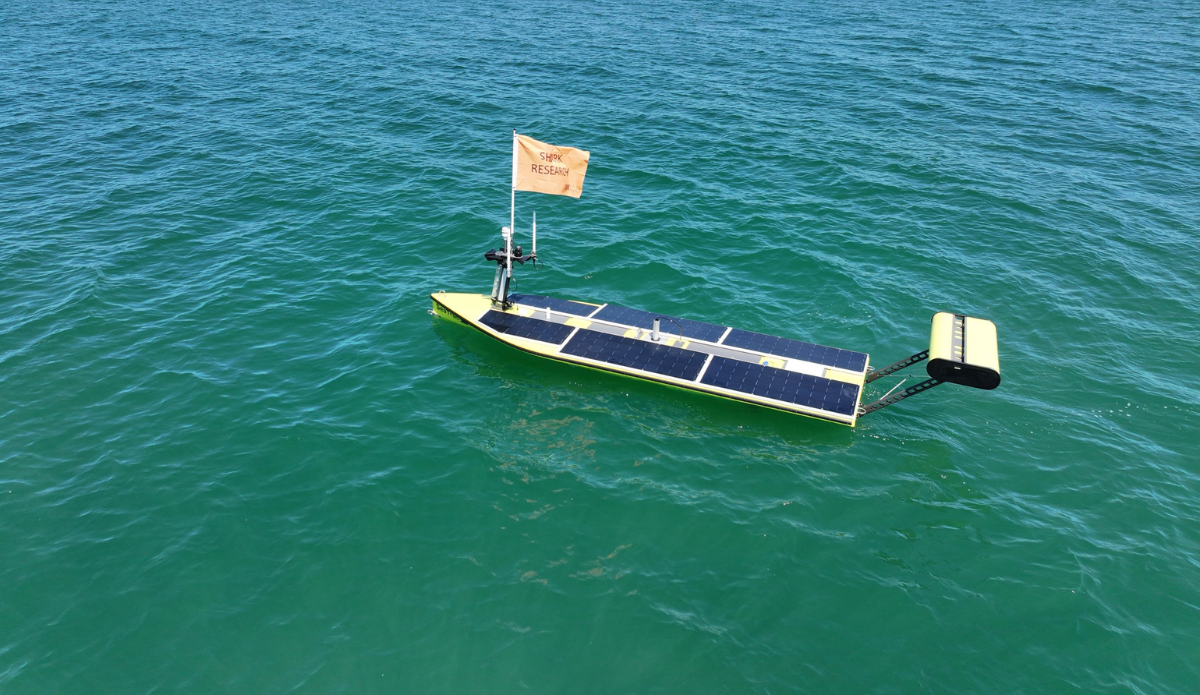
Photo: Cal State Long Beach

The Shark Lab at Cal State Long Beach was one of the first research centers to sound the alarm on the “sharky summer” California had coming its way in 2026. For several years, the lab has been operating on a strict budget that researchers were able to stretch further and longer than originally anticipated. The lab just revealed a prototype of one of its projects, which they say will become “the future of shark monitoring.
According to the Shark Lab, its new semi-autonomous shark surveillance bot (SSB) is “capable of patrolling off a beach, listening for tagged white sharks, sampling water for shark eDNA, and will have a drone nest on the back for aerial surveillance.”
Images of the machine appear like nothing more than a remote-controlled boat now, but the final product will come equipped with an aerial drone nesting on the deck. The boat component will be able to stream all of that live data, while the aerial drone can provide real-time footage, all fed back to the Shark Lab through Wi-Fi. The lab’s grand vision though is for the new monitoring robot(s) to become a tool for lifeguards, alerting them to the movements and behavior of sharks nearby.
“Our data suggests that there are sharks around our beaches all the time without incident,” Shark Lab Director Christopher Lowe told KTLA. “Knowing what sharks, and how many are out there helps lifeguards make better decisions in beach safety operations and in advising the public.”
If the SSB program can prove itself valuable, researchers are hoping it can be a resource during the 2028 Olympics in Los Angeles, where multiple events will take place in the Santa Monica Bay and along the Pacific Coast. Surfing, of course, will take place at Trestles, while the triathlon event will take place at Venice Beach, windsurfing, kiteborading, and other open-water swimming events will go down near CSU Long Beach in the Belmont Shores area.
“There are going to be Olympic events in Long Beach Harbor, down in San Clemente – there are white sharks in all those places,” said Chris Lowe, director of the Shark Lab. “Lifeguards will be scrambling for monitoring data, and they won’t have it if we run out of money.”
The lab has to endure a struggle for funding in order to reach that point, however. A request for $1.7 million in NOAA funding was made to get the lab through 2026 and 2027. The annual budget for the Shark Lab is approximately $1 million.

