
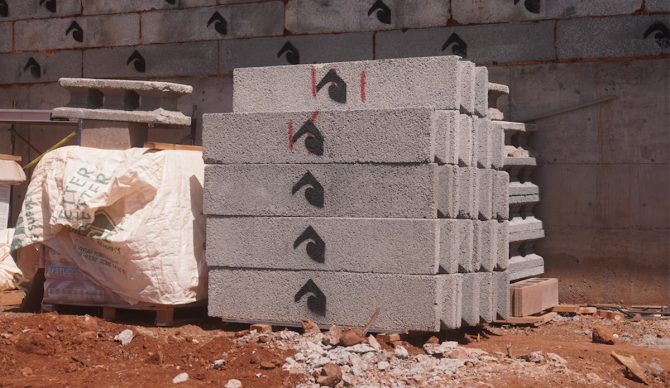
Photo: Surf Block

Surfing has a sustainability problem. While surfers can act as champions of the ocean in many ways, unfortunately the actual boards they ride on are made of wildly unsustainable materials. However, one Hawaii company has found an unlikely second life for leftover surfboards – as building material.
The product is called Surf Block, made by Maui-based architecture firm Hawaii Off Grid Architecture and Engineering. The company, which specializes in off-grid residential and commercial design, is based in Haiku, on the North Shore of Maui, just up the road from Jaws. Their proximity to one of the most famous surf breaks in the world, combined with Maui’s rich surfing culture, ended up inspiring them.
The Hawaii Off Grid office is located in the historic Pauwela Cannery, which also happens to house a number of local board shapers. After seeing nearby dumpsters full of off-cuts from surfboard blanks, principal architect and founder David Sellers began experimenting with using them to make Insulated Composite Concrete Forms (ICCF), a composite material made from styrofoam, Portland cement and a binder.
After plenty of trial and error, Sellers ended up with blocks that were strong, lightweight, durable and insulating. Most importantly, they help solve at least a little piece of the puzzle when it comes to making surfing more sustainable. Thus, Surf Block Maui was born.
I spoke to Sellers to learn more about the genesis of Surf Blocks, and what impact they could have on both surfing and housing in Maui.
What is your personal connection to surfing?
My wife was a professional surfer, so surfing is definitely part of our world. I enjoy it, but I’ll admit — I’m still a bit of a kook out there. My main hobbies are mountain biking and snowboarding, and with kids, work, and everything else, I don’t get in the water as much as I’d like. Plus, let’s be honest — when your wife absolutely shreds and makes it look effortless, it’s a little humbling! I’ve learned to embrace the role of cheerleader and just enjoy watching her do her thing.
How did you become aware of surfboard foam as a potential source for building materials?
Our office is located in the old Pauwela Cannery on Maui’s North Shore, right across the hall from Quatro, a well-known local surfboard manufacturer. Twice a week, they’d toss out their scraps — dumpsters full of EPS foam, the same material used in many surfboards. About 10 years ago, I took the trash out and saw two entire dumpsters packed with foam. With the landfill already at capacity — like many across the Hawaiian Islands — I thought, ‘there has to be a better use for this material.’
Years earlier, I had helped a good friend build a home in Washington state using ICCF (Insulated Composite Concrete Forms) blocks made from recycled EPS. I was really impressed with their performance. So that moment at the dumpster sparked an idea: What if we could turn this waste into a high-performance, sustainable building material for Maui?
What are the unique challenges of using surfboard foam versus other styrofoam in ICF block construction?
Surprisingly, it’s actually easier. Surfboard foam is usually higher-density, which makes it ideal for our purposes. It also tends to come in manageable pieces, so it’s easier to work with than other post-consumer EPS. And since it’s delivered right to our door twice a week, the logistics couldn’t be more convenient.
Are Surf Blocks functionally different from other ICF blocks?
Yes — and in some important ways. Our Surf Blocks, made from recycled EPS and cement, use about a third less concrete grout compared to traditional ICF systems. That’s because our blocks incorporate Grid Screen technology, which reduces the amount of grout needed without compromising strength.
We also don’t use any plastic connectors or braces, which simplifies construction. And since we’re diverting material that’s already been manufactured and transported for surfboard production, the embodied carbon is essentially accounted for — making our blocks close to carbon neutral. Functionally, they perform better, too. They have up to three times the R-value of a code-compliant wood-framed home, offer better adhesion for stucco and plaster, and are naturally more resistant to fire, mold, mildew, and pests. It’s a win across the board.
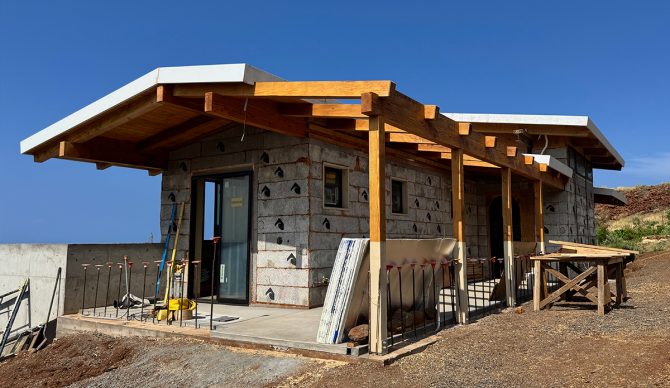
Photo: Surf Block
What has the company’s involvement been in rebuilding after the Lahaina wildfires?
In the immediate aftermath, we basically became a “no-profit” company. We paused regular operations and focused on helping with temporary housing and emergency school structures for fire survivors — much to the concern of a few clients, but it was the right thing to do.
Since then, we’ve partnered with the local AIA, the Council for Native Hawaiian Advancement, and the County of Maui to create a catalog of free home designs for people rebuilding in Lahaina. We’ve also hosted workshops and continue to do pro bono work to support the recovery. We’re committed to doing this for as long as it takes.
Can construction with ICCF and other alternative materials lessen the likelihood or impact of another wildfire in the future?
Absolutely. Surf Block walls are non-combustible, making them an excellent choice for wildfire resilience. They’re also incredibly strong — hundreds of times stronger than traditional wood framing — and resistant to hurricanes and earthquakes. It’s a resilient, durable solution that doesn’t come with added construction costs, and that’s exactly what communities like ours need.

