
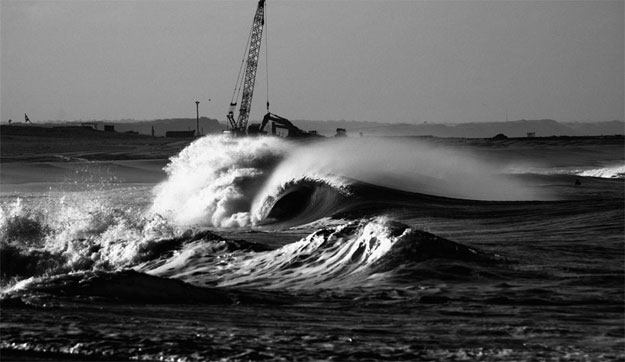
La Graviere, France. Not one of those flat days. Photo:Yoann Segalen.

There is a sticker on a signpost at my local surf spot that reads, “A bad day of surfing is better than a good day at work.”
When it comes to the bum surf trip, it’s an everysurfer tale. With only 25 days of holiday, each and every one is a precious gem. Preceded by months of saving pounds and pennies to bankroll the flights. Weeks of watching swell charts and weather systems praying for waves and, if the stars are aligned, some light offshore winds and sunny skies. Days of indecision as you pack and unpack your good wave board: Gun or groveler? Make the wrong choice and you risk floundering around like an ill-equipped kook, or worse still, left sitting on the beach.
You eventually arrive at your destination where the surf is as mushy, motionless and uninspiring as the soup-centric diet you adopted as part of your holiday saving austerity measures. Two-foot, crumbly onshore waves. You tell yourself, “Oh yeah, looks fun,” but it’s not. Each night you go to sleep dreaming of waking up to six-foot barreling blue seas. Sure enough, you’re on dawn patrol at first light, jogging down the point much like Rocky would have had he discovered surfing before pugilism. But no matter how much you will it, the wind is howling onshore and the waves are knee high. You sigh, pull up your collar, and make the disheartened walk back to base, and back to bed for more dream surfing. You never lose hope but to no avail. No dice.
It’s an all too familiar experience for me since I moved to London from my home on the north west coast of Ireland almost four years ago. Now I have to travel to surf, and that means preplanning holidays and praying they fall on days of the right swell, winds and weather conditions. I have gone on countless hopeful weekend jaunts back to Ireland only to be met with knee-high sludge or gale force onshores.
The most recent trip I took was to Hossegor in France in June. Having spent several university summers there, it’s a place of fond memories that I have always felt a special connection with. Something to do with early morning barrels at Graviere and watching the sun set from the dunes while drinking Kalimotxo – a Basque delicacy consisting of cheap red wine and joke-coke cola.
After weeks of convincing my non-surfing, sun-loving girlfriend that Hossegor was pretty much guaranteed soleil for her and surf for me, she eventually gave in and offered me her much sought-after consent to book the flights and a wee guesthouse that backed onto the beach. Somewhere along the way, I guess I forgot to mention the tempestuous thunderstorms that roll up from the Pyrenees, and the weeks of summer flat spells that render what is probably Europe’s most famous surf spot more like a grand paddling pool.
The weeks at work went by painstakingly slowly, and as the big day approached, the seven-day forecast made it clear that both sun and surf were going to be scarce commodities. Safe in the knowledge that the forecast is sometimes (often) wrong, I assured myself it would work out. It had to. Hossegor had always delivered before. And besides, what do a bunch of PhD meteorologists and offshore buoys really know about surf anyway?
Quite a lot, it turns out. The good folks at my swell chart provider got it pretty much bang on: six days of cold, wind, rain (mostly torrential), and, even more gloomily, no surf. “The weather is better in Ireland,” my girlfriend repeatedly swore. I summoned my inner optimist and pointed out every ray of sun that pierced through the clouds as a sign that it was “brightening up.” It didn’t. For six days. No matter how much I made the hopeful climb over the sand dune to check, the surf was bum and we were bummed.
So we improvised. We bought croissants, hot chocolate and baguettes at every opportunity. We went for runs. We even bought a plastic toy gun at the supermarche and set up an indoor duck-shooting contest. We went for rainy bike rides only to get beached in the two foot deep puddles that lined the cycle path. No matter how long we ventured outside for, we would come back sodden. For six days.
It wasn’t as if I didn’t try to surf. I did. I squeezed in two mornings of two-three foot mush at Capbreton, with about thirty other like-minded locals and travelers, who, like me, just wanted to get wet. And I did. On the way there. In the water. Getting changed. And on the way back. Sounds depressingly awful, right? But here’s the thing: I loved every minute of it! The cold, the howling wind, the unrelenting rain, and even the feeble surf. And here’s why…
A ripened old Aussie I met while traveling in Indo some time ago used to say of everything, good and bad, “Hey, that’s surfin’.” That might sound simplistic to the point of idiocy, but it has stuck with me and, to my mind, underscores one of the factors that makes surfing such a special endeavor: unpredictability.
Of course, getting good waves is great. There aren’t many better things than those days when it’s firing, the wind is offshore, and, if you’re lucky enough, you and your friends have the waves to yourselves. Sure, those days are impossible to beat. But the reality is that you only fully appreciate good waves in the context of bad waves. And the more you surf bad waves, the more grateful you are for those good days when they arrive. Maybe those bad days make us better surfers too, not only spiritually but also physically. Certainly that is one of the arguments for why Kelly Slater, having grown up surfing Florida chop, at 100 years old or whatever he is now, is both the greatest surfer of all time and still appears to be one of the most stoked guys around.
Surfing and the surf trip is a cocktail mixed up of equal parts good planning and luck. Planning because we have the tools at our fingertips to track weather systems and we know roughly what seasons, tides or cycles in what part of the world might deliver the best waves when. But also luck because nature is inherently unpredictable. At best, we can only somewhat accurately forecast conditions up to seven days beforehand and, even then, the mercurial temperament of the natural world can throw a Hail Mary that leaves our powers of predictability humbled. I may be wrong, but to my knowledge, no surf forecast is quite there yet. And we can build surf theme parks that deliver perfect waves all year round, but they will never live up to the real thing: the excitement and promise that the waves, while they may be worse, might also be better, possibly than we ever imagined.
And how bad is a bad day’s surfing anyway? Waiting for waves in Hossegor that week, it dawned on me that no matter how weak the surf, it was guaranteed to be better than in the concrete jungle of landlocked London. And rather than competing for a seat on the tube, or rushing around trying to meet unrealistic deadlines for this or that, I was outside in the open air with the wind and rain on my face in full knowledge that I am actually alive. Indeed, a bad day of surfing is better than a good day at work or doing most other things, for that matter. And that’s why I will continue to travel in search of waves, and always relish the bum surf trip.
In surfing, as in life, you can’t always plan things or be in total control all the time. Sometimes things just happen. Every now and then, things fall into place and you get the feeling that you are exactly where you’re supposed to be. And that’s exactly how I felt on my last day in Hossegor on day seven, when the sun broke through, the wind turned offshore, and I had a four to five foot barreling sand bank to myself at La Nord. Several hours of bliss, and a week well spent. Hey, that’s surfin’…

