
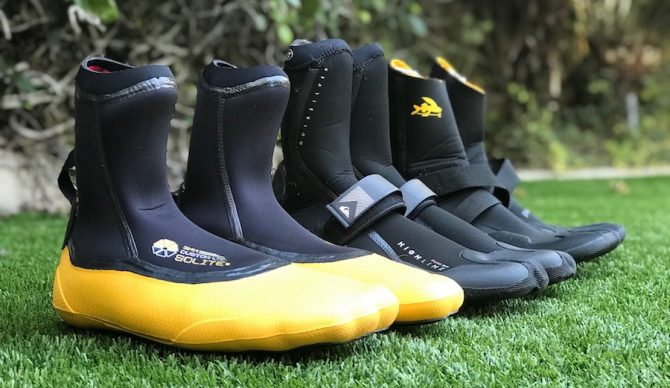
If you hate booties, why not give ’em another try? Photo: Dylan Heyden//The Inertia

Wetsuit booties get a pretty bad rap as far as surf equipment goes. Surfers complain that they look kooky, make it harder to grip your board, and are uncomfortable, and while the first might be true (depending on who you ask), the last two don’t have to be. Wetsuit manufacturers have responded to surfers’ general distaste for booties by investing time and effort to make surf booties totally awesome and well worth the investment, with different materials and useful features.
Our favorite overall surf booties are the Vans Surf Boot 2 Hi for their blend of awesome boardfeel, comfort, durability, and price. If you came here looking for a cheap pair of booties, our best budget option is the O’Neill Heat.
Navigate To: Comparison Table | Buyer’s Guide
Related: Best Men’s Wetsuits | Best Women’s Wetsuits | More Surf Gear Reviews
The Best Surf Booties of 2025
Best All-Around Surf Bootie: Vans Surf Boot 2 Hi
Runner-Up Best All-Around: Xcel Drylock Split Toe
Best Budget Surf Booties: O’Neill Heat
Best Sustainable Surf Bootie: Patagonia R3 Yulex
Best All-Around Surf Booties
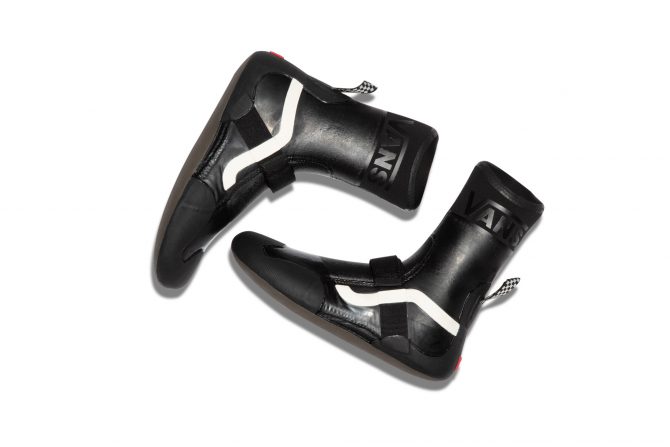
Vans Surf Boot 2 Hi ($85)
Available In: 3mm, 5mm
Fit: Size down one half size, narrower with medium volume
Style: Split toe (5mm version is a round toe)
Pros: Warm, comfy, and great board-feel
Cons: Narrow fit
For the best overall wetsuit booties when it comes to comfort and performance, with solid warmth, durability, and a decent price, look no further than the Vans Surf Boot. Whereas some wetsuit manufacturers aim to make their surf booties feel like socks rather than shoes, Vans said screw that and made its booties as much like its legendary skate shoes as possible. And just like those skate shoes, these booties work. These are warm and comfortable, with great board feel and proven durability.
The booties are a bit on the narrower side, with medium volume, and were some of the most difficult to get on in this test (in part due to the less-flexible rubber-dip seal that makes these booties super watertight), but the tight fit translated to incredible responsiveness and board-feel. Unfortunately, at the time, they are very difficult to get one’s hands on – your best bet might be ringing the local surf shop and seeing if they carry these booties. For example, Hansen Surfboards, a rad local shop in Encinitas, California, seems to have decent stock of the booties at the time of publishing, and is linked below.
Our Runner-Up Best Overall, the Xcel Drylock, can be easier to find in stock. It is a super close runner-up, with an easier entry, cozy lining, and a bit more rugged sole.
Read our review of the Vans Surf Boot here.
CHECK PRICE ON VANS CHECK PRICE ON Hansen Surf
Runner-Up Best All-Around
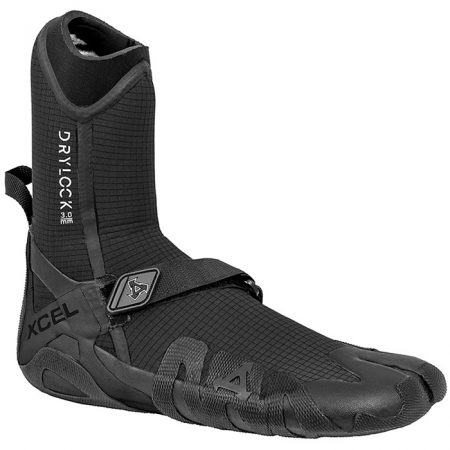
Xcel Drylock Split Toe ($95)
Available In: 3mm, 5mm
Fit: Size down one half or one full size. Medium width, medium volume
Style: Split toe, also available in round toe (3mm/5mm)
Pros: Very warm and cozy, great warranty, rugged sole
Cons: Can feel more like a shoe than a sock – a pro or a con depending on your preference
Xcel knows what it’s doing when it comes to neoprene, and its booties are no exception. The Xcel Drylock is the brand’s warmest, top-of-the-line bootie, and during my time working at a surf shop, we sold more Drylocks than any other booties combined. With thick fleece lining and the first bootie I had seen to incorporate a gusseted collar to keep water out, Drylock booties will keep you warm.
They are a particularly structured bootie, with more of a shoe rather than a sock feel, but with a good fit, your surf performance will not be hindered, and the rugged tread sticks to wax like none other, and is great for scrambling over wet rocks without slipping. There have been some reports of durability issues with the heel loop actually tearing off the bootie, but Xcel has a great neoprene warranty; just hold on to that receipt in case anything happens. Overall, the only reason it’s not a dead tie between the two is the legendary boardfeel and responsiveness that the Vans booties provide, just like the brand’s skate shoes. That said, those with wider feet, or those who prefer a more rugged sole, might be better served with the Drylocks.
Read our full review of the Xcel Drylock Booties here.
CHECK PRICE ON Cleanline surf CHECK PRICE ON XCEL
Best Budget Surf Bootie
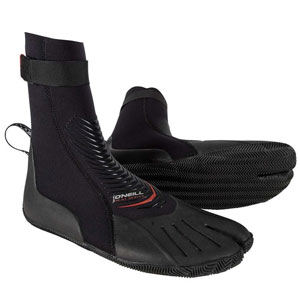
O’Neill Heat Split Toe ($80)
Available In: 3mm, 5mm (split toe), 7mm (round toe)
Fit: Size down one half to one full size, average width with average volume
Style: Split toe, also available in round toe (3mm, 5mm)
Pros: Warm and comfortable with a durable construction
Cons: Split toe is not connected, so it runs the risk of catching on your leash
The O’Neill Heat wetsuit booties are not only some of the cheapest wetsuit booties on the market (barring dubious Amazon options), but they’re also up there with the best of the best in terms of warmth and durability. Features are surprisingly good as well. We’re stoked about the inclusion of an ankle strap, which helps prevent water from pouring in. Another positive, the GBS seams (glued and blind-stitched, higher quality construction than flatlock seams) have interior taping, helping preserve the booties’ waterproofing.
The booties do not feature an arch strap, which isn’t the biggest deal, but for those with lower-volume feet, an arch strap can help lock the foot in to keep it from sliding around inside the bootie, especially in heavy surf. Boardfeel isn’t the absolute best due to a thicker sole, but the boots grip well, providing a secure connection to the board. All that taken into account, clocking in at $60 bucks, these booties provide an awesome value, coming oh-so-close in terms of performance to booties that cost an extra $30 or more.
The O’Neill Heat booties are available in both a round and a split-toe design. Round-toe booties are more comfortable but are more prone to the foot sliding around inside. One thing to note on the split-toe version of these booties is that the split toe is not connected, putting you at risk of the dreaded surf-leash-between-your-bootie-toes syndrome. Check out our buyer’s guide to learn more about the difference between round and split-toe booties.
CHECK PRICE ON EVO CHECK PRICE ON AMAZON
Best Eco-Friendly Surf Bootie
Patagonia R3 Yulex Split Toe Booties ($119)
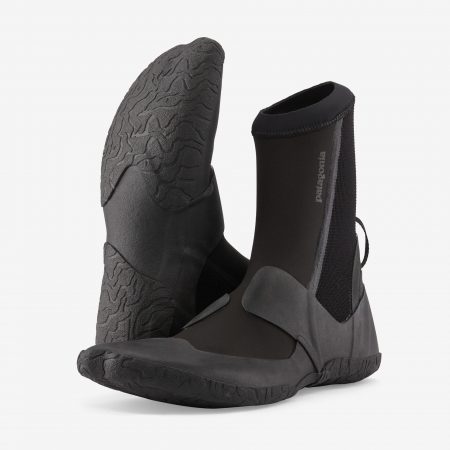
Available In: R2 (2mm), R3(3mm), R4 (5mm), R5 (7mm)
Fit: True to size, medium width, low volume
Style: Internal split toe (R2 and R3), round toe (R4 and R5)
Pros: Low environmental impact, Patagonia warranty, great grip, and a nice, tight fit
Cons: A bit tighter than some may prefer
The R3 Yulex Split Toe is 85% Yulex natural rubber and fair trade certified – no other pair of booties on the market is that friendly to the environment or the people making them. Under the hood, this boot’s got some serious features, including a z-strap with super sturdy webbing, arch support, and an incredible fit. The internal split toe also does a great job of allowing for more mobility in your big piggie without sacrificing warmth. No noticeable sacrifice in board feel, no “folding,” and all-around a very solid option with minimal environmental impact.
The great fit is in part due to the lower volume of the bootie – these guys really wrap onto your foot, especially in the arch area, which is great for boardfeel and eliminating slippage. The footbed is of medium width, but the low volume may be uncomfortable for those with wider feet. For higher-volume options, see below. Due to Patagonia’s unique wetsuit-rating system, the R2 uses 2mm of rubber, the R3 is a 3mm bootie, the R4 booties are 5mm, and the R5 are 7mm.
Shop R3 on Patagonia Shop R3 on Cleanline Surf
Other Great Surf Booties
Above are our top picks for wetsuit booties. However, there are plenty of other awesome styles to choose from, and some of the options below may be a better choice for you, depending on your preferences. So if you’re unconvinced, be sure to read on.
Fastest-Drying Booties
Rip Curl Flashbomb (100$)
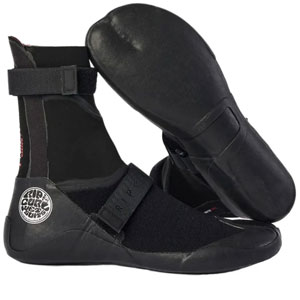
Available In: 3mm, 5mm, 7mm (round toe)
Fit: True to size, medium width, lower volume, but not as tight as Patagonia
Style: Internal split toe (5mm also available in round toe)
Pros: Cozy Flashbomb lining, ankle strap to help keep out water, great boardfeel with a thin sole
Cons: No heel loop, sole is sticky on wax, but slick on rocks
Those who are worried the Vans booties will be too narrow for their feet should check out the Rip Curl Flashbomb Booties. They’re a less-structured sock-like style of surf bootie, similar to the Patagonia R3 booties, but with an arch strap to prevent heel lift, and a slightly roomier fit. The Flashbomb lining is super cozy and dries fast – great for preventing bootie funk – and the ankle strap is a useful feature for keeping your boots from filling with water. Similar to the Patagonia R3 booties, they have a low-volume, high-performance fit, albeit with a lot less squeeze, so we could see them being a great choice for wider feet. The sole of the bootie is very thin, allowing for great board feel. It’s worth noting, however, that while the sole is plenty textured enough for great grip on a waxy deck, we found these booties can be a bit slick when navigating over wet rocks.
The lack of a heel loop is not our favorite (there is a heel loop on the 7mm version), as we’ve found booties without heel loops, combined with cold and clumsy fingers or simply laziness, can lead to ripped booties in the long run. However, that has yet to happen with our Flashbomb booties, and won’t as long as we remember to be careful. Of note, the 3mm booties are available in a narrow version, a nice perk for thin-footed surfers.
Check Price on Cleanline Surf Check Price on Amazon
Runner-Up Best Budget Bootie
Quiksilver Everyday Sessions Split Toe ($65)
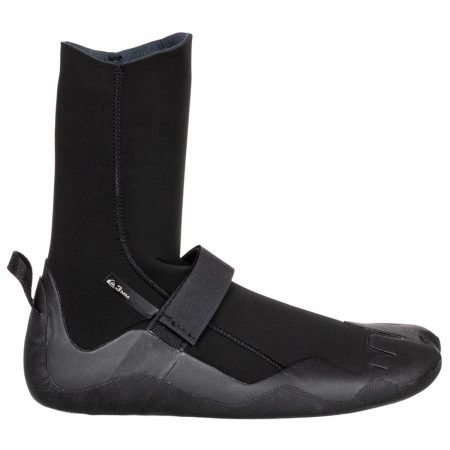
Available In: 3mm, 5mm
Fit: Size down one half size, medium width, medium volume
Style: Split toe, also available in round toe (5mm)
Pros: About as good a price as you can find in the surf bootie market
Cons: Lacks a premium feel, flatlock-stitched seams
When it comes to bang for your buck, you can’t go wrong with Quiksilver’s Everyday Sessions booties. They’re decently warm (though lack a cozy interior lining like many options on this list), have a connected split toe, a heel loop, an arch strap, and a comfortable fit – in other words, they cover the basics of what makes a good surf bootie without going above and beyond in any category.
The biggest downside is the flatlock-stitched seams, which are durable against major failure over time, but will allow a bit more leakage than might be desired right off the bat, as “flatlock” seams are stitched all the way through the rubber. If that doesn’t matter to you, and what does matter is finding a pair of booties that cost less than $80, the buck stops here, literally.
CHECK PRICE ON AMAZON CHECK PRICE ON Cleanline Surf
Warm And Flexible
O’Neill Psycho Tech ST ($90)
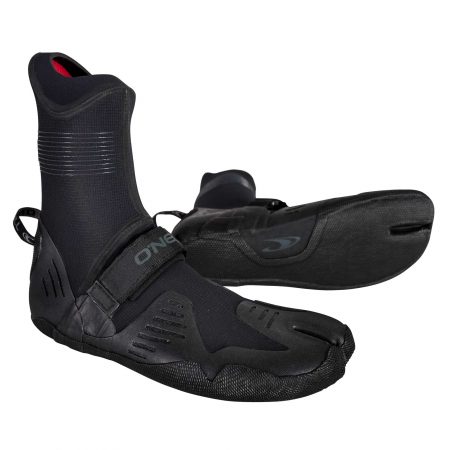
Available In: 3mm, 5mm, 7mm (round toe)
Fit: Size down one full size, medium width, higher volume
Style: Split toe, 5mm also available in round toe.
Pros: Warm, but also light and stretchy
Cons: Could be a little tighter on the upper foot area, mitigated by the foot strap
O’Neill boots keep your feet warm. Full stop. With O’Neill’s humble beginnings in the cold-water paradise of Santa Cruz, warmth has always been a priority with the brand, but so has comfort. The Psycho Tech booties are made of O’Neill’s Technobutter 3, which feels silky soft on the inside and stretches with any movement, as well as working wonders to retain warmth. They fit a bit on the looser side, a boon for those with wider feet. If you want a pair of classic surf booties with unparalleled warmth and comfort, these are a great choice.
Check Price on Evo
CHECK PRICE ON AMAZON
Custom Fit
Solite Custom Pro 2.0 ($105)
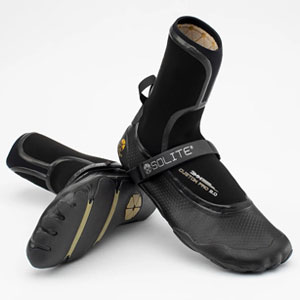
Available In: 3mm, 5mm
Fit: Size down one full size or more, wider, high-volume
Style: Internal split toe
Pros: Great board feel and game-changing “heat mold” system
Cons: Not the warmest 3mm booties, and a bit high-volume for our tester’s feet
Solite claims to have changed the game with their heat-moldable soles, and to be honest, they have. With just 25 minutes and some hot water, you can have a pair of custom-molded booties. To be honest, the heat mold isn’t necessary. Our tester just let his naturally stretch to fit his feet, and after a couple of sessions of having toes jammed up in the front, they fit perfectly.
Two years ago, Solite’s booties were at the top of our list. Last year, Solite debuted its 2.0 version of the Custom and Custom Pro booties, and these things are packed with features like heat booster socks, which help improve the fit and add an extra layer of warmth inside the boot, a three-point arch strap, a new sole design that they claim is more barefoot-feeling, and an upgraded lining.
That being said, we’re not as stoked on Solite’s 2.0 as the original version. There’s a lot more volume in the boot, which, for our tester, a skinny-footed surfer, resulted in a fair bit of slippage. This was fixed by cinching the straps tightly, but what he was so excited about with the first version of Solites was how they started way too tight, but stretched out over time into a perfect fit. Perhaps we should have sized down even more.
For a slightly cheaper ($75), no-frills option, check out the Solite Custom 2.0 (3mm, 5mm).
Check Price on Amazon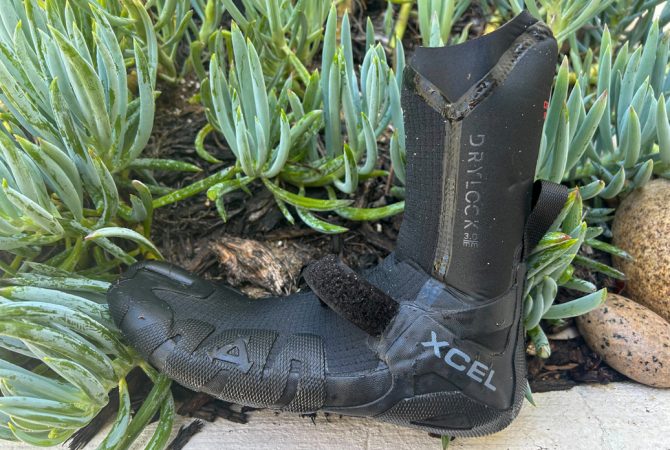
The Xcel Drylock 3mm. Photo: Zach Weisberg//The Inertia
Best Surf Booties Comparison Table
| Name | Price | Style | Sizing | Fit |
| Vans Surf Boot 2 Hi | $85 | Split toe or round toe | True to size | Narrower, low-mid volume. |
| Xcel Drylock | $95 | Split toe or round toe | Size down half or full size | Medium width, medium volume. |
| O’Neill Heat | $80 | Split toe or round toe | Size down half or full size | Medium width, medium volume. |
| Patagonia R3 Yulex | $119 | Internal split toe | True to size | Medium width, low volume. |
| Rip Curl Flashbomb | $85 | Internal split toe (round toe in 5mm) | True to size | Medium width, low volume. |
| Quiksilver Everyday Sessions | $65 | Split toe | Size down one half size | Medium width, medium volume. |
| O’Neill Psycho Tech | $90 | Split toe or round toe | Size down one full size | Medium width, high volume. |
| Solite Custom Pro 2.o | $105 | Internal split toe | Size down one full size | Wider, high volume. |

The Vans Surf Boot 2 Hi is our top pick for surf booties this year. Photo: Skyler Fitzmaurice//The Inertia
How We Tested The Best Wetsuit Booties
Gear Editor Will Sileo led the testing for this review at his home break of Ocean Beach, San Francisco. Growing up in such a cold-water paradise, he’s worn a lot of different booties in his time as a surfer, and over the past few years, has gotten his hands on (or should we say feet in) a wide variety of the latest and greatest surf booties from the top manufacturers in the surf biz. The booties were all tested in 3mm, as available, for accurate comparison. We tested these surf booties in waters up and down the West Coast from Los Angeles to Portland.
Fit is the most important variable, and that means different things for different people. We’ve done our best to indicate how each bootie fits – high volume will be better for wider feet, and low volume will be better for skinny feet – though it’s always best to err on the side of tighter rather than looser (within reason) to preserve a tight, high-performance fit. In general, it’s a good rule of thumb to size down, and for each option, we’ve indicated how much our tester sized down from his usual shoe size, if at all. You should also take into consideration whether you prefer round toe, split toe, or internal split toe booties, more of a “sock,” or more of a “shoe”-style bootie, and other features like heel loops, arch-straps, and more, all discussed in the following section.
The Inertia Founder, Zach Weisberg, has also contributed to this review with additional individual testing of the Vans Surf Boot and the Xcel Drylock Wetsuit Booties.
Our most recent update to this review was in August of 2025. We added a single product review of the Xcel Drylock Booties, expanded our buyer’s guide section with more details and photos, and made sure all of our links and prices are up to date.

A heel strap makes it a lot easier to get your booties on (especially without tearing them). Photo: Skyler Fitzmaurice//The Inertia
Wetsuit Booties Buyer’s Guide
Wetsuit Bootie Thickness
Most booties come in either 3mm or 5mm, with some going up to 7mm or higher. You’ll lose a bit of board-feel in thicker booties, but the extra warmth is worth it if the alternative is frozen feet. If you run cold, your extremities will often be the limiting factor on how long you can stay in the water, so it can be worth going for a thicker bootie. Our tester surfs in the San Francisco Bay Area, and 3mm booties do just fine as a year-round option, though it can be nice to have a pair of 5mm boots for cold spells or dawn patrols.
If you’re looking for your first pair of booties and aren’t sure what you need, think about where you live, what seasons you’ll be surfing, and reference a local water temperature chart online for comparison. For most of California, 3mm is probably fine, though as you venture further and further north of the Bay Area, 5mm becomes increasingly popular for winter surfing. For Oregon and the Pacific Northwest, except for mid-summer, you’ll probably want a pair of 5mm. Mid-Atlantic and Northeast winters warrant 5mm as well. Iceland? Now you’re in the 7mm range.

Vans has brought its skate shoe prowess to surfing with the Surf Boot Hi. Photo: Will Sileo//The Inertia
Different Toe Styles: Round Toe, Split Toe, or Internal Split Toe Booties?
For us, this is an easy one. Internal split toe all the freakin’ way. But for those who haven’t tried all three options from various brands and came to that conclusion themselves, let us break it down for you. Round-toe booties are by far the most comfortable and by far the biggest hindrance to your surfing. Without some sort of separation between your first and second toes, your foot can slide all over inside that bootie, especially problematic for shortboarding.
Split-toe booties are the least comfortable, but don’t suffer from the same foot slip. However, they do suffer from catching-your-leash-in-between-your-toes syndrome, unless they have a connected split toe, like Xcel’s Drylock. Booties like the Vans’ Surf Boot Hi sport an internal split-toe, promising the best of both worlds. The comfort of the round toe with the control of a split toe. They don’t always live up to that hype, but the ones on this list do unless indicated otherwise.
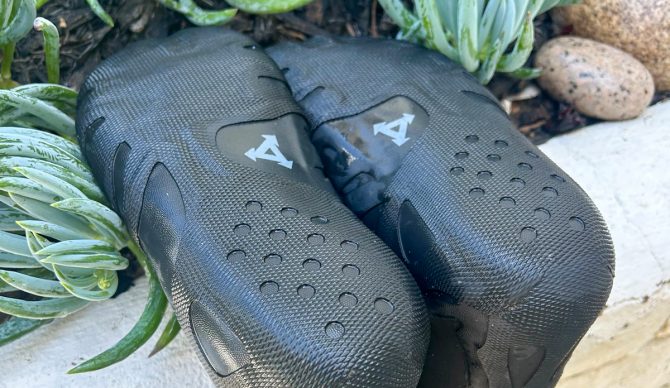
The structured sole of the Xcel Drylock booties makes it feel more like a shoe than a sock, but it provides a great grip on the wax of your board. Photo: Zach Weisberg//The Inertia
Overall Bootie Construction: Socks or Shoes?
Nowadays, booties tend to lean one way or the other. Some, like the O’Neill Heat and the Xcel Drylock, act more like shoes, with a sturdy, less flexible sole. It makes a certain amount of sense. You skateboard in shoes, why not surf in them? Others, like the Rip Curl Flashbomb and the Patagonia R3, go for more of a sock-style fit with less volume and a thinner sole that tends to wrap the arch a bit more for a barefoot feel, which also makes a certain amount of sense – you don’t surf in shoes, so why start now?
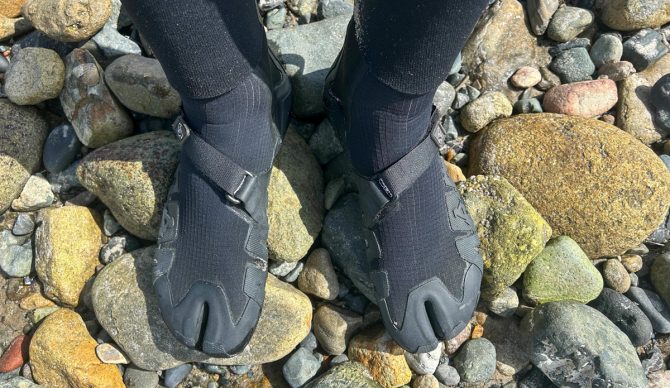
Arch straps on the Xcel Drylock booties. Photo: Zach Weisberg//The Inertia
Other Features To Look For In Surf Booties
Arch straps are great – they go over the top of your foot to prevent your heel from lifting up inside the bootie. In a perfectly fitting pair of booties, an arch strap isn’t necessary but is always a plus. A heel loop is another great feature that helps to get the booties on and off without busting through the heel (been there), and a thermal lining (found on most higher-end booties) will help yours dry out faster, and feels awesome too. A cool new feature that some brands have adopted is a gusseted collar at the top of the boot that seals onto the calf to help prevent water from flowing in, and some others take it a step further with an ankle strap.
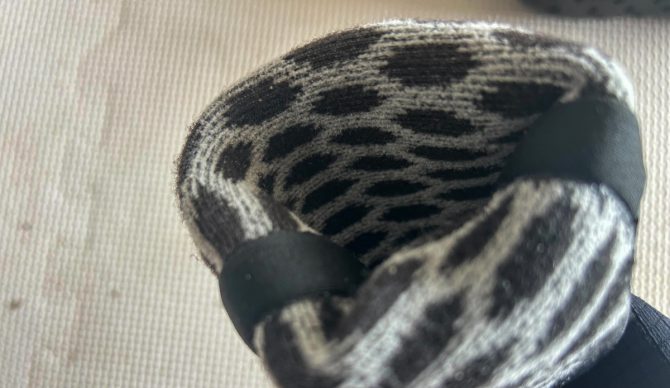
The Xcel Drylock booties benefit from a cozy interior lining. Photo: Zach Weisberg//The Inertia
How Should Surf Booties Fit?
Fit is all-important when it comes to surf booties. Feet are weird, vary a lot from person to person, and there is nothing worse than a poorly-fitting surf bootie. Too big and they’re worse than worthless, making you a worse surfer (but at least you’ve got an excuse!). It’s always better to have a little less room than you’d like to start out (see below), but go too small and your feet just hurt.
Our tester’s feet are long, skinny, and have finger toes. As a result, he wants a bootie that is low-volume but will stretch a decent bit to accommodate his toes. Someone with wider feet might want a higher-volume bootie so they can order a small enough size for the length of their foot but still have enough room from side to side. We’ve done our best to indicate the volume of each bootie included here.

Split-toe booties help keep your feet from sliding around inside. Photo: Skyler Fitzmaurice//The Inertia
Should I Downsize my Surf Booties?
Short answer: Yes. Long answer, it depends on the brand, but a straight one size down from your normal shoe size normally does the trick. Being made of neoprene and rubber, booties are destined to stretch, so when trying on booties, shoot for the mildly uncomfortable option rather than the ‘just right’ fit. You want as little room as possible in there, any extra material, and you’ll be prone to slippage or tripping during your pop-up.
Return to Comparison Table | Return to Top Picks
Related: Best Men’s Wetsuits | Best Women’s Wetsuits | More Surf Gear Reviews
Editor’s Note: For the most recent gear reviews and features on The Inertia, click here.

