
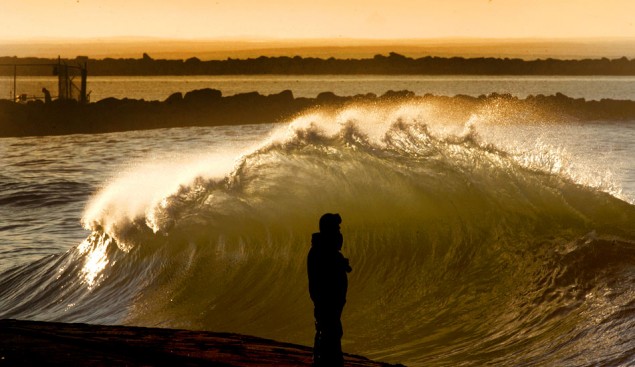
"In that moment, the world changed for me. Here was a young man who, by doing nothing more than pulling on a rubber suit, was able to go to a place and do something almost unbelievable." Photo: Sardelis

In the late 18th century, the Mallorcan friar Junípero Serra traveled up the coast of California with a band of Franciscan missionaries. Their aim was to found missions and convert local Native Americans to Catholicism. Many of the names they bestowed on their missions are still in use today: San Luís Obispo, San Juan Capistrano, Santa Clara. Sometime between 1782 and 1784, he traveled north from the mission in Ventura (then called Buenaventura) with the aim of scouting out the location for a new monastery to be named Santa Barbara. En route, Serra stopped to spend the night at a small village called Suku. It was located in a uniquely shaped inlet that the Spaniards had taken to calling “el Rincón.” Little did they know that it would eventually become one of the most famous surf spots in California. When Serra and his traveling companions entered that afternoon, the village was strangely empty. They walked a little farther north to find all of the natives gathered on the edge of el Rincón, staring anxiously out to sea at waves that were “perhaps the size of a man, or larger, a horse’s head,” in Serra’s words.
In a letter to his fellow missionary, Father Pedro Font, Serra comments with amazement on the “unusual angle” at which the waves break – incomparable to any others he had seen except for those breaking near a small Spanish town that he traveled through in his youth called….yes, “Mundaca.” However, it is not the waves themselves that are the focus of his letter.
That afternoon he watched in fear and excitement as three boats full of native men paddled out of the river mouth and through the pounding surf. One boat didn’t make it, and the crowd mocked its occupants mercilessly. When the other two had moved out past the breakers, instead of continuing onward, they turned back to shore and began paddling furiously. “I realized that their aim was to match speed and direction with one of the breakers, attempting to be swept up by the moving wall of water. And this, incredibly, they did!” he writes.
The boat managed to surf a wave all the way down the point, with one of its occupants even standing up. Given the well-established disdain that most missionaries of the time had for native diversions, Serra is a little embarrassed to confess: “I too felt something of a vicarious thrill for this dangerous enterprise, which I now know to be a foolish indulgence on my part. But in the moment of surprise at this feat of seamanship, were we not understandably moved?”
There is, perhaps no better account of early wave riding in existence today than that of Friar Serra at Rincon. More complete accounts, sure, but nothing that so perfectly captures the moment in which the land-bound first realizes the transcendent, miraculous beauty of riding a wave of oceanic energy for no other reason than because you can. Even this man, who has been conditioned his entire life to distrust frivolous amusements, cannot help but feel a certain fluttering of the soul when he first witnesses it. The act of wave riding itself is almost secondary to his sudden realization that the world is not as he believed it to be: the ocean, this intractable, monolithic source of danger and dread, is instead a simple playground for skillful seamen. It is as if a blind man had been given sight and observed for the first time, something seemingly impossible, like a bird in flight.
I come from a family of sea-going people, but of them, I am the first surfer. My mother is a sailor from North Carolina, and my father grew up fishing and swimming in the jagged inlets off the coastline of rural Japan. Sailors and fishermen are not like surfers, although it seems like they would be. Their sense of the sea is far wider than my own, but they have a conspicuous blind spot when it comes to the surf zone. In their minds, waves are something that wash you overboard, capsize your vessel, or cause you to run aground and sink. In my father’s case, tidal waves swallow up entire towns.
In hindsight, their discomfort with the surf zone was evident when I was growing up. During the summers we spent in North Carolina, much more time was invested in the marshes and tidal estuaries than in the ocean proper. When we did go to the beach, my brother and I were usually never far from their watchful eyes.
I was always aware of surfers, but only in an abstract sense. When I was young I had no interest in paddling out past the sandbars and trying to catch one of those terrible, powerful swells. I thought not more about surfing than I did about riding in hot air balloons or walking on the moon.
One winter evening when I was about seven, my father and I took a walk on the cold, deserted beach. The water was so chilly it hurt my fingers when I dipped them in at the tide line.
As we walked we came across a surfer just as he exited the water. For someone who has subsequently spent so much time in wetsuits, it’s funny to think that, at the time, I didn’t know what one was. In fact, no one in my family had ever even put one on, much less understood how one worked.

