
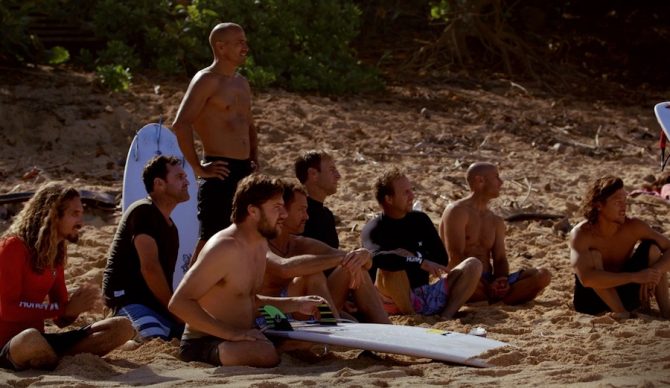
Photo: Momentum Generation / HBO Films

“All these problems were happening in my life, and the only time I felt really good was when I was surfing,” Shane Dorian says in the somber opening solo interviews that kick off Momentum Generation.
The 2018 HBO Films documentary, made by Jeff & Michael Zimbalist was all the talk in our global community of wave riders last year, but it gained new life recently when it was nominated for two Sports Emmy Awards: Best Long Form Documentary and Best Music Direction.
An adventure sports film does not win a nod for a mainstream Best Documentary Award because it out-muscled dozens of its peers with marginally more mind-blowing cinematography or gut-wrenching badassery. Rather, it has to transcend the entire genre by touching something within, by celebrating not just the physical genius of a demanding sport but by penetrating its soul.
“That’s when I had a sense of purpose,” Dorian continues. “This is who I am. I was that surfer kid, I wasn’t that bummed out kid at home.”
From those opening confessionals, a film that looks from its packaging like it could be just another montage of stoke — this one about a bunch of gifted kids who drove each other into what became arguably the greatest generation of competitive surfers ever — turns immediately inward, goes mid-life, gets real. The vehicle here may be a surf film, but the film was really about the consequences of domestic violence, adolescent rage, toxic masculinity, loss, grief, and redemption.
There’s no spoiler alert here because most of the people we know from the Momentum Generation have grown up to be fixtures in the surfing world. They are still tanned and ripped and they still shimmer on camera. Most were brutalized by alcoholic, addicted or controlling fathers, and/or neglected by overwhelmed mothers; it was their immense fortune that in fleeing their wrecked homes, they found their way as teenagers to the fabled North Shore of Oahu then found each other.
It is a great pleasure to see clips of what these pioneering shredders looked like out on the waves as prodigy groms — and fun to see the home movies of their frathouse pranks in the single-parent North Shore home that took them all in. But the bulk of the footage and photos of these champion athletes as scrawny, unkempt, overcompensating little kids is painful to watch: the menacing staredowns, the vicious fights on the beach, the anguished expressions when they thought no one was looking, all paired perfectly with the circumspect voiceovers of difficult memories, unresolved pain.
“Surfing was my savior,” Kelly Slater says. “All my challenges at home and my parents splitting up — I channeled all that into my surfing,” helping to turn surfing into a now $50-billion-dollar-a-year economic juggernaut as he did it.
But at what cost? Slater won those titles by beating, in most cases, not just friends, but his adoptive brothers and the only family he had left.
“Friendships, relationships, happiness. Is winning worth giving up those things?” asks Rob Machado. “The surf industry pitted us against each other.”

Here’s Rob Machado styling out 25 years ago. Photo: Momentum Files
Momentum Generation ably documented how the money and media and competitive pressure blew apart a testosterone-fueled tribe of wounded young men. They evolved from upstart punks trying to unseat the Australian and native Hawaiian champs into competitive enemies under immense pressure to perform. Some thrived and others fell apart.
Looking back three decades after Taylor Steele’s original Momentum, the gifted, wounded men of Momentum Generation do grow up and appear to be healing. After spinning apart, they seem to be coming to terms with themselves and each other — one of the great tasks of mid-life, if only for people with the time and energy to reflect on how they got from there to here. If there is any criticism of the story, it is the sneaking suspicion that, near the end, the reconciliations and reunions are a little too pat, a little Hollywood.
But this may be the result of a near-perfect story arc, light touches, and deep affection for its subjects. After competition, money, and unresolved grief finally blew them apart, sending them off on their separate journeys around the dark side of the moon, the lost boys of one of surfing’s most influential generations appears to have grown up just fine.
This, in the end, is what’s made Momentum Generation transcend the surf film or even adventure sports genre: its broad appeal, not just to surfers, but to families, to teen-aged boys who may or may not have it so rough, and to lost boys of all ages as both cautionary tale and redemption story.

