
“Six more months,” I told myself. “Six more months and then I can surf again.”

“How’d they let you into Afghanistan without body armor?”
I shrugged my shoulders and responded to the officer, “They told me I could get it here.”
“No son…you have to go back to Kyrgyzstan. The next flight leaves at 0300 hours.”
“Great” I thought to myself. “Another red eye flight, another sleepless night… I wonder how big Trestles is?” No, I can’t think like that; it’s probably overcast and south windy all day. “Six more months,” I told myself. “Six more months and then I can surf again.”
In March 2011, I became one of the many Americans over the last few years to hear (like a bad high school break up): “I’m sorry we have to let you go. It’s not you, we just can’t afford to keep you on. There’s not enough business.” I said good-bye to my Vietnamese co-workers watching anime or Spartacus on their cell phones and pointed my 1990 Toyota Tercel towards the Pacific. The surf was small, but the sun was out and the wind was light, a perfect day to contemplate my entrance into the freeing yet frightening world of unemployment. Looking for a new job would be the obvious next step, but now was the perfect time for a surf trip. I was In between jobs, just out of college, playing too much Call of Duty, living with my parents, and free from the responsibility imminently approaching with age.
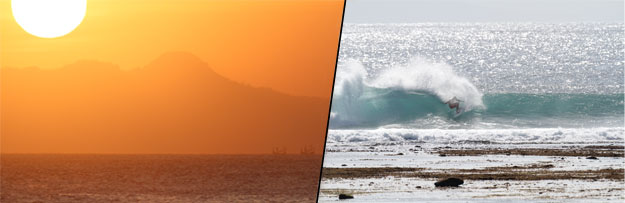
A couple of weeks later I boarded a flight headed for Indonesia. I had some new surfboards and an itch to get barreled. The first day I arrived at G-land it was clean 8-10 foot faces, but the swell direction was funky, making the barrels high and tight. I had not surfed a day bigger than head high in months, so the waves felt bigger than they were. Usually when traveling to a new spot you want the surf to be small the first few days than slowly build during your stay. The advantage of surfing huge waves the first day is that after getting smashed on the reef, donating some skin and blood in the process, your confidence gradually builds.
Since surfers in Indo are always chasing the next swell. Staying at a land camp in Indonesia for over a week will make you feel like a local, but of course, you are not a local, you just think you are. Australians, Kiwis, Europeans, and Brazilians dominate the line-up, and as we traded barrels by day and Bintangs at night, they shared life lessons. The consensus advice was you can’t chase epic waves all the time (pro surfers come close), but the next best scenario is chasing epic waves for part of the year by sacrificing surfing the rest of the year. It’s something to think about: trading lots of average days for a handful of epic days. I wonder what the ratio is between two-foot blown-out Newport and six-foot Deserts. Maybe 100:1? Whatever the ratio, working and waiting for the perfect days sounded worthwhile. Surfing good waves makes you sick of crappy waves. I soon said good-bye to the perfect waves and the nocturnal ping-pong tournaments at Joyo’s Surf Camp to travel back to California with the previous idea in mind.
Now I find myself sitting in a tent near the Afghan-Tajik border. I am working every day, 12 hours a day in the bureaucratic intersection of the military-industrial complex, sleeping in a big tent with eight other guys wondering if there will be a rocket attack tonight. I received an offer a few months ago to work as a contractor in Afghanistan and jumped at the opportunity. I am thankful for the job, since I probably would have gone back to volunteering for clinical trials (doctors tell me I have nice veins), donating my body for the greater good of humanity to bring safe, reliable drugs to the market (you are welcome world). Perhaps I made the wrong decision, but in six months the waves are sure to wash away Afghanistan’s grime.

