
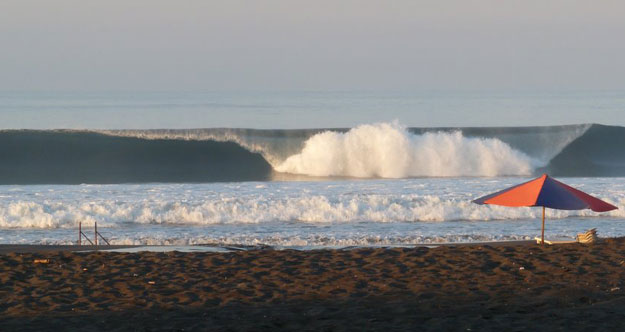
Pacuales on a smaller day. Photo: Steve Hauser

“Muy difícil entrada Esteban.” I have just returned to the crew’s tents and Jacobo is giving me a hard time about getting caught inside. I was the first one out that morning and was racing to get my fins and tethers on before the next set arrived but, as they say, timing is everything…
Here I am, an aging gringo surfer at one of México’s classic breaks with a crew of kids young enough to be my grandchildren. I have been driving down to Mazatlán for 5 years, spending 3-4 months in the winter pursuing a 40 year deferred dream of surfing. At 66, I’m the oldest surfer in town and the only one of the “rucos” [old fart surfers] who hasn’t been doing it most of his life. I have surfed with these kids, two shortboarders and two bodyboarders, for several winters but still, when they ask me to go to Pascuales with them, I’m a little surprised. It’s not a beginner wave. You go there to get shacked. I asked if this wasn’t a little beyond my skill set.
“Leave your chalán [longboard, “cheater board”] at home and take the boogie. You’ll be fine. And if it’s too big for you, you can take photos of us!”
“It’s a holiday. Won’t about a zillion other surfers have the same idea?”
“It’s a beachbreak, there are several peaks. No hay problema.”
So I go.
New Year’s Day, 2011
I plan to stay another day if for no other reason than a dicey lower tract. I’m in the restaurant finishing my chilaquiles and coffee. I’ve asked for a raw garlic clove and a knife and am dicing it up, planning to toss it down like a pill with the remaining sludge of my coffee. Cures most anything.
I am trying to meditate, but thoughts are distracting me. In the background, there is the whine of a rotary sander. Edgar, the proprietor of our hotel Real Pascuales, is a surfer and shaper and has a couple guys working for him on ding repair. He’ll make me a fish for 3500 pesos, 3K without fins. Not bad. This morning he’s out with a garbage bag, picking up the trash from last night’s New Year’s Eve partying. I see him stop before a small cross, barely noticeable among the vegetation on the beach. He has a quiet moment. I feel like an interloper to even observe this private act. Someone he knew, no doubt. Did he die surfing here? Or was this the break where they scattered his ashes? A couple hours later I go over to the rusty iron cross and look at the plaque, now mostly unreadable. The other wooden cross is gone. All I can make out is “Jose Leonardo.” I ask Yahir about it and he gives me the story of “El Pana.” He was a drop knee pro bodyboarder from Venezuela who was crazy for surfing the biggest waves he could find, always DK. He would pray for bigger and bigger waves. Four years ago he died here on a 20-foot wave.
02 January 2011, sitting in the restaurant with Jacobo, his girlfriend Itzel, and Santiago.
I’m not following the conversation. They aren’t trying to exclude me, but since I speak passable Spanish they assume I understand at the same level — which is not the case. I feel frustrated, thinking that both my Spanish and my surfing have plateaued before ever getting to the level I want. Later, listening to the Discovery Channel, I find that I’m getting most of the dubbed Spanish. Slower, clearer, standard Spanish and visual cues about what the narrator is talking about. Maybe I’m too hard on myself.
03 January 2011
I’m up before 8 and wander down to the crew’s tents for a surf check. Samuel is the only one up and greets me by saying “Your team rider’s still in his tent.” We watch the only guys out, two of the French bodyboarders who are killing it in perfect 6-8 foot, offshore. Where’s the Dawn Patrol? Is everyone getting spoiled or has the party vibe won out? I go back for my board. The paddle out isn’t too bad, but wave selection is tricky. I finally pick one, late, not quite an air drop but I’m not able to set a rail and get turned. Not that it matters, since it closes out on me anyway. For a fraction of a second, I’m in an overhead tube looking at a curtain of water in front of me. It all ends in a washing machine cycle that tears my right fin off. The fin isn’t totally gone, however. It is now acting like an anchor holding me down while my bodyboard is above me stretching out the bicep leash. I pull myself up with the leash for some air before the next wave hits. Back on the beach, I focus on the fin tethers, a type I haven’t used before. Santiago’s tether advice was clearly wrong:
“You’re an engineer. Figure it out. Why listen to some kid just because he surfs better than you?”
The morning of the 4th
I don’t need to look. I can hear that the swell has arrived. I grab the camera and go over to the crew’s tents. They are up this time and now I’m faced with a decision: surf or shoot? I have to leave by noon and I wuss out, rationalizing that I don’t want to pack away a wet springsuit, that this is a chance to get the best photos yet. I shoot.
I wrestle with this later. A real surfer would have stayed, eating the cost of the return ticket if necessary. The crew stays on for a couple more days, even taking a side trip to La Ticla, another barreling wave south of Pascuales. But when they come up to my apartment after their return, flash drives in hand to download my photos, I know I made the right decision. In some ways, surfing has broken the age barrier between these guys and me. In others, it has been a window into my own issues of aging, forcing a realistic assessment of what are purely physical limitations and what are mental. Youth never consider their own decline. Yahir vows he will “bodyboard hasta que se evapore el mar” [until the seas evaporate]. I love being around that kind of optimism, but I’m also comfortable knowing that it will someday end. I shall continue to surf as long as possible and to chronicle, through prose and photos, the lives of those who do it after I no longer can.

