
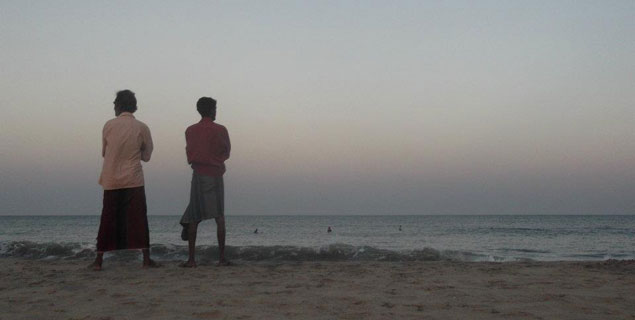
Sri Lanka skunking. Photo: Robbie Cowan

I traveled to Sri Lanka because an ex-girlfriend had gone there. She told me of how she swam with turtles and how beautiful the people were. I wasn’t going to let her have that one over me. I too was going to Sri Lanka.
I arrived at Bandaranaike International Airport, Colombo, late in the evening. It was dark, there were too few people and I stood out. I began to be approached by young men who were assertively offering to carry my bags. I needed to check a large piece of luggage at the airport, something that I would pick up again when I left. I was moving, from the southern hemisphere to the north, and had far too much luggage to carry around. My cheap suitcase was beginning to tear and was only secured by a small padlock on the zipper – which was largely for show anyway, as anyone could have just ripped the thing wide open. In my luggage was my external hard-drive, which had years of work and photos, as well as other important documents, like employers’ letters of recommendation. I also had an entire wardrobe of clothes in there. It was what I was moving with and the only thing linking me to my bag was a small plastic tag that I was given.
I had been fortunate enough to live in several cities, and travel in between. I hailed originally from New Zealand but had moved to London. On the way over, I’d traveled for several months through South East Asia, and once in England, through Europe. After coming back to New Zealand for a brief holiday, I was now moving to New York, and used the trip as an opportunity to visit friends in Sydney and then go on to travel through Sri Lanka and Bali, surfing at each. I remembered what an incredible experience I had several years earlier, traveling largely by myself through the tropics, and I hoped to replicate this.
When I arrived at my hotel in Midigama, situated on the southern coast of Sri Lanka, I was expecting to be greeted by a couple of fresh-faced Scandinavians. I had read on the website that the establishment was run by Amy and Phil, a couple of charismatic, easy-going Norwegian surfers. Apparently they had a range of boards, knew all the breaks and enjoyed taking their guests on customized tours, showing them the secret spots. On arrival, however, I found that ownership had changed hands. Phil, the former owner, had died while surfing. He drowned right out in front of the hotel.
Ronald operated the place with his wife Bernadine. Both were very pleasant and very British. Ronald, on several occasions, recited stories of his time in Her Majesty’s Armed Forces and his experiences in the “colonies.” He seemed to be in a mild but constant struggle with managing the place: ensuring staff were on time, books were in order and the building was maintained. Bernadine calmly responded, “Yes Ronald,” when he would talk about room reservations, or the lack thereof, for the second or third time that day. I’m not sure if his retirement dream was as he had hoped. He stated, on more than one occasion, “It’s not always paradise in paradise.”
The Lonely Planet described the south coast favorably:
“Southern Sri Lanka overwhelms the senses. The landscape is one of utter beauty, the radiant green rice paddies and forest of swinging palm trees contrast starkly with beaches of ivory-colored sand and an ocean of rich turquoise. The air is heavy with the scent of jasmine and cinnamon and the people drift past in clouds of bright colors.”
My experience differed. There was a constant and strong on-shore wind, so the waters were messy and grey, with lots of white froth due to the churn. The sky was mostly overcast, dulling all colors on the land, and there were consistent bouts of rain. The town seemed deserted, as if even the locals found it too unpleasant to stay. Ronald informed me it was the off-season. I couldn’t remember if I had read this; I wasn’t even sure if I had bothered to check.
Thinking that perhaps I was just at the wrong beach, I took a three-wheeler, the Sri Lankan taxi, from my hotel to Unawatuna. The beach was on the corner of a peninsula, with a hill separating the two coasts. I walked to the summit where a Pagoda sat. Ostensibly the environment fulfilled all my criteria: a monk in full dress, walking calmly and giving a gentle nod as a greeting; a large golden statue of Buddha – legs crossed, tranquilly looking out to the Indian Ocean with a nameless dog sleeping at his feet. The ambience was impressive, but I strained to be impressed. Perhaps I had used up all of my wonder.
When heading back to the main beach I noted a roadside sign that read “yoga”. The adjacent path led to a large dome room, with white plaster on the walls and ceiling. The room was empty apart from a few cushions and mats, and in one corner there was a small collection of books and photographs. When I entered, the instructor, a young Sri Lankan man, maybe in his late twenties or early thirties, was lighting incense in the corner. Following a minimal introduction, he leaned on my back with his shin, applying what felt like all of his weight. I felt pain, and was concerned that I may be injured, wondering if the Sri Lankan instructor’s understanding of the human body was at odds with Western science’s. But I thought it would be undignified to express as such so I instead let the sweat drip from my face as I tried to breathe.
After the session we conversed. We were of similar age and discussed each other’s personal histories. He was relatively new to Unawatuna and had just come out of six months of isolation and meditation. He showed me a photo of where he stayed during his half-a-year retreat. It was a picture of him in a pose, on a rock, in what appeared to be a fairly non-descript remote setting. I asked him what it was like, if he got bored. “No, not at all, it was peaceful,” he answered. “I miss it.” He said he continues to eat only once a day and sleeps no more than three hours a night; the rest of the evening he “listens to the life around him.” He went on to explain that “life is like a movie, it’s samsara, people happy one minute, sad the next, alive for a while, and then dead; some people rich, some people poor… like a movie.” His tone implied that he thought it was all a bit ridiculous, like an illusion that people take too seriously.
Along with the turtles, one of the main reasons I’d come to Sri Lanka was to surf. But the persistent, blustery on-shore winds meant there would be no surfing at any of the breaks I had seen. I needed a local to advise me. I had read in my guide book about a near-by surf hostel. The owner, Ramyadva, known as Ram, was one of the first Sri Lankans to learn to surf. He was quoted in the book describing his initial experiences with foreigners:
“I think the first surfers arrived in Midigama in 1977. My parents told me not to go near them because they were hippies and it might make problems if I touched them, because everyone thought that hippies were dirty.
Today people in the village know the surfers don’t have germs and most people like them because they spend money here. After the tsunami many of the surfers staying here have given money as well as books and clothing for the children. Some of them stayed on to help clean up and rebuild… But after the tsunami a surfer was caught stealing people’s stuff from the rubble. When he was caught he was beaten up by the other surfers and sent away. Before he did that I thought all foreigners were good people.”
Ram seemed like an honest-talking character and someone that could give me the kind of advice I needed.

