
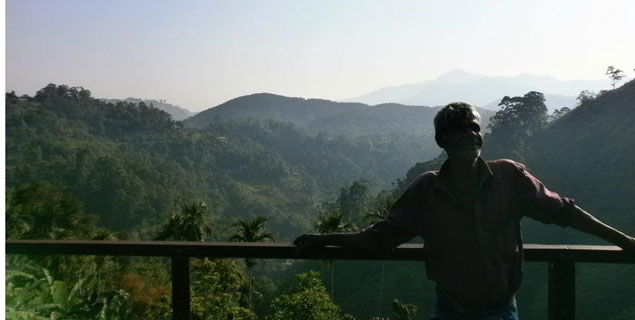
Over the valley with the guide. Photo: Robbie Cowan

When I arrived at the hostel, it was empty and unkempt. An elderly man came to the doorless doorway. I asked for Ram and he said that he wasn’t there, that he wouldn’t be back until the season started again. “When would that be?” I asked. “February,” he responded. It was now May. He said that the surfing season had ended and that I should go to the east coast.
When I arrived there, I found it to be arid. The rain and winds that were present on the south coast weren’t there on the east and instead the sky was open with an oppressive dry heat throughout the day. As we drove into Aragum Bay the scene was quietly dramatic. Bright green rice fields stretched to the horizon either side of the road. To the left was the beach that curved around the long bay and the bridge contrasted with the orange sky behind it. It was dusk, the heat had abated, and flocks of crows swooned high above the bridge. Barracuda was the local fish and if you surfed at this time it was not uncommon for one to jump, breaching the water, near or at you.
There were more fellow travelers here on the east coast, compared to the desolate south, and small but decent surf. The locally made rum was cheap and marijuana was offered by locals under their breath. There were evening barbeques on the beach, with fire lanterns and small fireworks. But I still wasn’t getting that joy and wonder that I’d experienced in previous South East journeys. The conversations weren’t stirring me; I wasn’t 25 anymore and no longer saw my fellow travelers as intriguing free-spirits, exploring the world with one-another. Instead, I saw them as kids: a little lost, naive and silly. There was the Russian girl with French braids, who slept outside every night, despite the mosquitoes and malaria, and who ate exclusively dried fruit, for “health reasons.” And the South African guy, who told everyone he was Australian, who while surfing often looked into his camera that he’d attached to the front of his board.
My next few days were filled with several exploratory solo missions on the scooter I had hired. I saw wild peacocks and long-tailed monkeys roaming the rice fields. On one long journey I came across a wild baby elephant, up close. There were also many meals alone and too much rumination. After the third day, it was time to move on.
The next and final destination was Ella, in the Hill country – a quieter town with a milder, fresher climate that sounded appealing after several days baking in the dry heat of the east coast. Tea plantations covered the terrain there, with dark green leaves that wound their way around the hills in neat rows.
A common activity for travelers in Ella was to walk the train tracks leading up to Ella Rock. The guide book recommended that I grab a local en route, to show you me the way. I came across a gentleman by the name of Mr Generialida, who was commonly referred to as “The General,” at least according to him. The General was an elderly, small, wiry character and was enthused about the about the idea of guiding me. He led me first to the waterfall, which required scurrying down rocks and a small jump. While the falls, at this time of year, were dry, a month earlier it was bellowing. We stood at the precipice of the rocks, leaning over something like a sheer 900-foot drop. The General seemed happy with my response.
We carried on up the hill, now walking through grass that rose above our heads. As the incline steepened I had trouble keeping up with The General, who was collecting sticks that had amassed to large bundle over his shoulder. When we reached the summit we sat on the rock that extended out over the cliff. The drop was awe inspiring, as was the view. We looked down and across and the entire valley, full of tea plantations and mist. The General asked what the climate was like in my country and what the economy was there. In conversation I discovered that my guide was 65-years-old and a local farmer. He was collecting the sticks to be used as staves for his vine produce – tomatoes and squashes – and had been doing so here in Ella his whole life. He had been smoking frequently throughout our hike and lit another roll-your-own as we sat on the rock that hung out over the cliff. The rolling paper was a dried leaf of some kind; he said it was better for you than paper. I smelled that he wasn’t smoking tobacco, and asked if I could acquire some. What followed was a nerve racking experience of descending the hill, the General gathering his friend, me crouching and smoking with the 65-year-old Sri Lankan man on a path beside the train tracks, because if we were caught by the soldiers they could fine us heavily, then getting too inebriated, wondering if this was all going horribly wrong, being handed a small bag and the General wishing me well, refusing to take any money and me heading on my way.
When reflecting on my trip through Sri Lanka, I realized that travel is a time of expectations: you embark with them and then look to meet them. But it seems that the experiences outside of these expectations, the ones you can’t foreshadow, are the ones of value. Those experiences that you can predict, those that you already have a grasp of, are neither novel nor exploratory. Perhaps these experiences are of tourism or holidaying, but not travel. Those times that we have while abroad that are beyond our conception, those that ruminate with us long after we return home, those that expand our knowledge and view of the world, and our place in it, are travel: the wild peacocks and the monkeys with the long tails that run the rice fields, the young elephant, a corpse of a monk being burnt ceremoniously road-side, and the interactions with locals which take you out of your small world and into theirs. In between are the hours of boredom, the discomfort of sand in the bed sheets, the anti-malarial-dreams, the disappointment of expectations not met and frustration with the lies of travel writers that created them.

