
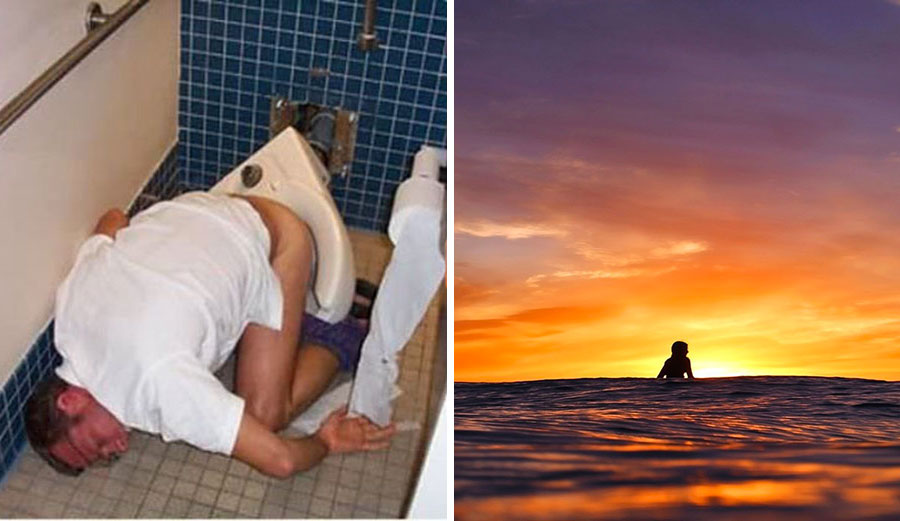
Don’t wake up like toilet guy. Wake up like sunrise girl!

I’ve been hungover far too many times to count. So have most of you, probably. You know the feeling all too well: the morning sun cracks through your window, birds chirping happily outside. The sky is a liquid blue, a gentle wind is whispering outside your front door, the forecast is promising, and the air, on any other day, would be crackling with promise. You spent much of the previous night talking about how good the waves were going to be today and promised yourself you’d be up at the crack of dawn, hangover be damned.
But instead of promise, the air is filled with the putrid stench of old vomit and sweat. Your head feels as though it’s full of cement and a rabid, angry gorilla is hammering on the inside of it. Bleary-eyed and sullen, it’s all you can do to crawl from your dark cave, timidly throw ten aspirins into your parched, stinking gullet, and drag yourself back to bed, hoping for the sweet relief of sleep or the sweet release of death. The world moves on outside, the waves fire without you, and the brisk morning air slowly warms to greet the coming day. It would all be so glorious if you hadn’t spent the previous night poisoning yourself with alcohol. But there is a chance you can have your cake and eat it too. Scientists are currently testing a synthetic alcohol that won’t give you a hangover. Screw hoverboards, space tourism, and real life Transformers–I want hangover free alcohol.
Known as “alcosynth”, the new drink was created by London-based futuristic moonshiner, Professor, and former government drug advisor David Nutt. “It will be there alongside the scotch and the gin, they’ll dispense the alcosynth into your cocktail,” he explained to Business Insider. “Then you’ll have the pleasure without damaging your liver and your heart. They go very nicely into mojitos. They even go into something as clear as a Tom Collins. One is pretty tasteless, the other has a bitter taste.”
So far, the Professor has taken out patents on almost 100 different alcosynth compounds, two of which are now being tested for public consumption. Nutt hopes that by the year 2050, some of them will replace regular old rot gut.
According to reports, the new compound is non-toxic and does everything regular alcohol does–except make you retch violently into your toilet, girlfriend’s laundry hamper, or if you’re really in a bad way, the kitty litter box (been there, done that).
“We know a lot about the brain science of alcohol; it’s become very well understood in the last 30 years,” Professor Nutt continued. “So we know where the good effects of alcohol are mediated in the brain, and can mimic them. And by not touching the bad areas, we don’t have the bad effects.”
Much the way Kelly Slater held off on announcing his wave pool for nearly a decade, Nutt and his colleagues have been working on this for around 10 years and keeping mum about it. According to him, the alcoholic beverage industry “knows that by 2050 alcohol will be gone.” He believes they’ve been planning on it happening, “but they don’t want to rush into it because they’re making so much money from conventional alcohol.”
Professor Nutt has a checkered history with drugs. In 2009, he was fired from his job as a government drug advisor for saying that riding a horse was more dangerous than taking ecstasy–a fact that, if I weren’t too lazy to do a few seconds of Googling–is probably true.
Alcosynth, however, still has a long way to go. The Department of Health isn’t taking it too seriously, despite the fact that everyone on earth who drinks would like to drink without the hangover. “It’s an interesting idea, but too much in its infancy at the moment for us to comment on,” a Department of Health spokesperson told The Independent.
And there’s another possible benefit/downfall. Nutt claims that his team has managed to effectively limit how drunk the drinker could get. “We think the effects round out at about four or five ‘drinks’, then the effect would max out,” he said. That means that one tequila shot that puts you over the edge might not exist in a few years. “We haven’t tested it to destruction yet, but it’s safer than drinking too much alcohol,” Nutt said. “With clever pharmacology, you can limit and put a ceiling on the effects, so you can’t ever get as ill or kill yourself, unlike with drinking a lot of vodka.”

