
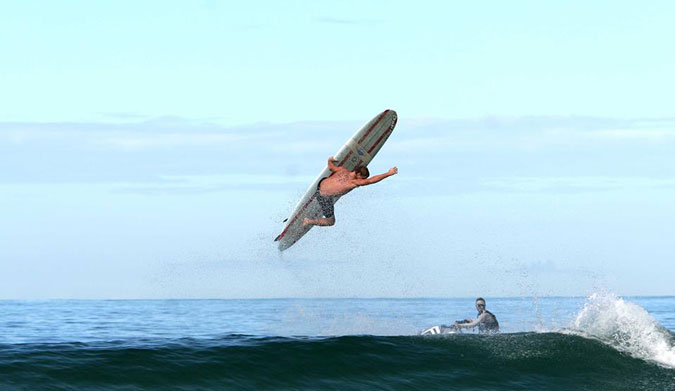
This is world champ longboarding. Photo: Facebook/Phil Rajzman

Gabriel Medina is one of the best surfers in the world right now. Lord knows he’s proved his worth in everything from aerials to giant barrels. But competitive surfing’s a funny thing – while judges have criteria that makes up the scores that determine the so-called “best surfer,” a big part of it comes down to strategy. For the most part, talent on a surfboard is a very subjective thing – and Medina has strategy nailed, which, while it may be written in invisible ink, is just another page in the judges’ “variety of repertoire” book. In the world of competitive surfing, Medina has the screws as tight as they can be. When Medina won his world title, he was widely hailed as Brazil’s first world surfing champion. But he was not.
Phil Rajzman holds that title. In 2007, the Brazilian won the ASP World Championship Title at the Oxbow event in France, making him the world’s first Brazilian surf champ. And yes, it was on a longboard. Longboarding, in particular, holds a little more soul than shortboarding; it’s smoother, more fluid, and to some, much less exciting to watch. But that doesn’t mean it’s not surfing.
Much of the so-called “Brazilian Storm” can be credited to Medina. Without him, we wouldn’t be seeing an influx of hyper-talented Brazilian surfers. The country’s immense sporting fever has lead to an opening of the floodgates; in recent years, a host of surfers from Brazil have smashed their way onto the tour, using blunt force and unheard of talent to make their way into the upper echelon of a sport usually dominated by Americans and Australians. But if Medina is the door that opened the Brazilian Storm, then Rajzman was the key.
Back in 2007, Rajzman was (and still is) one of the best longboarders in the world. Combining powerful surfing and style, his masterful approach to riding waves is on par with any of the legends. While he may not be a household name, the Brazilian deserves a place at the table. His innovative approach to riding a longboard is unparalleled, blending a unique mix of progressive surfing and old-school soul.
Rajzman made his mark on Brazilian surfing early. From the age of six, his talent was obvious. In 1994, he entered his first contest, and became a podium fixture immediately. Although it wasn’t until the age of fifteen that anyone outside his home town sat up and took notice, it’s not just longboarding he excels at. As a teenager, he was invited to join the first Brazilian tow-in team, and his prowess in waves of real consequence became obvious. His comfort on surf crafts of nearly any type, from tow boards to longboards, put him on the radar – but the surf world’s lack of interest in longboarding and Brazil’s lack of available sponsors kept him from the main stage.
None of this is meant to take away from Gabriel’s enormous accomplishments. It’s only meant to pay homage to Brazil’s surfing roots. Phil Rajzman sowed the seeds for the still-blooming flower of Brazilian surfing. So while Gabriel Medina, whether he wins the title this year or not – and if he does, it will be well deserved – has been the lightning rod in the Brazilian Storm, the day the dam in the Brazilian talent pool developed the first crack was the day Phil Rajzman hoisted the first Brazilian World Title.

