

Almost seven years have passed since the tragedy in Japan. The earthquake and ensuing tsunami decimated vast portions of the island nation. Fukushima, of course, was hardest hit, housing the power plant that quickly made headlines around the world. The earthquake was a magnitude of 9.0, one of the biggest on earth since 1900, and it opened up a rift 15 miles below the sea floor that stretched nearly 200 miles long and 93 miles wide. Japan sunk two feet, and the tsunami waves rolled in. An earthquake of this size does strange things to the planet. When the earth moved, some of its mass shifted towards the center, increasing its rotation slightly, similar to the way a record moves faster closer to the middle. Its axis shifted 6.5 inches and shortened the day by 1.6 microseconds. Around 16,000 people died in total, and no one will ever forget. That’s why Julian Sharpe, Scott Hill, and Eddie Bernard built the survival capsule.
A few years prior, an engineer named Julian Wilson was spending a weekend on the beach in Oregon. Another tsunami, the Indonesian Boxing Day tragedy in 2004, was still fresh when he had an idea that would shape the next decade of his life. The survival capsule is a simple idea: an impregnable ball that protects its inhabitants from basically anything. The next day, Wilson told Scott Hill, another engineer. That, in a somewhat literal sense, got the ball rolling.
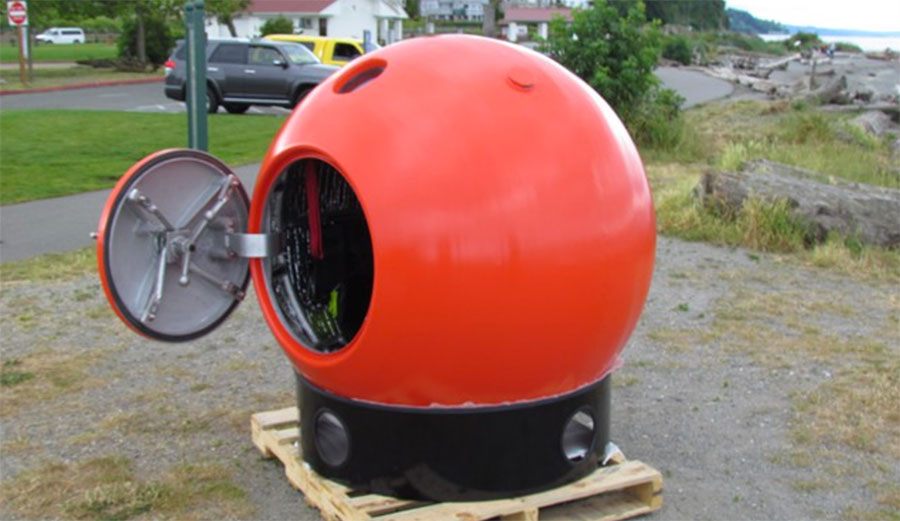
The two-seater model. It’d be a bit of a squeeze… but any port in a storm, right? Photo: Survival Capsule
By 2011, after a few years of serious R&D, they entered their design into a NASA contest. Out of 350 entries, Wilson and Hill took fifth place, garnering some serious attention. Soon after, they met Dr. Bernard, a subject matter expert with a Ph.D and three Presidential Rank Awards. At the time, Bernard was basically at the top of the pyramid when it came to tsunamis–he’d published over eighty scientific papers about them, produced a film on tsunami research, and was on over twenty television specials on tsunamis, including programs on The History Channel, The Learning Channel, and National Geographic. He also worked for National Oceanic and Atmospheric Administration’s (NOAA) Pacific Marine Environmental Laboratory and retired as Director in 2010.
Bernard, who was working alongside a Japanese company called Toho Mercantile on an unrelated project, played matchmaker, and Toho ended up commissioning the group to build two prototypes, one for the Yokohama Disaster Preparedness Exposition in February 2013 and one for testing.
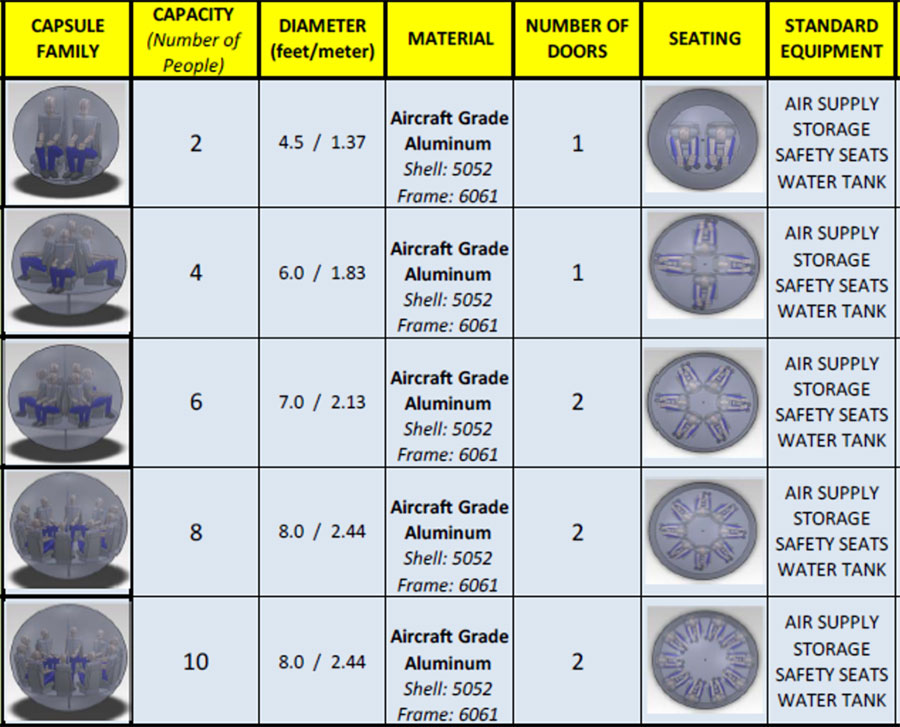
The Survival Capsules are made from aircraft grade aluminum and come in a range of sizes. Housing two to ten people, they feature an air and water supply, safety seats, and a bit of storage.
And yes, they dropped it off a 200-foot waterfall for testing. See more at SurvivalCapsule.com.

