

Gabriel Medina, testing his leash’s performance capabilities.

Often the only thing keeping your beloved sled safe is a urethane cord attached to a neoprene cuff. It’s a simple piece of gear — but not as simple as you might think. We caught up with a couple of major leash manufacturers to learn about the newest innovations and glean a few tricks for getting the most out of our kook cords.
#1. Put it on dry, not wet. It makes a difference.
Strap your leash on before you get in the water to make sure the hook-and-loop fabric will perform its best. When it’s dry, the loop side (the fuzzy side) is fluffier, says Todd Janda, Dakine product manager. “This allows for the hooks to intertwine better. When it gets wet, it still works, but isn’t as fluffy,” and therefore not as strong, he says.
#2. How long will a leash last?
The effectiveness of your leash’s urethane cord is all about the stretch. Too little, and the cord will be prone to snapping, or yanking your leg out of its socket. Too much, and your board will tombstone and take too long to retrieve.
After stretching, your leash can return to its original length, or close to it. But eventually it’ll lose too much stretch, and you run the risk of snapping it. When that happens depends on how many strong pulls the leash has sustained, says Micah Nickens, DaKine marketing director. “If you surf big waves in Hawaii and your board’s getting tugged, I’d give one up after the end of a season,” he says. On the other hand, if you only use a leash in head high surf in California, it’ll last a lot longer, on the order of three to four years, Nickens says. Take care of it — by rinsing it and storing it out of the sun — and it will last even longer. “I have friends who have leashes that are 10 years old. They refuse to get a new one because they trust that one.”
Pro-Lite co-owner Micah Bundy (why are all these leash designers named Micah?) says that if a six-foot leash has stretched to eight feet, he’d retire it, but not necessarily because the urethane is at risk of breaking. “That’s more from drag,” he says.
#3. You can now own the big-wave leash developed at Peahi.
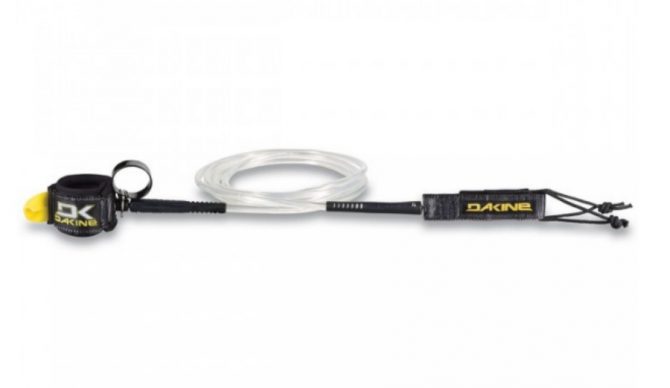
Dakine’s big wave leash, now available for purchase, went through some very rigorous research and development: wipeouts at Jaws. Photo: Dakine
Until last November, a big wave leash that spent years in development by Dakine could only be obtained by those who had the cell phone number of Micah Nickens, the company’s marketing director. His neighbors must’ve thought he was drug dealer, he says, because many a jonesing surfer pulled up to his home on Maui during huge swells. Now the 12-foot, 11-millimiter-diameter leash, vouched for by Ian Walsh and Kai Lenny, among others, is available to anyone with $70 and the cojones to charge mighty large surf.
Whether or not you have use for a cord like that, you may be glad Dakine learned a few lessons developing it: Many heavy wipeouts and failed leashes led to design improvements now incorporated into all of Dakine’s leashes. “We’ve learned everything from Jaws,” Nickens says.
Check out the story behind Dakine’s big wave leash:
https://youtu.be/G__hnW8Ozs4?t=1m18s
#4. The weakest link is not the leash itself.
The urethane cord isn’t the weak link. That would be the rubber molding pieces at the leash’s ends, where the leash is most prone to breaking, except in the event of a fin cut. Both Dakine and Pro-Lite have recently introduced new molding cups. “We figured out how to address it with flexibility,” says Dakine’s Nickens.
Pro-Lite just introduced a five-piece twisted mold that Bundy says is much stronger than the traditional two-piece mold used by many companies. “The way the cutouts are positioned allows the molded piece to to flex more right at that fail point,” he says.
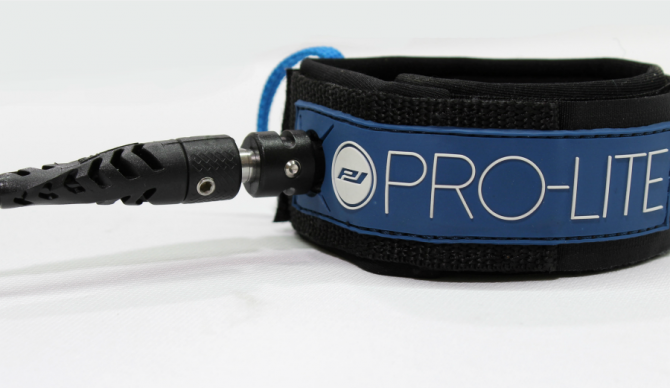
A shot of Pro-Lite’s newly designed molding piece. Photo: Pro-Lite
#5. Don’t wrap your leash around the tail.
Wrapping the leash around the tail stresses the urethane in the same place over and over, weakening it. Bundy recommends just stuffing the leash into your board bag or your car without coiling or wrapping it. And remember, keep it clean, dry and out of the sun.
Editor’s Note: Check out a wide selection of leashes here.

