
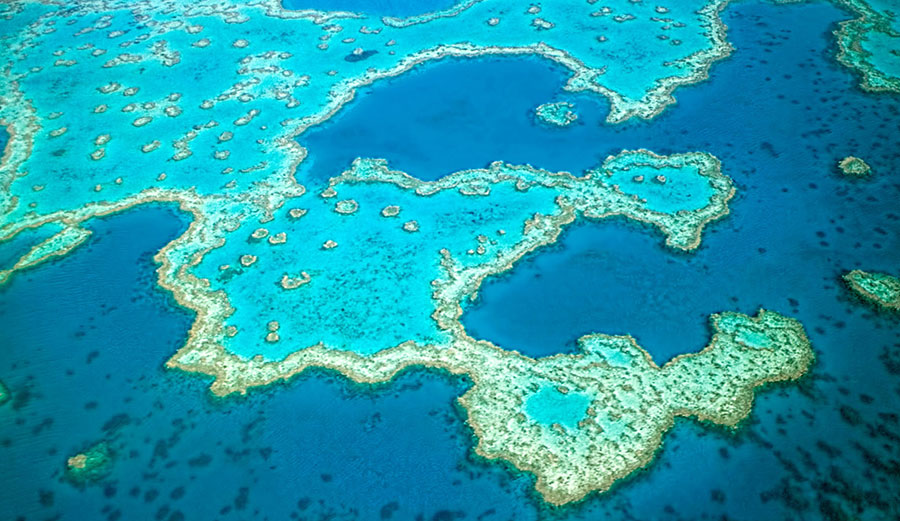
The Australian government has pledged A$500 million to try and save the Great Barrier Reef. Image: Great Barrier Reef Foundation

The Great Barrier Reef is in very dire straights. Years of back-to-back bleaching events coupled with warming seas have decimated vast portions of it. The Australian government has just announced that they’ll drop A$500 million in an effort to keep it from going the way of the dodo.
Researchers doing an aerial survey in April of 2017 found that nearly a thousand miles of the reef had been severely damaged by warming waters. “We didn’t expect to see this level of destruction to the Great Barrier Reef for another 30 years,” said Terry P. Hughes, lead author of the cover article of the journal Nature. “In the north, I saw hundreds of reefs — literally two-thirds of the reefs were dying and are now dead.”
The Great Barrier Reef is massive—some 134,360 square miles—and plays a vital role in everything from the ecosystem to Australia’s tourism. According to studies, the Great Barrier Reef World Heritage Area generates $6.4 billion for the Australian economy each year and supplies around 70,000 jobs. “Like reefs all over the world, the Great Barrier Reef is under pressure,” Turnbull said on Sunday. “A big challenge demands a big investment – and this investment gives our reef the best chance.”
While 89 percent of the money will go the Great Barrier Reef Foundation to assist in restoring water quality, figuring out exactly what should be done about the invasive crown-of-thorns starfish, and breeding coral that’s able to stand the new, warmer temperatures, 11 percent will go to federal and park agencies “to expand environmental management and compliance operations on the Reef.”
When it comes to the reef, Turnbull’s government has often been the focus of environmentalist ire. “Despite the clear environmental and economic contribution of the reef,” wrote Josh Davis for IFLScience, “many have accused the current coalition of not only turning a blind eye to the damage being wrought by climate change – which is estimated to have killed up to 30 percent of the coral in the last few years alone – but actively contributing to its decline by supporting the highly controversial Adani coal mine. The government was even accused of lobbying the United Nations to prevent the reef from being listed as a heritage site “in danger.”
The detractors do have a point, though. Despite the fact that numerous studies have conclusively shown that the reef is dying largely due to the effects of our changing climate, Australia hasn’t done much to curb the greenhouse gas emissions they promised to cut back on. In 2016, just a year after signing onto the Paris Climate Agreement, their emissions skyrocketed to the highest on record.
Many environmentalists who’ve spoken out against the pledge believe that the government needs to relocate those resources into fighting the main cause of the reef’s troubles: climate change. “If the Turnbull government was serious about saving the reef they would be willing to take on the industry responsible for the damage,” said Bill McKibben, the American founder of anti-climate-change group 350.org.“To simultaneously promote Adani’s coal mine, which would be one of the world’s largest, pretending to care about the world’s largest reef is an acrobatic feat only cynical politicians would attempt.”

