
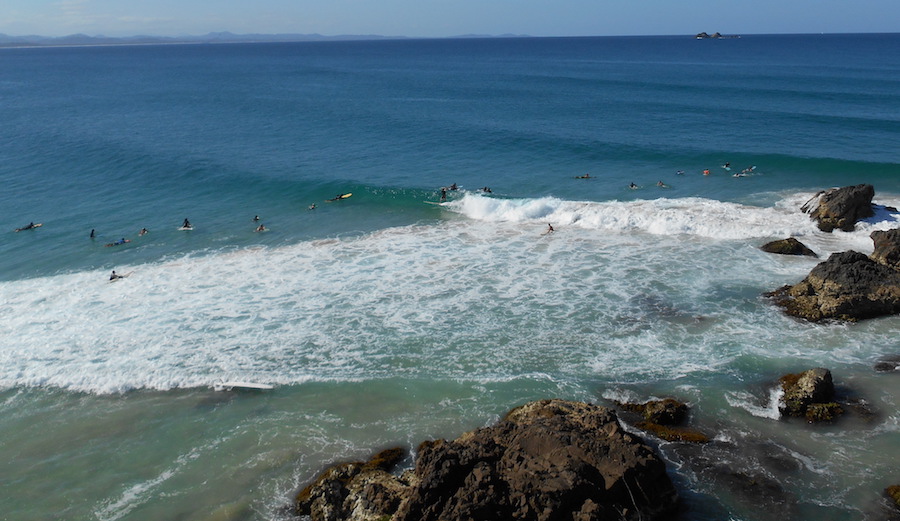
A former member of parliament and Byron Bay surfer says surfing without a leash is like driving without brakes. Photo: Wikimedia Commons

We live in what you might call the Renaissance of surfboard design. The general surfer’s openness to out-of-the-box shapes (compared to the closed off, high-performance orientation in the ’90s) has yielded interesting results. For one, shapers are pioneering highly futuristic-looking craft. On the other, surfers are increasingly looking backward to time-honored shapes, too, like the single fin longboard, or twin-keel fish.
In its day, the former existed before the onset of the leash (aka the leg rope). Either in an effort to honor that tradition, to free up their feet for cross-stepping, or simply because it’s trendy, many surfers across the world these days are electing to paddle out sans leash. One Byron Bay local equates that to driving without brakes, calling the behavior “selfish” and “reckless.”
“There’s been some horrendous damage out there and people are getting life-changing injuries,” Ian Cohen, a former member of parliament who now refuses to surf The Pass without a helmet, told ABC News Australia. “[These are] serious injuries where they don’t recover, and I think that’s an appalling situation.”
The solution, explains Cohen, might require a physical presence at beaches like The Pass to enforce order.
“I actually think we’re going to need some sort of patrol thing, like lifesavers with their flags patrolling for safety,” Cohen said. “Have a whistle and say to a person, ‘Look you’re acting like a ratbag, you either get out of the water or we call the police.'”
The ABC News article in which Cohen is quoted cites one particular incident during which a woman named Thais Pupio sustained three broken ribs and a collapsed lung from an errant board.
“He looked at me and asked if I was okay and I said no, but then he started paddling away,” she explained. “He said you can’t just sit still on your board like that.”
Pupio believes it isn’t fair that the man who lost his board wasn’t held accountable. “I reckon … if you leave the scene, you [should face] really serious consequences like in a car accident or something.”
This debate, of course, is hardly unique to Byron Bay. Malibu to San Diego, Montauk to the Outer Banks, plenty of surfers not only go leashless, they hate on the leash itself for depraving surfers far and wide the ability to truly be free, or some such.
In the case of Byron, though, injuries may reach a tipping point where the government may be forced to intervene.
“If the number of injuries reached a sufficiently high number and they’re also sufficiently serious enough, then parliaments may well decide it’s an area that needs to be legislated on,” said Southern Cross University law lecturer Andy Gibson. “But it would be a very tricky area to enforce as well.”
As it stands, according to Gibson, surfers could be held liable for negligence if a victim takes it upon themselves to levy a suit. But even then, it could be costly for the victim with little return.
“You can always bring a negligence [claim] against someone who causes you injury,” said Gibson. “But that pre-supposes that that person’s got the necessary funds to be able to pay the damages in the first place, and historically surfers have not been considered to be people with loads and loads of money.”

