

Say what you will about comps. There was a slew of Australians celebrating Ethan Ewing’s recent win at Bells. Photo by Ed Sloane//World Surf League

As someone with more than a passing interest in competitive surfing, I’m alternately amused and irritated by the rather relentless criticism of the World Surf League’s efforts to manage and present a professional championship world tour. If coverage on non-affiliated websites regularly leans toward cynicism, served up with an extra dose of sarcasm, the comment section can get down right vitriolic, when it’s not simply absurd.
Consider one recent post leading into the Margaret River Pro where an opinion was given that the pro tour’s problem is holding contests at so many sh-tty surf spots. I had to check the event schedule after reading that one, puzzling over where A and A+ locations like Pipeline, Sunset Beach, SuperTubos, Bells Beach, Margaret River, Punta Roca, J-Bay, Teahupo’o and Lower Trestles – not the mention the Surf Ranch, a wave 99 percent of all living surfers would sell their dog for a chance to ride – fall on the sh-t scale. But digesting this and so many other strident criticisms of contemporary competitive surfing has me wondering if this is merely a deleterious affect of the Internet Age, or has this pervasive tone of dissatisfaction been with us all along. So I went looking.
The first reference to surfing competition I could find comes from the writings of the 19th century Hawaiian scholar and historian David Malo (1795-1853), who in his Hawaiian Antiquities, translated in 1898, provided a vivid description of ancient Hawaiian surf contests. These popular events, on which the Islanders loved to gamble, were by our standards more like races, with surfers paddling far outside the break, then at a signal racing to shore in the waves. The first surfer in each “heat” to round an inner buoy was declared the winner — the first, and perhaps the last truly objective surf contest ever held.
Not much criticism from Malo, but of interesting note is mention of the sport’s first interference call. In a hotly contested bodysurfing heat between ‘Umi and Pai’ea, two prominent Big Island watermen, Pai’ea dropped in on ‘Umi, forcing him into some rocks and injuring his shoulder. ‘Umi went on to win the event, yet many years later, after being crowned king of the island of Hawaii, ‘Umi had Pai’ea put to death for the long-remembered infraction. And today’s competitors think that being docked a scoring wave is harsh treatment.
The first real criticism of surf contests I uncovered came in Tom Blake’s seminal tome Hawaiian Surfriders 1935. In one chapter Blake describes a contest held in Waikiki in 1918, in which it was suggested that rather than simply racing to shore on the wave, the surfer would also be judged on his or her form while up and riding.
“Everyone disagreed, “ reported Blake. “And that led them to believe surfriding contests were impractical.” He also noted that surfriding contests began being held in Southern California that same year, but, as he put it, “…often without proper selection of rules and judges.” So there you have it: problematic since before surfboards had fins.
Moving forward along surfing’s timeline I discovered that complaints about contests fell into several frequently addressed categories. Not surprisingly, sub-par surf conditions was right up there near the top. Writing of Australia’s “Metropolitan Surfboard Championships” in 1962, reporter Peter Rae lamented that, “By the time the finals rolled around the tide, which was on its way out, left only two feet of water on the sand bank, causing the waves to dump hard…along with the increasing winds the situation looked hopeless for the seniors.”
Sounds an awful lot like your typical Sunday afternoon final at Huntington Beach (Katin Pro/Am, Op Pro, U.S. Open of Surfing — take your pick.)
A decade later, renowned surf filmmaker Greg MacGillivray showed us the definitive anti-contest segment in his 1972 cinematic opus Five Summer Stories (still holds up—you should check it out) focusing on the 1971 U.S. Championship at the H.B. Pier. In one particularly pointed clip period surf star David Nuuhiwa winces about having to compete in the substandard “wind chop,” but which looks to me like the sort of surf that any of the events mentioned above would be lucky to have.
Not to be outdone, while covering the 1976 U.S. Championships for Surfing magazine, held in tiny, barely rideable conditions at Ala Moana, photographer Alan Rich reported that, “Halfway through one heat a top Florida surfer paddled out of the water, muttering, “I don’t want to win that bad.” Others labeled it a “regression session.” Most just said “karma.”
The bad vibes weren’t based entirely on bad surf, however. Almost 60 years after Tom Blake first indicted “surfriding contest” organizers and judges, angry surfers were still at it. In the aforementioned Five Summer Stories segment, along with the cruddy surf the filmmaker also flogged organizers and judges for playing fast and loose with the rules, cheating perennial finalist Corky Carroll out of his victory, painting the whole tawdry spectacle as an abomination.
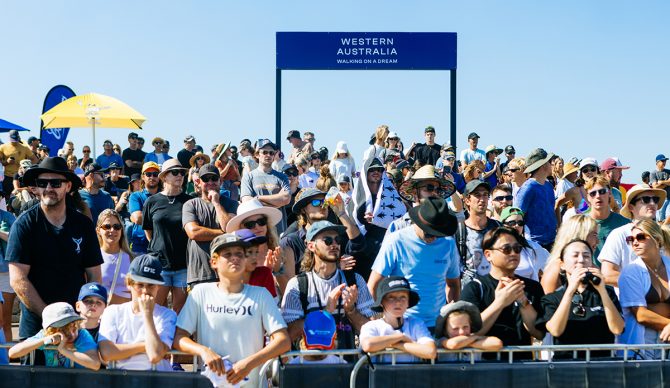
Plenty of people not criticizing contests in West Oz. Photo: Cait Miers//World Surf League
But this anti-establishment attitude wasn’t merely a reactive by-product of the ‘soul surfing’ era. Writing about the Makaha International Surfing Championships, which in 1965 still featured 24-man, half-hour heats, the quintessential early-sixties surf star Dewey Weber unleashed his frustration in a SURFER magazine feature titled “Makaha Is The Worst!” Ranted Weber: “Among the top-notch competitors who year after year show up at the contest, there’s general agreement that the regulation rules and scoring methods are as outmoded as the old redwood planks of bygone days. [The contest] is actually detrimental to the development of surfing.”
Can’t make it any plainer than that. But perhaps the most prescient criticism leveled at organized surfing competition that I came across appeared in a 1968 “Peterson’s Surfing Yearbook” publication — especially so, considering today’s wide and vociferous opposition to the World Surf League’s mid-season cut. In a very earnest editorial it was contended that, “…the contests were more important than ever before for some of the surfers who assumed semi-professional or professional status…[who] had a possible chance at a trip to the World Contest in Puerto Rico hinging on the outcome of a single heat, in a single contest. When poor decisions are made, as invariably they are with the best of judging systems, more than fur flew in the direction of those promoting the contest system.”
Sound familiar? Echoing complaints about competitive surfing that date back to the early 20th century, it should. And yet today, much the same grousing can be found in the comment section of just about any website covering the World Championship Tour. In fact, the only opinion I found through my search of surf history’s archives that we’ll probably never hear voiced today came in that same “Surfing Yearbook” editorial. And it came from the establishment itself.
“Many of the officials began to counter these vicious attacks with their own brand of gripe,” wrote the publication’s editors. “Asking, ‘Why do we spend so much of our precious time, with little or no recompense, for surfers who don’t care about us or the job we are doing…when all they do is criticize? If they don’t like it, then let them come and do it themselves.’”
I don’t know about the WSL officials, but if it were up to me I’d have Joe Turpel read this passage aloud at the opening of every live broadcast. Nevertheless, having looked back on more than a century of competition put-downs, I will say this to all those salty commenters out there: If you’re going to hate on surf contests, c’mon, guys, at least give us something original.

