
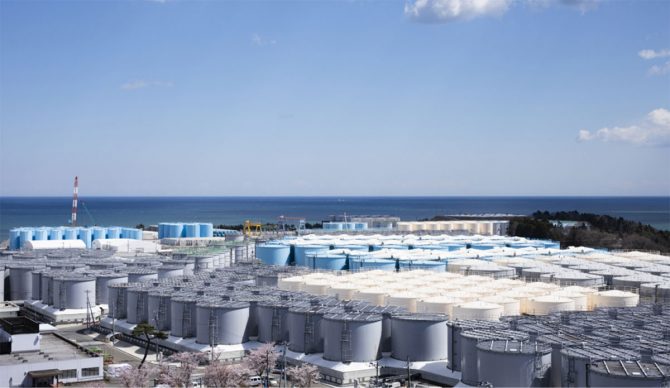
TEPCO is releasing another round of radioactive wastewater into the Pacific. Photo: TEPCO

When Japanese authorities announced plans to release treated radioactive wastewater for the destroyed Fukushima nuclear power plant into the ocean, there were a lot of worried people. But after the first round went smoothly, the second round is planned for October 5.
Despite a large number of researchers saying that the wastewater was, in fact, safe to be released, there have been some serious repercussions from Japanese groups and other countries. South Korea, for example, was the site of various protests and rallies that saw hundreds of people in the streets. China has banned all Japanese seafood, a move that likely impacts Japan’s fishing industry.
The first wastewater discharge began on Aug. 24 and ended Sept. 11. TEPCO (Tokyo Electric Power Company), the company tasked with cleaning up the enormous and dangerous mess, said during that first round they pumped nearly 8,000 tons of water from 10 tanks through an underground tunnel into the Pacific Ocean.
“So far, we are strictly following the procedures and everything is moving smoothly as planned,” said TEPCO spokesperson Keisuke Matsuo to the Associated Press. TEPCO workers are taking samples of seawater constantly, looking for any and all indicators of anything wrong.
The releases will be an ongoing thing for decades to come. Over a million tons of radioactive wastewater is stored in about 1,000 tanks, building up since the 2011 earthquake and ensuing tsunami that caused the destruction of the plant.
According to TEPCO and Japanese government authorities, the wastewater discharge simply needs to be done. The tanks are nearing capacity, and the work to decommission the entire plant will take decades.
The water, according to TEPCO, has been treated to reduce radioactive materials to relatively safe levels, then mixed with enormous amounts of seawater to dilute it. Still, though, releasing any amount of radioactive materials — even at very low levels — can’t be a good thing. TEPCO has a webpage dedicated to explaining the treatment process and how it all works, for those interested in the nitty gritty.

