
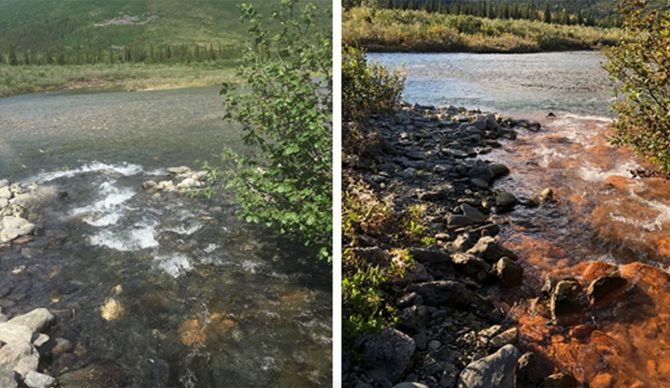
A before and after image of the discoloration. Photo: Nature

Something strange has been happening to the rivers in Alaska: they’re changing colors from clean and clear to a burnt, acidic orange. According to a new study published in Nature, it’s because of metals being release from thawing permafrost.
Over the last decade or so, the changing colors have been pretty tough to ignore. A team of researchers from the National Park Service decided they should probably try and figure out what, exactly, was going on, so they dipped their proverbial toes into the running waters of 75 waterways running through the Brooks Range.
The Brooks Range is a stunningly beautiful area. Stretching nearly a 1,000 miles from northern Alaska to the Yukon Territory in Canada, its highest point is Mount Isto. It’s somewhere in the area of 126-million years old, so those rivers have been gouging out their paths for a long, long time.
After pulling samples, the researchers found that the water was chock full of metals. Iron, zinc, nickel, copper, and lead, most of which are toxic in higher concentrations. Those minerals have been trapped in permafrost for thousands of years, but as that permafrost is melting rapidly, they’re being released at alarming rates.
“We’re used to seeing this in parts of California, parts of Appalachia where we have mining history,” said Brett Poulin, a co-author of the study. “This is a classic process that happens in rivers here in the continental U.S. that have been impacted for over 100 years since some of the mining rushes in the 1850s. But it’s very startling to see it when you’re on some of the most remote wilderness and you’re far from a mine source.”
Soil in the Arctic, like anywhere else, isn’t devoid of metals, but when those metals are released far faster than they have been historically, the rivers run red.
“What we believe we’re seeing is this thawing of soil that’s happening faster there than it would happen elsewhere,” said Poulin. “It’s really an unexpected consequence of climate change.”
The study found that the most drastic increases in metal contamination came in 2017 and 2018, which by no coincidence were the warmest years on record… up until now.
It’s not just an eyesore, either. High concentrations of metals in the water are terrible for the animals that rely on the water, not to mention the communities down stream.
The study is slated to continue in the coming years, and researchers are hopeful that they’ll be able to answer more questions about just how much of an impact the rusty rivers will have in the future. And with any luck, give us a starting point to clean up the mess we’ve made.
“Thawing permafrost can foster chemical weathering of minerals, microbial reduction of soil iron, and groundwater transport of metals to streams,” the researchers warned. “Compared to clear reference streams, orange streams have lower pH, higher turbidity, and higher sulfate, iron, and trace metal concentrations, supporting sulfide mineral weathering as a primary mobilization process. Stream discoloration was associated with dramatic declines in macroinvertebrate diversity and fish abundance. These findings have considerable implications for drinking water supplies and subsistence fisheries in rural Alaska.”

