
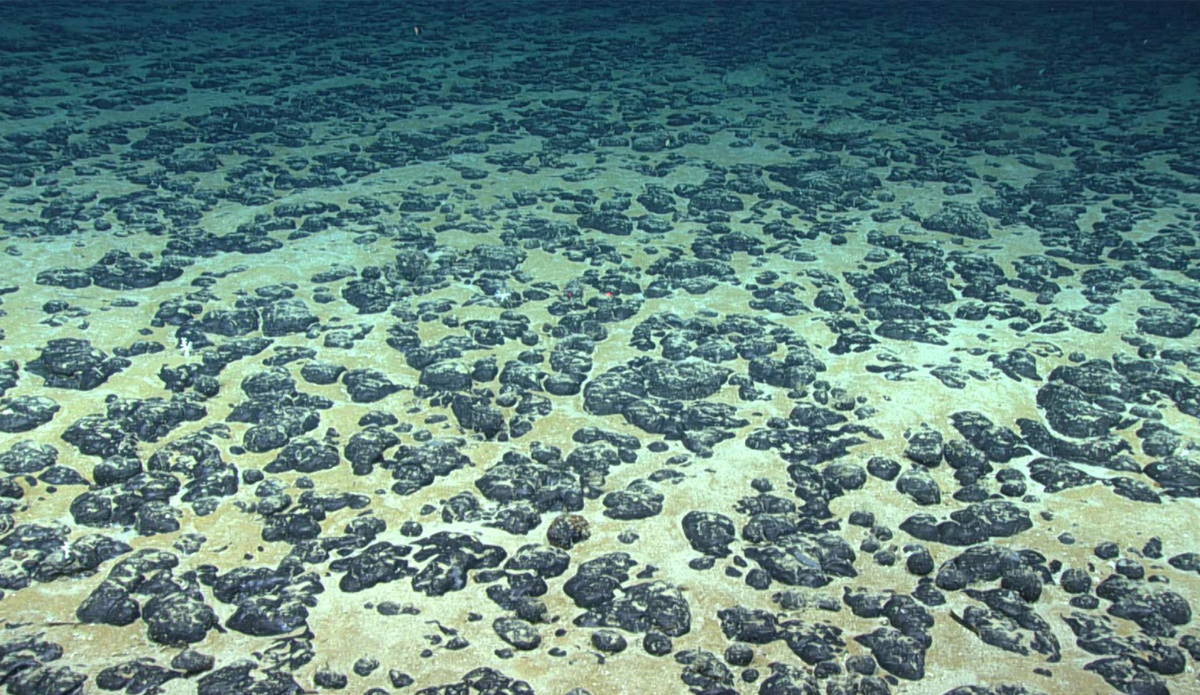
Polymetallic nodules on the ocean floor may be producing their own oxygen. Photo: NOAA Office of OER, 2019 Southeastern US Deep-sea Exploration

Scientists have found evidence that the metallic nodules found on the Pacific Ocean seafloor are producing oxygen. Dubbed “dark oxygen,” due to being produced at depths where light can’t penetrate, the discovery adds a new wrinkle to the issue of whether and how humans should mine for the nodules.
Polymetallic nodules are roughly potato-sized lumps of metal covering large areas of the ocean floor, miles below the surface. They form over the course of millions of years, and provide an anchor to a slow-growing and delicate ecosystem on the ocean floor. However, they also contain metals such as manganese, nickel and cobalt, which are required to produce lithium-ion batteries. For that reason, the nodules have attracted the interest of deep-sea mining companies, who seek to attain the rights to extract them from the seabed.
In order to assess the possible impacts of deep-sea mining, Professor Andrew Sweetman of the Scottish Association for Marine Science (SAMS) led a team that sampled the seabed of the Clarion-Clipperton Zone, a vast area in the Pacific Ocean where the nodules are abundant. As described in a paper published in the journal Nature Geoscience, they found the nodules to be carrying a very high electric charge, which could lead to the splitting of seawater into hydrogen and oxygen in a process called seawater electrolysis.
“When we first got this data, we thought the sensors were faulty,” explained Sweetman in a press release, “Because every study ever done in the deep sea has only seen oxygen being consumed rather than produced. We would come home and recalibrate the sensors but over the course of 10 years, these strange oxygen readings kept showing up.
“We decided to take a back-up method that worked differently to the optode sensors we were using and when both methods came back with the same result we knew we were onto something ground-breaking and unthought-of.”
This marks the first time scientists have ever observed oxygen being generated without the involvement of organisms, a discovery that Sweetman calls “one of the most exciting findings in ocean science in recent times.” As a result, he also called for further study into the phenomena during deep-sea mining baseline investigations, in addition to an assessment of how sediment kicked up during mining operations may alter the process.
However, The Metals Company (TMC), the deep-sea mining operation that partially funded the study, disagrees with the assessment. Patrick Downses at TMC told New Scientist that he had “serious reservations” about the findings, suggested that Sweetman’s results were due to oxygen contamination from external sources, and said “We will be writing a rebuttal article.”
Still, Sweetman, who had previously been involved in identifying marine protected areas around the Clarion Clipperton Zone where mining should be avoided, says this new discovery should be factored into those findings. “Through this discovery, we have generated many unanswered questions and I think we have a lot to think about in terms of how we mine these nodules, which are effectively batteries in a rock,” he said.

