
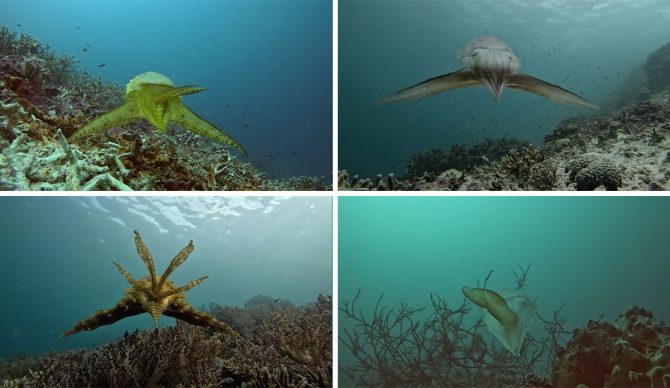
Four different methods of tricking a crab into getting eaten. Cuttlefish are one of the most interesting creatures on Earth. Photo: Screenshot//Journal Ecology

There are many strange creatures that we share the planet with, but cuttlefish are among the strangest. And in a stunning video from researchers intent on finding out more about them, their bizarre hunting techniques are on full, hypnotizing display.
Related to the octopus and the squid, cuttlefish are named for a thick internal shell called a cuttlebone. There are around 100 different species, ranging wildly in size. Some are just an inch long while others can grow to over two feet. They have flat bodies and fins that resemble wings, both in form and function. They have almost supernatural abilities, too, from chameleon-like camouflages to full-on shape-shifting. Put it all together and you have something called “adaptive camouflage,” but having a name doesn’t make it any less crazy.
While the octopus famously has eight tentacles, the cuttlefish as only two. Cuttlefish tentacles are longer than those of the octopus relative to the body size, and they’re used generally for hunting things like crabs. Although they live mostly in warm, shallow water, they can move to deeper areas in the winter. And like the squid and octopus, we suspect that the cuttlefish is very, very smart. They have large brains, at least relative to their body size, and they’ve shown intelligence traits like forgoing an immediate, lower-quality food source for a tastier morsel at a later time.
All that is why Dr. Matteo Santon, a marine visual ecologist at Bristol University in England, was interested enough in cuttlefish to explore the reefs around Indonesia for them in May, 2023. His interest was in one particular bit of cuttlefish behavior: the hunt. Cuttlefish love crab, and Santo wanted to see what it would look like to be hunted by one from the crab’s perspective. Although he likely had an idea of what he’d see, he didn’t expect it be quite so… spectacular.
“The first time I saw these hunting displays,” Dr. Santon said, “it was probably one of the coolest things I’ve ever seen.”
Over the course of the next year, Dr. Santon and his team of researchers rolled cameras on over 200 cuttlefish hunts, all from the angle a crab would see. Their results were published in the Journal Ecology in February, 2025.
The scientists watched in amazement as the cuttlefish displayed a staggeringly diverse array of methods to catch their prey, including strange, pulsating displays of skin color changes and imitations of what certainly looks to be coral or leaves.
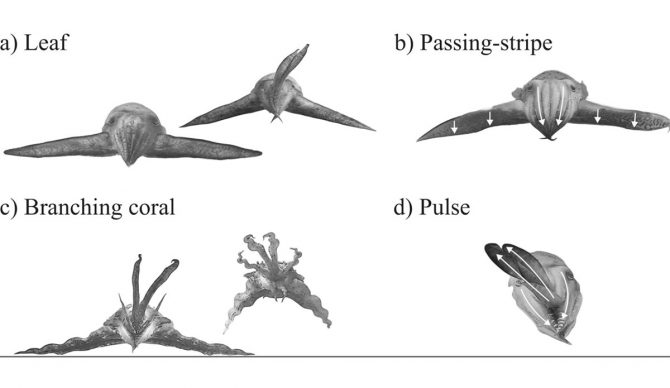
Multiple hunting displays in broadclub cuttlefish. Image: Matteo Santon.
“The cuttlefish displays may somehow hack the visual system of their prey, which may mask their movement or convince the crabs they are harmless flora and fauna rather than wily predators soon to end their lives,” wrote the New York Times in an article called “What a Crab Sees Before It Gets Eaten by a Cuttlefish.”

