
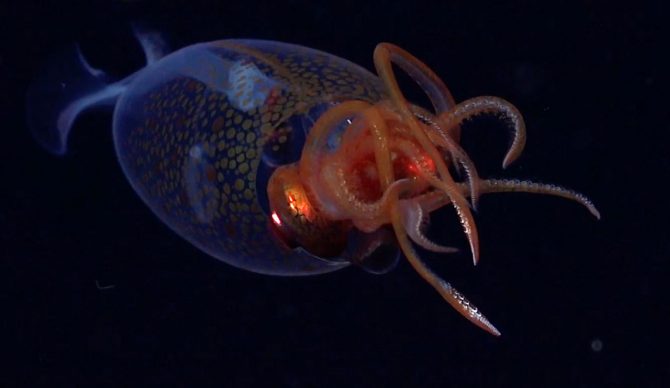
Sure, it might not be colossal in size, but it will be. Photo: Schmidt Ocean Institute

Exactly 100 years ago this year, humans realized that the colossal squid was a thing. In the intervening years between then and March 9, 2025, no one had actually seen one alive in the wild. But thanks to an international team of scientists aboard the Schmidt Ocean Institute’s research vessel Falkor, that’s off the checklist. The footage, which you can see here, is hauntingly beautiful.
Just last year, researchers thought they might’ve captured a fleeting glimpse of a baby colossal squid, but they weren’t able to confirm it for sure. Now, with this new footage, they have.
“The 30-centimeter juvenile squid was captured on video at a depth of 600 meters (1968 feet) by the Institute’s remotely operated vehicle (ROV) SuBastian,” researchers wrote in a press release. “The sighting occurred on an expedition near the South Sandwich Islands in the South Atlantic Ocean. This year is the 100-year anniversary of the identification and formal naming of the colossal squid, a member of the glass squid family (Cranchiidae).”
The colossal squid is a pretty crazy animal. Despite their enormous size, the incredible depths they live at in the unexplored regions of the Southern Ocean have made them about as elusive as elusive gets. It is thought that rare sightings of them, along with parts of their beaks found in sperm whale stomachs, have played a starring role in many legends of sea monsters, but the one captured on film isn’t one that would’ve terrified ancient mariners. That’s because it was just a little baby, only about a foot long.
As with any first sighting, it is huge news in the scientific community. The squid was filmed on a 35-day trip that was searching for new marine life, but no one on the expedition expected to get what they got.
“It’s exciting to see the first in situ footage of a juvenile colossal and humbling to think that they have no idea that humans exist,” said Dr. Kat Bolstad of the Auckland University of Technology, one of the independent scientific experts the team consulted to verify the footage. “For 100 years, we have mainly encountered them as prey remains in whale and seabird stomachs and as predators of harvested toothfish.”
When they’re not little babies like the one in the video, they are estimated to grow up to nearly 25 feet in length and can probably weigh over 1,000 pounds. We know almost nothing about their life cycle, but we do know that when they grow up, they lose the translucency of the juveniles. We know that because dying adults have been filmed rarely over the years by fishermen, but never before has one been filmed at depth.
So how do the researchers know that it is indeed a baby colossal squid? Well, they have a very distinguishable feature: hooks on the middle of their eight tentacles. Amazingly, the colossal squid wasn’t the only confirmed “first footage” they captured on the trip. Also caught on tape was the the glacial glass squid, which was spotted in January.
“These unforgettable moments continue to remind us that the ocean is brimming with mysteries yet to be solved,” said Schmidt Ocean Institute’s executive director, Dr. Jyotika Virmani.

